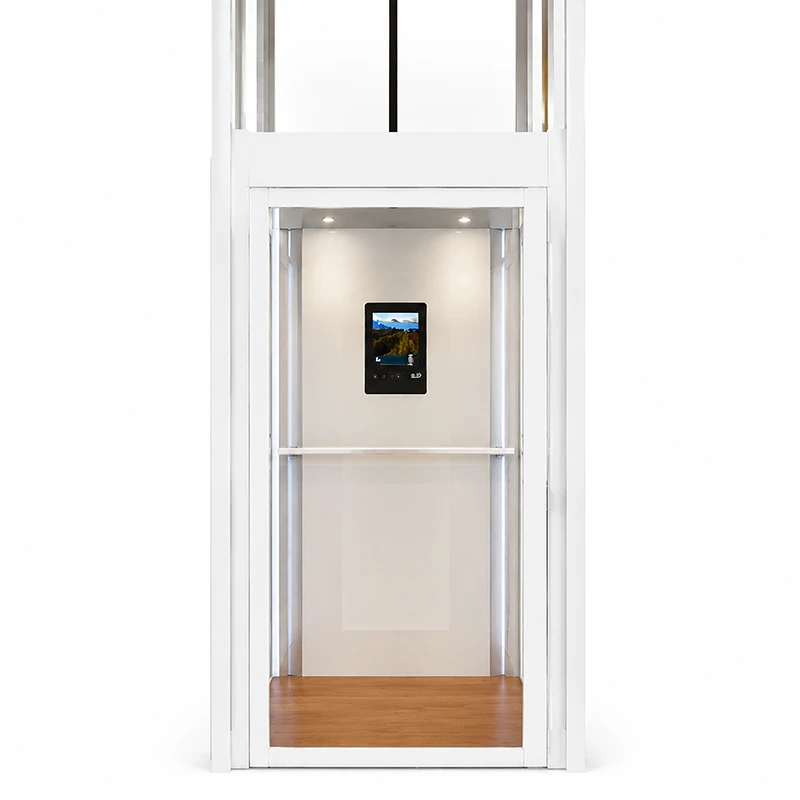
Why Architects and Building Owners Choose Servo Screw Elevators
Many elevator projects face challenges such as limited construction space, existing building constraints, or the absence of a reserved elevator shaft.
Servo Screw Elevators address these challenges through a compact structural design that reduces dependence on large machine rooms, counterweight systems, and extensive civil construction.
Compared with traditional elevator systems, they offer:
- Compact installation footprint
- No counterweight requirement
- No traction ropes
- Reduced overhead construction requirements
- Flexible shaft configurations
- Strong suitability for retrofit projects
- Stable low-rise vertical transportation
These advantages make Servo Screw Elevators particularly attractive for villas, duplex homes, accessibility upgrades, and existing building modernization projects.
The Technology Behind Screw Drive Elevators
A Servo Screw Elevator operates through a precision screw drive mechanism powered by servo motors.
Instead of relying on the friction between ropes and traction sheaves, the drive assembly moves along a fixed screw structure, creating direct mechanical movement between floors.
The elevator car remains connected to the drive system throughout operation, allowing controlled travel during both ascent and descent.
A typical Screw Drive Elevator system includes:
- Servo drive motors
- Precision screw assembly
- Drive carriage
- Guide rail system
- Elevator car
- Landing door system
- Intelligent control system
- Safety monitoring devices
This configuration reduces the number of major transmission components commonly found in traction elevators while maintaining stable vertical movement.
Built-In Self-Locking Safety Design
One of the most important advantages of a Servo Screw Elevator is its self-locking mechanical structure.
Because the elevator car moves through a direct screw engagement system, the drive mechanism remains physically connected to the lifting structure during operation.
This design helps eliminate concerns associated with rope slippage and provides an additional level of operational stability.
For residential and accessibility applications where safety is a primary concern, the self-locking characteristic is one of the reasons many building owners choose Screw Drive Elevator technology.
Servo-Controlled Dual Drive System
Modern Servo Screw Elevators typically use advanced servo motor technology to achieve smooth acceleration, accurate positioning, and stable travel performance.
The servo control system continuously monitors movement conditions and adjusts motor output to maintain consistent operation.
Benefits include:
- Precise floor leveling
- Smooth starting and stopping
- Reduced vibration
- Improved ride comfort
- Stable long-term performance
For projects where comfort and reliability are priorities, servo-controlled operation provides a significant advantage over conventional lifting systems.
When Screw Elevators Outperform Traction Elevators
Both traction and screw-driven technologies have their strengths.
However, there are situations where a Servo Screw Elevator offers clear advantages.
Limited Construction Space
Traditional traction elevators often require:
- Counterweight space
- Larger shaft dimensions
- Additional structural coordination
Servo Screw Elevators reduce these requirements and allow more efficient use of available space.
Existing Building Renovation
Many older buildings were not designed for elevators.
The compact design of Screw Drive Elevators allows easier integration into existing structures while minimizing building modifications.
Low-Rise Residential Buildings
For villas, townhouses, duplex residences, and accessibility-focused projects, the travel height often falls within the ideal operating range of screw-driven systems.
Simplified Building Coordination
Because no counterweight system is required and machine room requirements are reduced, project coordination becomes more straightforward during design and construction.
Why Retrofit Projects Prefer Screw Drive Systems
Retrofit projects represent one of the fastest-growing applications for Servo Screw Elevators.
Property owners frequently face challenges such as:
- No reserved shaft space
- Limited floor area
- Structural restrictions
- Budget limitations
- Occupied buildings during installation
Servo Screw Elevator systems help address these issues through a compact and integrated design.
Advantages for retrofit projects include:
- Reduced construction disruption
- Less structural modification
- Lower installation complexity
- Flexible placement options
- Improved accessibility for existing properties
For residential renovation projects, this often translates into shorter project schedules and reduced overall construction work.
Key Technical Characteristics
Servo Screw Elevators are designed for low-rise and mid-rise vertical transportation applications.
Typical characteristics include:
| Feature |
Capability |
| Drive System |
Servo Screw Drive |
| Counterweight |
Not Required |
| Traction Rope |
Not Required |
| Machine Room |
Not Required |
| Shaft Design |
Compact Configuration |
| Installation Type |
Indoor or Outdoor |
| Pit Requirement |
Shallow Pit or Customized |
| Control System |
Intelligent Servo Control |
| Cabin Design |
Customized |
| Door Configuration |
Multiple Options Available |
Specifications can be customized according to building conditions, project requirements, and local regulations.
Servo Screw Elevator Design Options
EKCNE supports project-based customization to match different architectural and operational requirements.
Cabin Configurations
Available options include:
- Standard passenger cabins
- Glass panoramic cabins
- Accessibility-focused layouts
- Custom interior finishes
Door Arrangements
Customers may choose:
- Automatic doors
- Manual doors
- Single-entry configurations
- Through-opening configurations
Structural Solutions
Servo Screw Elevators can be adapted for:
- Existing building shafts
- New construction projects
- Steel structure shafts
- Indoor installations
- Outdoor installations
Capacity and Travel Customization
Each project can be configured according to:
- Passenger requirements
- Accessibility requirements
- Building height
- Available installation space
Servo Screw Elevator Manufacturer – EKCNE
Founded in 2009, EKCNE is a project-oriented vertical transportation solution provider serving residential, commercial, healthcare, industrial, and infrastructure projects worldwide.
We provide complete elevator systems, escalators, accessibility lifts, industrial lifting equipment, elevator shafts, and elevator components for global customers.
As a Servo Screw Elevator manufacturer, we support:
- Project consultation
- Customized engineering
- Shaft planning
- Manufacturing coordination
- Export logistics
- Technical support
Our goal is to help customers select the most appropriate vertical transportation solution based on actual project requirements rather than standardized configurations alone.
FAQ
What is a Servo Screw Elevator?
A Servo Screw Elevator is a screw-driven vertical transportation system that uses servo motors and a precision screw mechanism instead of traditional ropes and counterweights. It is commonly used in residential, accessibility, and retrofit applications.
Does a Servo Screw Elevator require a counterweight?
No. Servo Screw Elevators operate through a direct mechanical screw drive system and do not require a counterweight, which helps reduce shaft space requirements and simplify installation.
Are Screw Drive Elevators suitable for existing buildings?
Yes. Their compact structure and reduced construction requirements make them a popular solution for retrofit projects, particularly in buildings where conventional elevator installation would be difficult.
Is a Servo Screw Elevator safe during power interruptions?
The mechanical engagement between the drive system and screw structure helps maintain controlled elevator behavior. Specific safety features depend on system design, configuration, and applicable local standards.
Can the elevator be customized for different projects?
Yes. Cabin size, load capacity, travel height, door arrangements, finishes, shaft structure, and installation configuration can all be customized according to project requirements.