
Quick Answer
Moving walkway capacity describes how many passengers a system can transport within a given period, usually expressed in passengers per hour (PPH).
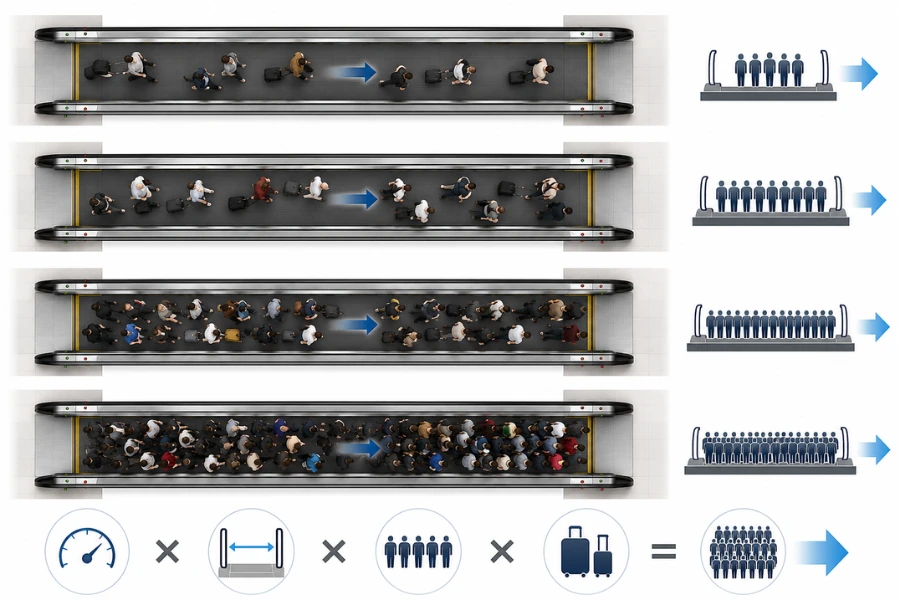
Capacity cannot be determined from speed or pallet width alone. Practical passenger throughput also depends on passenger density, luggage, boarding behavior, landing congestion, surrounding circulation, and peak-hour traffic.
For airports, shopping malls, transit stations, convention centers, hospitals, and other high-traffic facilities, capacity planning should therefore begin with expected passenger flow before equipment specifications are finalized.

What Does Moving Walkway Capacity Mean?
Moving walkways provide continuous passenger transportation rather than moving passengers in batches like elevators.
Their capacity is influenced by two groups of variables.
Equipment variables
Pallet width
Rated speed
Moving walkway configuration
Traffic variables
Passenger density
Boarding behavior
Luggage or carts
Entrance and exit circulation
Peak-hour demand
Surrounding pedestrian flow
Two moving walkways with the same nominal width and speed can therefore produce different real-world passenger throughput.
The basic planning principle is:
Peak traffic demand → Passenger characteristics → Practical capacity requirement → Equipment configuration
rather than:
Maximum equipment specification → Assumed traffic capacity
Theoretical Capacity vs. Practical Capacity
The distinction between theoretical and practical capacity is one of the most important concepts in moving walkway planning.
Theoretical Capacity
Theoretical capacity estimates the maximum passenger flow under defined or idealized operating assumptions.
These assumptions can include:
Continuous boarding
Consistent passenger spacing
No entrance or exit congestion
Stable passenger movement
Limited disruption from luggage or carts
Theoretical capacity is useful for equipment comparison and preliminary planning.
Practical Capacity
Practical capacity considers how passengers actually use the system.
It can be affected by:
Passenger density
Luggage and baggage
Shopping carts
Boarding hesitation
Family groups
Older or mobility-limited passengers
Landing congestion
Peak traffic distribution
For this reason, practical throughput can be lower than the theoretical value even when the moving walkway itself is operating normally.
| Factor | Theoretical Capacity | Practical Capacity |
|---|---|---|
| Passenger density | Defined assumption | Varies |
| Luggage | Limited or excluded by calculation assumptions | Affects passenger spacing and movement |
| Boarding delay | Idealized | Included |
| Congestion | Excluded | Can reduce flow |
| Passenger behavior | Standardized | Variable |
| Result | Design or reference capacity | Expected operational throughput |
[IMAGE POSITION 2 — Diagram comparing theoretical moving walkway capacity with practical passenger throughput]
For project planning, the difference between these values matters more than the highest published capacity number.
What Determines Moving Walkway Capacity?
Pallet Width
Pallet width affects how passengers occupy the moving surface and how easily luggage or carts can be accommodated.
A wider walkway can provide:
More passenger space
Better luggage accommodation
More flexible passenger positioning
Greater potential throughput
It also requires:
More installation space
A larger equipment footprint
Appropriate structural support
Increasing width is therefore most useful when passenger characteristics and available building space justify the additional area.
Rated Speed
Rated speed affects theoretical passenger throughput and travel time.
Higher speed can provide:
Greater theoretical throughput
Shorter travel time over long distances
It can also affect:
Boarding comfort
Landing design
Braking requirements
Passenger stability
Speed should therefore be selected together with passenger characteristics and circulation conditions rather than maximized independently.
Passenger Density and Behavior
Practical capacity depends on how closely and consistently passengers occupy the moving walkway.
Real passengers may:
Travel in groups
Carry luggage
Use baggage carts
Wait for companions
Hesitate before boarding
Leave larger gaps
Stand rather than walk
These behaviors reduce the consistency assumed by theoretical calculations.
Boarding and Landing Areas
The equipment cannot maintain useful throughput if passengers cannot enter or leave it efficiently.
Undersized or poorly organized landing areas can create:
High equipment capacity → Exit congestion → Slower passenger discharge → Reduced practical throughput
Planning therefore needs to consider the pedestrian circulation immediately before and after the moving walkway.
[IMAGE POSITION 3 — Engineering diagram showing moving walkway entrance, passenger flow, landing area, and exit congestion]
How Is Moving Walkway Capacity Calculated?
Capacity planning normally combines equipment characteristics with passenger-flow assumptions rather than relying on a single equipment specification.
Core inputs include:
Pallet width
Rated speed
Passenger density
Boarding efficiency
Passenger type
Luggage or cart use
Landing capacity
Peak-hour traffic
Traffic distribution
Typical rated speeds used in project planning may include 0.50 m/s, 0.65 m/s, and 0.75 m/s, depending on the moving walkway configuration and applicable requirements.
The calculation process can be understood as:
Peak-hour demand
↓
Passenger characteristics
↓
Width and speed assumptions
↓
Theoretical capacity
↓
Practical utilization adjustment
↓
Landing and circulation verification
↓
Selected moving walkway configuration
For complex transportation hubs, traffic simulation can provide additional information about queues, passenger distribution, entrance loading, and downstream congestion.
Moving Walkway Capacity Reference Table
The following figures are planning references from the original project material rather than universal capacity guarantees. Actual capacity depends on the calculation method, equipment configuration, passenger behavior, luggage, and operating environment.
| Pallet Width | Rated Speed | Theoretical Capacity | Typical Practical Capacity |
|---|---|---|---|
| 800 mm | 0.50 m/s | 3,000–3,800 PPH | 2,600–3,400 PPH |
| 800 mm | 0.65 m/s | 3,700–4,600 PPH | 3,200–4,100 PPH |
| 1,000 mm | 0.50 m/s | 3,800–5,100 PPH | 3,300–4,500 PPH |
| 1,000 mm | 0.65 m/s | 4,600–6,400 PPH | 4,000–5,700 PPH |
| 1,000 mm | 0.75 m/s | 5,400–7,700 PPH | 4,700–6,900 PPH |
| 1,400 mm | 0.75 m/s | 7,700+ PPH | Project dependent |
These values should be compared with peak-hour passenger demand rather than used to select the largest available system.
[IMAGE POSITION 4 — Moving walkway capacity chart comparing pallet width, rated speed, and passenger throughput]
Moving Walkway Capacity by Project Demand
A preliminary screening matrix can help connect expected demand with equipment configuration.
| Peak Passenger Demand | Potential Configuration | Planning Context |
|---|---|---|
| Under 3,000 PPH | 800 mm, around 0.50 m/s | Lower-demand commercial applications |
| 3,000–5,000 PPH | 1,000 mm, around 0.50–0.65 m/s | Shopping malls and commercial complexes |
| 5,000–7,000 PPH | 1,000 mm, around 0.65–0.75 m/s | Airports and convention facilities |
| Above 7,000 PPH | Project-specific high-capacity configuration | Major transportation hubs |
This matrix is a preliminary planning reference, not a final equipment specification.
Final selection should also consider passenger behavior, luggage volume, landing geometry, applicable requirements, installation constraints, and traffic distribution.
Width vs. Speed
Increasing width and increasing speed do not produce the same operational result.
When Greater Width Can Help
Greater width can be useful when the project needs:
More passenger space
Better luggage accommodation
Higher potential passenger occupancy
Improved circulation during peak periods
The trade-offs include:
Larger equipment footprint
Greater structural requirements
Higher equipment and installation costs
When Higher Speed Can Help
Higher speed can be useful for:
Long transportation distances
High theoretical throughput requirements
Reducing passenger travel time
The trade-offs can include:
More demanding boarding conditions
Greater braking requirements
Additional attention to passenger comfort
[IMAGE POSITION 5 — Side-by-side engineering comparison of wider pallet versus higher moving walkway speed]
The decision should therefore be based on the actual bottleneck.
If passengers cannot comfortably occupy the available width because they carry luggage, increasing speed alone may not solve the practical capacity problem.
If the walkway is lightly occupied but covers a long corridor, travel time may become more important than additional width.
Capacity Planning for Different Building Types
Different facilities create different passenger-flow patterns.
| Building Type | Traffic Characteristics | Main Capacity Consideration |
|---|---|---|
| Airport | Continuous flow with luggage | Width, luggage accommodation, long travel distance, peak demand |
| Metro station | Strong peak-hour surges | Peak throughput and surrounding circulation |
| Shopping mall | Mixed walking and standing passengers | Boarding behavior and variable traffic |
| Supermarket | Shopping carts and continuous circulation | Cart compatibility and usable width |
| Convention center | Event-driven traffic surges | Temporary peak demand |
| Office building | Predictable commuter periods | Morning and evening peaks |
| Hospital | Controlled pedestrian movement | Passenger comfort, accessibility, and circulation |
Building type provides context, but the final capacity should be based on measured or forecast traffic rather than the building label alone.
Capacity Planning for Airports and Transit Hubs
Transportation hubs require particular attention because passenger demand can vary significantly by time and location.
Traffic analysis may need to consider:
Flight or train arrival peaks
Security or ticketing queues
Passenger transfer routes
Luggage volume
Directional traffic imbalance
Walking and standing behavior
Connection to escalators and elevators
Downstream corridor capacity
A moving walkway with adequate nominal capacity can still create congestion if passengers are discharged into a restricted corridor or intersecting pedestrian stream.
For these projects, the surrounding circulation network should be evaluated together with the moving walkway.
Intelligent Operation and VVVF Control
Variable-frequency control can allow moving walkway operation to respond to passenger demand.
Depending on the system configuration, low-demand operation may include reduced-speed or standby modes, with normal operation restored when passengers approach.
The main benefit is energy management rather than increasing the physical maximum passenger capacity.
Control strategy should therefore be treated separately from capacity sizing:
Capacity planning determines how much traffic the system needs to handle.
Operating control determines how the selected equipment responds when actual demand changes.
This distinction avoids using energy-saving features as a substitute for adequate traffic capacity.
Capacity vs. Lifecycle Cost
Higher nominal capacity can affect more than equipment price.
Potential project impacts include:
| Capacity Decision | Possible Project Impact |
|---|---|
| Wider pallet | More building space and structural requirements |
| Higher speed | More demanding boarding, braking, and operating conditions |
| Larger equipment | Greater installation footprint |
| Longer operating hours | Higher energy use and component operating time |
| Higher passenger volume | Greater wear exposure under actual operation |
Lifecycle evaluation may therefore include:
Initial equipment cost
Installation
Building modifications
Energy consumption
Maintenance
Spare parts
Equipment availability
Service life
Future expansion
Modernization
The objective is not to minimize capacity. Undersizing can create congestion and operational problems, while unnecessary oversizing can increase space and ownership costs without providing useful passenger-flow benefits.
[IMAGE POSITION 6 — Lifecycle trade-off diagram showing moving walkway capacity, equipment size, energy, maintenance, and passenger demand]
Common Moving Walkway Capacity Planning Mistakes
Treating Theoretical Capacity as Guaranteed Throughput
Published or calculated theoretical capacity assumes defined passenger-loading conditions.
Real passenger spacing, luggage, hesitation, and congestion can reduce actual throughput.
Selecting Equipment by Speed Alone
Increasing speed changes travel time and theoretical capacity but does not correct every passenger-flow problem.
If the bottleneck is landing congestion or insufficient usable width, a faster walkway may simply deliver passengers to the bottleneck more quickly.
Ignoring Peak-Hour Demand
Average daily passenger volume can hide short periods of intense demand.
Capacity planning should identify the peak period that the circulation system needs to accommodate.
Ignoring Luggage and Passenger Type
Airport passengers with suitcases do not occupy or use a moving walkway in the same way as commuters without luggage.
The same principle applies to shopping carts, family groups, and passengers requiring additional boarding time.
Ignoring the Landing Area
A high-capacity moving walkway cannot compensate for an undersized exit.
The walkway and surrounding circulation should therefore be evaluated as one passenger-flow system.
Oversizing Without Evaluating Lifecycle Impact
Selecting the widest or fastest configuration can increase equipment size, structural requirements, energy consumption, and ownership cost.
Additional capacity only creates value when the building can use it.
Moving Walkway Capacity Planning Workflow
A practical planning sequence is:
1. Establish Peak-Hour Demand
Determine how many passengers are expected during the design peak rather than relying only on average daily traffic.
2. Identify Passenger Characteristics
Evaluate luggage, carts, passenger groups, accessibility requirements, and expected walking or standing behavior.
3. Map Passenger Circulation
Identify where passengers approach the walkway, where they leave it, and whether surrounding corridors can accept the resulting flow.
4. Establish Required Practical Capacity
Use traffic demand and passenger behavior to define the operational throughput the system needs to provide.
5. Compare Equipment Configurations
Evaluate pallet width, rated speed, installation space, and equipment arrangement against the capacity requirement.
6. Verify Landing Capacity
Confirm that entrances, exits, and downstream circulation do not create a lower-capacity bottleneck.
7. Evaluate Lifecycle Requirements
Consider energy use, maintenance, operating hours, spare parts, and future traffic growth before finalizing the configuration.
[IMAGE POSITION 7 — Seven-step moving walkway capacity planning workflow diagram]
Moving Walkway Capacity Planning Checklist
Before finalizing the equipment configuration, confirm:
Peak-hour passenger demand has been evaluated
Passenger type and luggage have been considered
Surrounding pedestrian circulation has been analyzed
Practical rather than theoretical capacity is being used for operational planning
Pallet width matches passenger characteristics
Rated speed matches the application
Boarding and landing areas have sufficient capacity
Installation space is available
Building interfaces have been coordinated
Operating hours have been considered
Lifecycle requirements have been reviewed
Future traffic growth has been considered
Conclusion
Moving walkway capacity is a passenger-flow problem before it is an equipment-selection problem.
Pallet width and rated speed establish the equipment’s potential transportation capacity, but passenger behavior, luggage, boarding efficiency, landing geometry, and surrounding circulation determine how much of that potential can be used in practice.
A practical planning sequence is therefore:
Peak demand → Passenger behavior → Required practical throughput → Width and speed → Landing verification → Lifecycle evaluation
For project teams, this approach provides a more reliable basis for moving walkway selection than simply specifying the highest capacity, widest pallet, or fastest available system.












