
Quick Answer
Effective moving walkway maintenance focuses on detecting wear before it develops into a service interruption. A practical program combines routine inspection, cleaning, lubrication, safety-device testing, condition monitoring, maintenance records, and planned replacement of wear components.
Maintenance frequency should reflect passenger traffic, operating hours, environmental exposure, equipment condition, and manufacturer requirements. Airports and transit stations generally require closer monitoring than lower-traffic buildings, while outdoor installations need additional attention to drainage, contamination, corrosion, and weather exposure.
Why Preventive Maintenance Matters
Moving walkways operate under repeated mechanical loading that affects the drive system, chains, rollers, bearings, handrails, gearbox, and electrical components.
Preventive maintenance uses scheduled inspection and servicing to identify deterioration before equipment fails. Predictive techniques can add another layer of information by identifying changes that may not yet be visible during routine inspection.
Useful condition-monitoring inputs can include:
-
Vibration trends
-
Motor or gearbox temperature
-
Thermal inspection
-
Controller fault codes
-
Repeated safety-device activation
-
Component wear measurements
The value comes from comparing these observations over time. A single vibration reading or fault code may identify a symptom, while a recurring trend can indicate a developing mechanical or electrical problem.
How Often Should a Moving Walkway Be Inspected?
There is no universal service interval for every installation.
Inspection frequency should be determined by the equipment manufacturer’s requirements and adjusted according to operating conditions.
A practical planning reference is:
| Installation Type | Example Inspection Approach |
|---|---|
| Airport | Daily operational checks plus scheduled engineering maintenance |
| Metro or railway station | Daily operational checks plus scheduled engineering maintenance |
| Shopping mall | Frequent visual checks plus scheduled maintenance |
| Office building | Routine visual checks plus scheduled maintenance |
| Outdoor installation | Frequent checks plus additional weather-related inspection |
High passenger volumes and long operating hours increase component loading. Outdoor installations may also need additional inspection after severe weather to check debris accumulation, drainage, electrical protection, and exposed components.
Maintenance Interval Reference
The following intervals can be used as a planning reference rather than a universal maintenance schedule.
| Maintenance Item | Example Service Interval |
|---|---|
| Visual inspection | Daily or weekly |
| Chain tension inspection | Monthly |
| Gearbox oil inspection | Every 3–6 months |
| Roller bearing inspection | Every 6 months |
| Safety-device functional testing | Monthly |
| Comprehensive engineering inspection | Annually |
Actual intervals should follow the manufacturer, applicable requirements, equipment condition, operating hours, and site environment.
Moving Walkway Maintenance Workflow
A structured maintenance process can follow:
Inspection → Condition Evaluation → Adjustment → Component Replacement → Performance Verification → Documentation
The maintenance record should capture information that can support future diagnosis, including:
-
Inspection findings
-
Component replacements
-
Lubricant specifications
-
Measured wear
-
Controller fault codes
-
Corrective actions
-
Recurring abnormalities
Historical records become particularly useful when the same symptom appears repeatedly.
For example:
Repeated motor temperature increase → Compare operating conditions and previous records → Inspect developing mechanical or electrical load → Identify root cause before replacing components repeatedly
The purpose of documentation is therefore not merely record keeping. It provides baseline data for troubleshooting, maintenance planning, and spare-parts management.
Daily Moving Walkway Inspection Checklist
Routine operational checks can identify visible or audible changes before they develop into larger problems.
A daily or frequent inspection may include:
-
Visually inspect the walkway and entrance areas
-
Listen for abnormal noise
-
Check for unusual vibration or movement
-
Observe pallet and handrail operation
-
Remove debris from comb plates, pallet grooves, and entrances
-
Look for visible sprocket, pallet, or handrail damage
-
Check for oil or lubricant leakage around the gearbox
-
Review warning indicators or controller fault information where accessible
-
Record abnormalities for technical follow-up
Tasks requiring covers to be removed, adjustments to be made, or safety devices to be functionally tested should be performed by appropriately qualified personnel according to the maintenance procedure.
A routine visual check is most useful when current conditions can be compared with previous observations rather than treated as an isolated inspection.
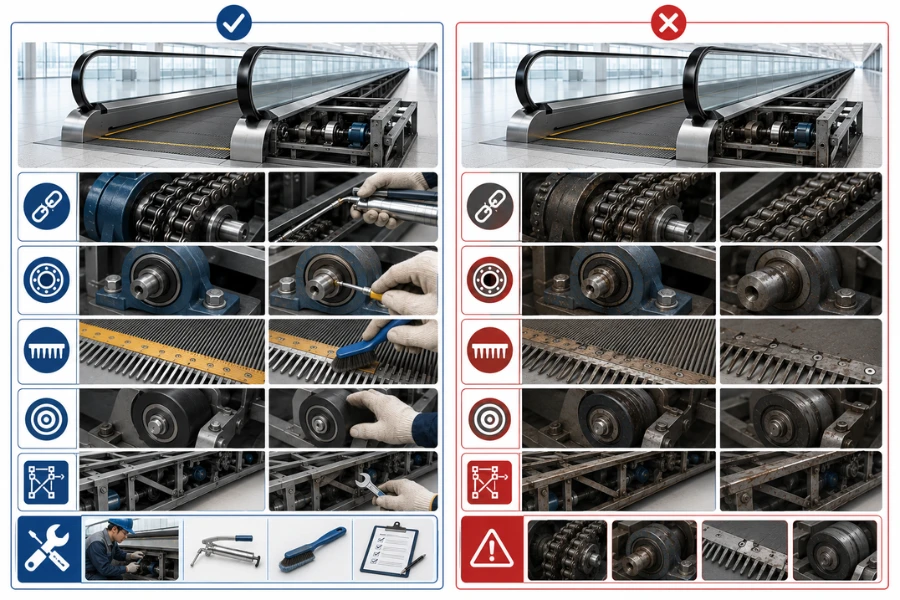
Cleaning and Lubrication
Contamination and incorrect lubrication can accelerate wear in moving components.
Internal Cleaning
Maintenance cleaning may need to cover areas such as:
-
Truss
-
Return track
-
Pallet underside
-
Pit
-
Machinery spaces
-
Drainage paths
-
Ventilation openings
Dust, grease buildup, sand, and foreign objects can interfere with moving parts or accumulate around mechanical and electrical equipment.
Drainage deserves additional attention in outdoor or moisture-exposed installations because blocked water paths can expose equipment to conditions that routine mechanical servicing alone cannot correct.
Surface Cleaning
Common collection points include:
-
Pallets
-
Comb plates
-
Side panels
-
Handrails
-
Landing areas
Coins, paper, packaging material, sand, and other debris can become trapped around moving interfaces or safety devices.
Cleaning methods should also be compatible with the surface material and protective finish.
Lubrication
Lubrication reduces friction and heat in components designed to operate with lubricant, but more lubricant is not necessarily better.
Excessive or incompatible lubricant can attract contamination or affect surrounding components. Maintenance personnel should follow the equipment manufacturer’s lubricant specification, quantity, and application procedure.
| Component | Maintenance Focus |
|---|---|
| Drive chain | Lubrication condition, tension, and wear |
| Roller bearings | Lubricant condition, noise, temperature, and rotation |
| Gearbox | Oil level, condition, temperature, and leakage |
| Drive and idler sprockets | Tooth wear, alignment, and lubrication condition |
| Handrail drive | Friction, tension, wear, and synchronized movement |
Lubrication work provides an opportunity to check related alignment, fasteners, contamination, and visible wear rather than treating lubrication as an isolated task.
Critical Components to Inspect
Drive System
The drive system may include the motor, gearbox, drive chain, drive sprocket, idler sprocket, and associated transmission components.
Warning signs can include:
-
Increasing operating temperature
-
Abnormal vibration
-
New or increasing noise
-
Oil leakage
-
Chain wear
-
Sprocket wear
-
Changes in operating stability
The value of temperature or vibration monitoring is greatest when measurements are trended over time. A rising trend can justify further diagnosis before functional failure occurs.
Handrail System
Inspect handrail:
-
Tension
-
Synchronization
-
Running stability
-
Surface condition
-
Drive-system condition
Slipping or excessive stretching can indicate that adjustment or component inspection is required rather than simply a cosmetic handrail problem.
Pallet Chains and Rollers
Pallet chains should be inspected for:
-
Elongation
-
Lubrication condition
-
Tension
-
Alignment
-
Visible wear
Rollers should rotate without abnormal resistance, noise, vibration, or visible damage.
Changes in roller or chain condition can affect both ride quality and the loads transmitted through the pallet system.
Comb Plates
Inspect comb plates for:
-
Damaged or missing teeth
-
Loose components
-
Alignment
-
Foreign objects
-
Impact damage
Debris at the pallet-to-comb interface should be addressed promptly because it can interfere with normal movement or activate protective devices.
Electrical and Control System
Technical maintenance should include appropriate inspection of:
-
Controller
-
Electrical cabinet
-
Sensors
-
Relays
-
Wiring
-
Communication circuits
-
Stored fault information
Controller history can be particularly useful when an intermittent shutdown cannot be reproduced during an inspection.
Where appropriate, thermal inspection can help identify abnormal heating in electrical components or connections that may not be apparent visually.
Typical Moving Walkway Wear Components
Wear cannot be eliminated through maintenance. The objective is to detect deterioration early enough to schedule corrective work before it causes secondary damage or unplanned downtime.
| Component | Typical Wear Symptoms | Maintenance Response |
|---|---|---|
| Handrail | Cracking, glazing, slipping, excessive stretching | Inspect tension and condition, replace when required |
| Drive chain | Elongation, noise, lubrication deterioration | Check tension and wear, adjust or replace as required |
| Roller bearings | Noise, temperature increase, vibration | Inspect lubrication and bearing condition |
| Comb plate | Broken teeth, impact damage, deformation | Replace damaged components and verify alignment |
| Gearbox | Leakage, high temperature, abnormal vibration | Inspect oil, seals, bearings, and gearbox condition |
| Safety switches | Delayed or unstable response | Test the device and investigate or replace as required |
Replacement decisions should follow applicable wear limits and manufacturer requirements rather than symptoms alone.
Safety Device Testing
Visual inspection cannot confirm that every protective device will respond correctly when activated.
Maintenance procedures may therefore include functional testing of systems such as:
-
Emergency stop devices
-
Comb plate protection
-
Handrail entry protection
-
Pallet monitoring devices
-
Brake monitoring
-
Overspeed protection
-
Safety circuits and controller diagnostics
The exact devices and test procedures depend on the moving walkway design.
Functional testing should be performed according to the manufacturer’s procedures and applicable requirements because incorrect testing or resetting can itself create a safety risk.
Common Moving Walkway Problems and Troubleshooting
A useful troubleshooting process starts with the symptom, identifies plausible causes, and verifies them before components are replaced.
| Symptom | Possible Cause | Diagnostic Direction |
|---|---|---|
| Abnormal noise | Poor lubrication, bearing wear, chain wear | Locate noise source, inspect lubrication, bearings, and chain |
| Excessive vibration | Misalignment, loose components, roller wear | Check vibration source, alignment, fasteners, and rollers |
| Handrail slipping | Incorrect tension or drive wear | Inspect handrail tension and drive system |
| Slow or unstable operation | Gearbox, motor load, or electrical issue | Inspect drivetrain and review controller information |
| Comb plate impact | Debris, damaged teeth, or alignment problem | Remove debris and inspect comb and pallet interface |
| Frequent emergency stops | Sensor, wiring, safety-circuit, or control issue | Review fault history and inspect the affected safety circuit |
The table should be used as a diagnostic starting point rather than proof of a specific failure.
Historical information can narrow the diagnosis. Repeated vibration at the same location, recurring fault codes, or progressively increasing motor temperature provides more evidence than a single isolated symptom.
How Installation Environment Changes Maintenance
Airports and Transit Stations
Transportation hubs typically combine long operating hours with high passenger volumes.
Maintenance planning should pay particular attention to:
-
Drive chains
-
Rollers and bearings
-
Handrails
-
Comb areas
-
Traction components
-
Recurring fault history
Frequent operational observation can identify changes before they affect passenger flow.
Shopping Malls
Shopping malls introduce a different contamination profile.
Food waste, shopping bags, packaging, dust, and small objects can accumulate around comb plates, pallet grooves, and landing areas.
Cleaning and entrance-area inspection therefore become important parts of the maintenance plan in addition to mechanical servicing.
Office Buildings
Office installations may operate under lower or more predictable passenger loads than major transport facilities.
This can affect inspection frequency, but lower traffic does not eliminate age-related deterioration, lubrication requirements, electrical faults, or safety-device testing.
Outdoor Installations
Outdoor moving walkways add environmental deterioration mechanisms that indoor maintenance programs may not address.
Inspection should consider:
-
Rain and moisture
-
Drainage
-
Dust and debris
-
Corrosion
-
Temperature variation
-
Electrical enclosure sealing
-
Weather-related contamination
Severe weather can justify additional inspection even when the regular maintenance interval has not yet been reached.
Preventive Maintenance vs. Reactive Repair
Reactive maintenance begins after a fault has already interrupted operation. Preventive maintenance attempts to identify or correct deterioration before that point.
| Preventive Maintenance | Reactive Repair |
|---|---|
| Planned inspection and servicing | Repair after failure |
| Scheduled downtime | Unplanned shutdown |
| Wear detected before failure where possible | Fault discovered after performance is affected |
| Spare parts can be planned | Emergency parts procurement may be required |
| Historical condition data available | Diagnosis may begin only after breakdown |
| Lower risk of secondary damage | Failure may affect surrounding components |
Preventive maintenance does not eliminate every breakdown. Its practical value is reducing avoidable failures and making maintenance intervention more predictable.
Using Maintenance Data to Reduce Lifecycle Cost
The useful measure of maintenance cost extends beyond the annual service budget.
An unplanned failure can also create:
-
Emergency labor
-
Expedited spare-parts costs
-
Longer downtime
-
Disruption to passenger circulation
-
Secondary component damage
-
Operational impact on the facility
Maintenance records help convert these risks into more predictable planning.
For example, historical data can be used to identify:
-
Components with recurring failures
-
Increasing replacement frequency
-
Repeated controller faults
-
Changes in vibration or temperature
-
Spare parts that should be held onsite
-
Maintenance tasks requiring shorter intervals
This allows maintenance frequency and spare-parts planning to respond to actual equipment behavior rather than relying only on a fixed calendar.
Moving Walkway Maintenance Checklist
A complete maintenance program should establish how the following areas are controlled:
-
Inspection frequency based on operating conditions
-
Cleaning of exposed and internal areas
-
Lubrication according to manufacturer requirements
-
Drive-system inspection
-
Handrail inspection
-
Pallet chain and roller inspection
-
Comb plate inspection
-
Electrical and controller diagnostics
-
Safety-device functional testing
-
Wear-component replacement criteria
-
Environmental and drainage inspection
-
Maintenance records
-
Fault-trend analysis
-
Spare-parts planning
The checklist should be adapted to the actual moving walkway model, operating environment, applicable requirements, and manufacturer maintenance documentation.
Conclusion
Moving walkway maintenance is most effective when routine servicing and condition information are used together.
Visual inspection can identify contamination, leakage, damage, or abnormal movement. Scheduled technical maintenance can verify wear, lubrication, adjustment, electrical condition, and safety-device operation. Condition monitoring and maintenance history can then reveal trends that individual inspections may miss.
The resulting maintenance cycle is:
Inspect → Measure → Compare → Diagnose → Correct → Verify → Record
For facility managers and maintenance teams, this approach provides a stronger basis for deciding when to service, adjust, or replace components while reducing avoidable downtime and improving long-term equipment availability.












