
Indoor and outdoor escalators use the same basic operating principle, but they shouldn’t be specified as the same equipment package. Weather exposure changes corrosion risk, electrical protection, drainage requirements, lubrication conditions, maintenance workload, and long-term component reliability.
The project decision also goes beyond whether the escalator appears inside or outside a building. A covered transit entrance may still receive wind-driven rain and operate under uncontrolled temperatures, while an indoor metro escalator may require a much heavier structural and operating configuration than an outdoor escalator serving a lightly used commercial property.
A reliable Indoor vs Outdoor Escalators comparison should therefore evaluate three connected dimensions.
Environmental Exposure × Traffic Duty × Building Conditions
These dimensions determine the appropriate escalator specification, environmental protection strategy, maintenance requirements, and project-specific escalator configuration.
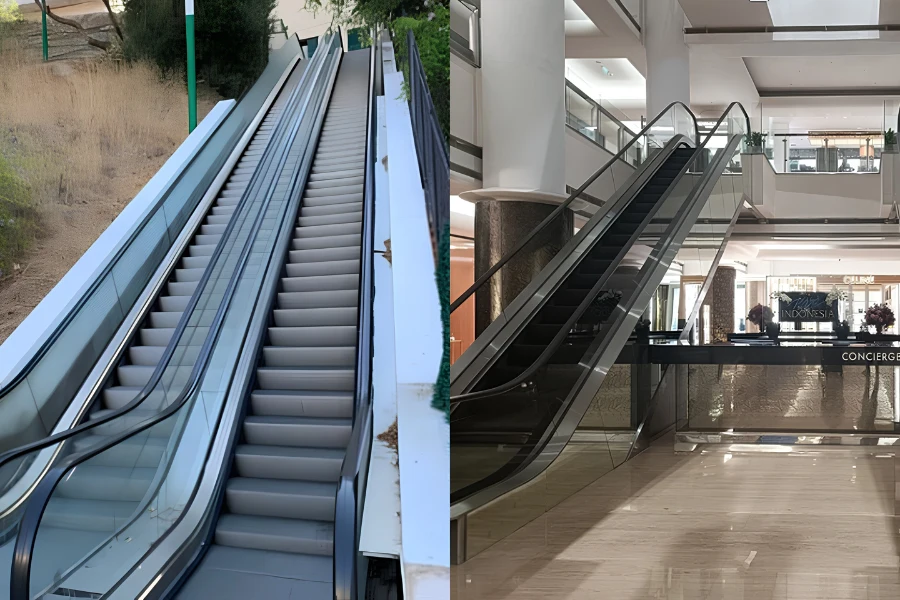
Indoor vs Outdoor Escalators at a Glance
| Factor | Indoor Escalator | Semi-Outdoor Escalator | Fully Outdoor Escalator |
|---|---|---|---|
| Environmental exposure | Controlled or protected | Partially exposed | Directly exposed |
| Rain and snow | Minimal | Wind-driven moisture possible | Direct exposure |
| Temperature variation | Usually limited | Moderate to high | Climate dependent and potentially severe |
| Corrosion protection | Standard project coating | Enhanced protection | Project-specific corrosion protection |
| Electrical equipment | Standard environmental configuration | Enhanced sealing and enclosure protection | Weather-resistant electrical configuration |
| Drainage | Mainly building drainage coordination | Dedicated assessment required | Integrated equipment and civil drainage strategy |
| Heating or cooling | Rarely required | Climate dependent | Evaluated according to project climate |
| Maintenance burden | Lower environmental burden | Moderate | Higher environmental inspection demand |
| Typical applications | Malls, hotels, indoor terminals | Covered bridges, open-sided entrances | Outdoor transit entrances, plazas, hillside projects |
| Procurement complexity | Relatively standardized | Project specific | Highly project specific |
This table is only a starting point. Two outdoor escalator installations can require very different engineering solutions when one operates in a dry inland climate and another faces coastal salt spray, heavy rainfall, freezing temperatures, or airborne sand.
Environmental Exposure Should Be Evaluated Before the Product Label
Escalator installation environments are better defined by actual exposure conditions than by architectural labels.
Rain direction, humidity, temperature range, solar radiation, dust, nearby roads, salt exposure, drainage capacity, and maintenance accessibility can all change the required escalator technical requirements.
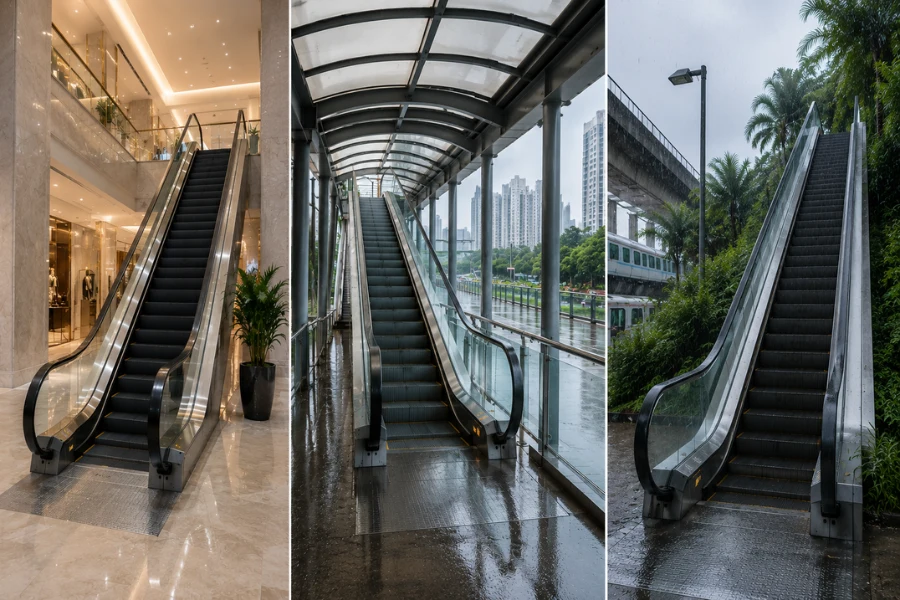
Indoor Escalators Operate Under Protected Conditions
An indoor escalator normally operates within an enclosed building where direct rain, snow, and strong solar exposure are prevented. Shopping malls, hotels, office buildings, exhibition centers, and indoor airport terminals are typical applications.
Indoor escalator installation requirements usually focus on passenger flow, operating hours, inclination, step width, architectural integration, noise, energy use, structural interfaces, and maintenance access.
Environmental protection remains relevant. Escalators close to large entrances, swimming facilities, food processing areas, or persistently humid spaces may require additional corrosion protection and electrical enclosure measures.
One recurring project mistake is assuming that all equipment shown inside the building envelope can use a standard indoor configuration. Large entrance openings and uncontrolled humidity can create exposure conditions that are substantially different from those in the building’s central interior.
Semi-Outdoor Escalators Require More Careful Classification
A semi-outdoor escalator is usually installed beneath a roof, canopy, or other overhead structure but remains exposed to ambient environmental conditions.
Covered pedestrian bridges, transit entrances, open-sided commercial buildings, and partially enclosed transportation facilities are common examples.
A canopy reduces direct vertical rainfall but doesn’t necessarily prevent wind-driven rain, condensation, temperature cycling, dust, or water entering the lower landing.
In covered transit projects, a recurring specification problem occurs when architectural drawings show a roof and the escalator is classified as indoor during procurement. After operation begins, wind-driven rain reaches the landing, drainage capacity proves insufficient, and water repeatedly accumulates near or inside the lower pit.
The escalator installation environment should therefore be evaluated according to roof coverage, open sides, prevailing weather, drainage routes, humidity, temperature range, and the probability of direct water entry.
Fully Outdoor Escalators Need Project-Specific Environmental Protection
A fully outdoor escalator may face direct rain, snow, solar radiation, dust, wind, freezing conditions, salt spray, or industrial contamination.
Outdoor escalator specifications should reflect the actual climate and operating environment rather than a generic “outdoor model.”
A dry-region outdoor escalator may require strong dust protection, ventilation, and heat management. A coastal installation may prioritize corrosion protection, sealed electrical equipment, suitable fasteners, and more frequent inspection of hidden structural areas.
Cold-region projects create another configuration. Heating systems, low-temperature operating requirements, drainage, freeze protection, and seasonal maintenance all become part of the weather-resistant escalator system.
Environmental Classification Is Not the Same as Traffic Duty
One of the most important engineering principles in an Indoor vs Outdoor Escalators comparison is that environmental exposure and operating duty are separate decisions.
Indoor, Semi-Outdoor, and Fully Outdoor describe the escalator’s environmental exposure.
Commercial, Public Transport, and Heavy-Duty describe passenger demand, operating intensity, and structural requirements.
An outdoor escalator isn’t automatically heavy-duty, and an indoor escalator isn’t automatically commercial.
Commercial Escalators
Commercial escalators commonly serve shopping malls, hotels, retail properties, and office buildings with moderate passenger demand and operating schedules.
They can be installed indoors or outdoors. An outdoor commercial escalator still requires suitable outdoor escalator weather protection even when passenger traffic doesn’t justify public transport or heavy-duty construction.
Public Transport Escalators
Public transport escalators operate under more demanding traffic conditions. Railway stations, airports, transit facilities, and major pedestrian connections may require longer operating hours, stronger structural criteria, additional braking provisions, and more intensive maintenance planning.
Industry classifications may consider approximately 140 operating hours per week and sustained braking-load conditions when defining public transport applications.
A public transport escalator can still be indoor, semi-outdoor, or fully outdoor. The environmental protection package must be specified separately.
Heavy-Duty Escalators
Heavy-duty escalators are intended for high-intensity transportation environments such as metro systems with long daily operating hours and sustained passenger loads.
Compared with standard commercial equipment, project specifications may require more demanding truss deflection criteria, higher safety factors for drive components, longer horizontal sections, additional braking provisions, and more rigorous maintenance programs.
In some heavy-duty specifications, structural deflection limits may be more demanding than those used for standard commercial or public transport escalators, while drive elements may be designed around higher safety factors.
These technical differences reinforce a basic procurement rule.
Environmental classification determines exposure protection. Traffic duty determines operating and structural capability.
How Outdoor Exposure Changes Escalator Engineering
Outdoor escalator installation affects more than exterior decoration. It can change the specification of the truss, electrical equipment, chains, bearings, drainage system, lubrication strategy, safety devices, and maintenance program.
Truss Protection Must Match the Corrosive Environment
The truss supports the escalator and transfers equipment and passenger loads to the building structure.
Indoor projects may use standard project coating systems. Semi-outdoor and outdoor projects require closer evaluation of humidity, standing water, salt spray, industrial pollutants, and long-term inspection access.
Enhanced coating systems, hot-dip galvanizing, corrosion-resistant materials, or other project-specific treatments may be considered according to environmental severity.
In practice, corrosion problems aren’t always first visible on exterior decorative panels. Water can remain in concealed structural areas, around connections, or near poorly drained lower sections, allowing deterioration to progress before routine visual inspections identify it.
Electrical Protection Should Follow Actual Weather Exposure
Motors, control cabinets, safety switches, sensors, wiring connections, and terminal boxes can be affected by moisture, condensation, dust, and temperature variation.
Outdoor and semi-outdoor projects may require protected sensors, sealed connections, weather-resistant enclosures, suitable cable routing, and appropriate ingress protection.
A common procurement mistake is copying an ingress protection requirement from another project without comparing climate, cleaning practices, enclosure location, or direct water exposure.
The correct electrical configuration should follow the real operating environment and applicable project standards.
Drainage Is an Equipment and Building Interface Issue
Drainage is one of the most important differences between indoor and outdoor escalator projects.
Rainwater, snowmelt, cleaning water, and runoff from surrounding structures can reach the lower landing and accumulate in the pit.
Outdoor escalator reliability therefore depends on both the equipment configuration and the building drainage design.
The escalator system may include internal drainage arrangements, water collection measures, water-level monitoring, and project-specific discharge provisions. The building must provide adequate drainage outlets, discharge routes, pipe capacity, cleaning access, and protection against backflow.
A well-protected outdoor escalator can still experience repeated shutdowns when surrounding paving directs stormwater toward the entrance or when drainage channels can’t be accessed for routine cleaning.
Climate Changes Temperature and Lubrication Requirements
Cold climates can affect steps, comb plates, handrails, drainage systems, chains, lubrication, and moving components.
Project-specific heating may be considered for selected components, while drainage design should reduce the possibility of standing water freezing inside or around the equipment.
High temperatures create different problems. Direct solar exposure, poor ventilation, dust accumulation, and elevated ambient temperatures can affect control cabinets, motors, electronic components, lubrication performance, and handrail materials.
Outdoor escalator specifications should therefore consider component temperature ratings, ventilation, cooling requirements, lubricant suitability, and maintenance frequency.
Indoor vs Outdoor Escalators Require Different Maintenance Strategies
Outdoor maintenance isn’t simply indoor maintenance performed more often.
Moisture can accelerate corrosion and affect electrical connections. Dust and sand can contaminate lubricants, increase mechanical wear, block drainage paths, and reduce cooling efficiency.
Temperature cycling can affect seals, materials, electrical enclosures, and mechanical clearances.
| Component | Indoor Maintenance Focus | Outdoor Maintenance Focus |
|---|---|---|
| Truss | Structural condition | Corrosion, coating damage, moisture, water accumulation |
| Step chains | Wear, tension, lubrication | Contamination, corrosion, lubrication condition |
| Bearings | Wear and lubrication | Sealing, moisture ingress, contamination |
| Electrical equipment | Connections and safety functions | Condensation, sealing, corrosion, water ingress |
| Drainage system | Building interface | Blockage, discharge capacity, water accumulation |
| Handrail system | Wear, tracking, tension | UV exposure, temperature, contamination, material aging |
| Safety devices | Functional testing | Functional testing plus environmental sealing condition |
| Lubrication system | Oil level and delivery | Contamination, temperature suitability, cleaning frequency |
One operational pattern seen in dusty outdoor installations is that lubrication intervals remain unchanged from indoor maintenance plans. Contaminated lubricant then becomes part of the wear mechanism rather than providing effective protection.
Maintenance planning should therefore respond to environmental failure mechanisms, not only calendar intervals.
How Indoor and Outdoor Conditions Affect Lifecycle Cost
A meaningful Indoor vs Outdoor Escalators cost comparison should extend beyond equipment purchase price.
A project should consider:
Equipment Cost + Civil Works + Environmental Protection + Drainage Infrastructure + Climate-Specific Systems + Preventive Maintenance + Replacement Components + Downtime Risk
An under-specified outdoor escalator may cost less initially but create higher maintenance expenses, repeated shutdowns, accelerated component replacement, and earlier modernization needs.
Over-specification also creates unnecessary cost. A lightly used covered commercial escalator doesn’t automatically require a heavy-duty outdoor configuration.
Another procurement issue appears when two quotations use the same basic escalator dimensions but include different truss treatments, drainage provisions, electrical protection, safety configurations, and component specifications. Comparing the final price before normalizing the escalator specification can produce a misleading supplier decision.
The objective isn’t to purchase the strongest system available. It is to select a configuration that matches environmental exposure, traffic duty, building conditions, and the intended maintenance strategy.
Typical Indoor, Semi-Outdoor, and Outdoor Escalator Applications
Shopping Malls and Commercial Buildings
Shopping malls typically use indoor commercial escalators.
Passenger distribution, visibility, architectural integration, operating noise, energy-saving operation, and traffic flow between floors are usually more important than severe environmental protection.
Escalators close to open façades, rooftop retail zones, or large entrances should still be evaluated separately.
Covered Pedestrian Bridges and Transit Entrances
These projects frequently require semi-outdoor configurations.
A roof may prevent direct rainfall but leave the equipment exposed to humidity, wind-driven rain, dust, uncontrolled temperatures, and surface runoff.
Building drainage and maintenance access should be evaluated before confirming the escalator technical requirements.
Metro and Railway Station Entrances
Transit entrances can combine severe weather exposure with long operating hours and sustained passenger demand.
The project may require an outdoor public transport or heavy-duty escalator with corrosion protection, drainage, water-level monitoring, enhanced electrical protection, additional braking provisions, and planned maintenance access.
This scenario clearly demonstrates why environmental exposure and traffic duty must be evaluated independently.
Coastal and High-Humidity Projects
Salt-laden air and persistent humidity can accelerate corrosion.
Truss treatment, fastener materials, electrical enclosures, drainage, chains, bearings, hidden structural areas, and maintenance intervals should all be evaluated.
One recurring specification weakness is focusing on stainless steel exterior panels while overlooking the internal components and connections that determine long-term escalator reliability.
Cold-Climate Outdoor Projects
Snow, ice, freezing water, low-temperature lubrication, and freeze-thaw cycles create combined engineering challenges.
Heating systems may be required, but heating alone doesn’t solve poor drainage, snow accumulation, or inaccessible maintenance areas.
The building layout, escalator configuration, drainage strategy, and seasonal maintenance plan must work together.
Hot, Dusty, and High-Solar-Exposure Projects
Outdoor escalators in hot and dusty regions face a different combination of failure mechanisms.
Airborne sand can enter mechanical areas, contaminate lubricants, increase chain and bearing wear, block drainage paths, and reduce ventilation efficiency. Strong solar radiation can raise temperatures around control cabinets, exterior surfaces, handrail systems, and enclosed machine spaces.
Project teams should evaluate control cabinet temperature limits, ventilation and cooling, protected electrical enclosures, bearing sealing, lubricant selection, solar exposure, and cleaning frequency.
A recurring maintenance problem occurs when dust removal is treated as an appearance issue rather than a reliability task. In severe environments, cleaning frequency directly affects cooling performance, lubrication condition, sensor reliability, and component wear.
Common Specification Mistakes in Indoor and Outdoor Escalator Projects
Several project problems begin before manufacturing.
Classifying a covered, open-sided location as indoor. A canopy doesn’t eliminate wind-driven rain, humidity, dust, or temperature variation.
Assuming every outdoor escalator must be heavy-duty. Environmental exposure and traffic duty are separate engineering decisions.
Selecting corrosion protection without evaluating the actual atmosphere. Coastal, industrial, humid, and dry dusty environments create different risks.
Treating drainage as the manufacturer’s responsibility alone. Escalator drainage and civil drainage must operate as one system.
Ignoring maintenance access during building design. Restricted access increases inspection time, repair difficulty, and downtime.
Comparing suppliers only by price. Outdoor escalator specifications must be normalized before commercial comparison.
How to Choose Between Indoor, Semi-Outdoor, and Fully Outdoor Escalators
A practical Indoor vs Outdoor Escalators selection process begins with the operating environment.
First, determine whether the escalator is fully enclosed, partially exposed, or directly exposed. Review rainfall, snow, humidity, solar radiation, temperature range, dust, salt spray, industrial pollutants, and potential water entry.
Next, define traffic duty. Passenger demand, daily operating hours, peak loading, transportation function, and sustained operating conditions determine whether commercial, public transport, or heavy-duty construction is appropriate.
Building conditions must then be reviewed. Elevation rise, inclination, horizontal length, support points, pit dimensions, structural loads, entrance areas, drainage, transportation access, and maintenance space all affect escalator installation compatibility.
Only after these conditions are defined should the project establish corrosion protection, electrical configuration, drainage provisions, climate-specific systems, safety requirements, and maintenance strategy.
Finally, supplier quotations should be compared against the same escalator specification. Equipment price, civil works, environmental protection, energy use, preventive maintenance, spare parts continuity, expected downtime, and modernization requirements should be evaluated together.
Information to Provide Before Requesting an Escalator Quotation
A technically complete inquiry improves quotation accuracy and reduces repeated specification revisions.
Project buyers should provide information such as installation location, destination country, indoor or outdoor exposure, building type, elevation rise, inclination, step width, passenger demand, daily operating hours, commercial or public transport application, temperature range, rainfall, snow, coastal exposure, dust conditions, drainage arrangements, structural interfaces, power supply, applicable standards, delivery requirements, and project schedule.
If some information is unavailable, the supplier should identify the missing engineering conditions before finalizing the project-specific escalator configuration.
How EKCNE Evaluates Indoor and Outdoor Escalator Projects
EKCNE evaluates escalator projects through three connected dimensions: environmental exposure, traffic duty, and building conditions.
Environmental exposure is translated into project requirements for corrosion protection, electrical equipment, drainage interfaces, temperature control, contamination protection, and maintenance planning.
Traffic duty is used to evaluate whether commercial, public transport, or heavy-duty construction is appropriate for the expected operating hours and passenger demand.
Building conditions are reviewed to coordinate elevation rise, inclination, structural interfaces, pit conditions, drainage, installation access, and long-term maintenance accessibility.
This approach allows EKCNE to support contractors, distributors, developers, and procurement teams with project-specific escalator configuration, manufacturing coordination, export delivery, and long-term component supply continuity.
The objective is not to promote one standard indoor or outdoor model. It is to define an escalator system that remains compatible with the building, operating environment, traffic requirements, and intended lifecycle strategy.
Final Thoughts
Choosing between Indoor vs Outdoor Escalators is not simply a matter of equipment location.
The correct decision requires coordinated evaluation of environmental exposure, traffic duty, and building conditions.
These factors determine corrosion protection, electrical configuration, drainage strategy, climate-specific systems, maintenance requirements, structural capability, and lifecycle cost.
A project that defines these requirements before comparing suppliers is better positioned to avoid under-specification, unnecessary over-specification, installation conflicts, repeated downtime, and misleading price comparisons.
EKCNE supports project teams in evaluating these connected engineering conditions and developing escalator configurations that match building interfaces, operating environments, passenger demand, installation requirements, and long-term supply and maintenance needs.












