
Modern escalator safety depends on layered engineering controls rather than a single emergency device. Effective escalator safety features combine passenger protection systems, mechanical safety devices, electrical safety devices, motion monitoring, braking controls, inspection interlocks, and preventive maintenance practices.
For project owners, contractors, developers, and procurement teams, the practical question isn’t simply how many escalator protection devices are listed in a specification. The more important issue is whether the complete configuration can detect abnormal conditions, stop movement reliably, support safe maintenance, and remain suitable for the building’s traffic demand and operating environment.
A shopping mall escalator and a metro escalator may share similar dimensions and nominal speeds, yet their operating hours, passenger loads, maintenance windows, and consequences of downtime can differ significantly. Understanding escalator safety features therefore requires both component knowledge and project engineering judgment.
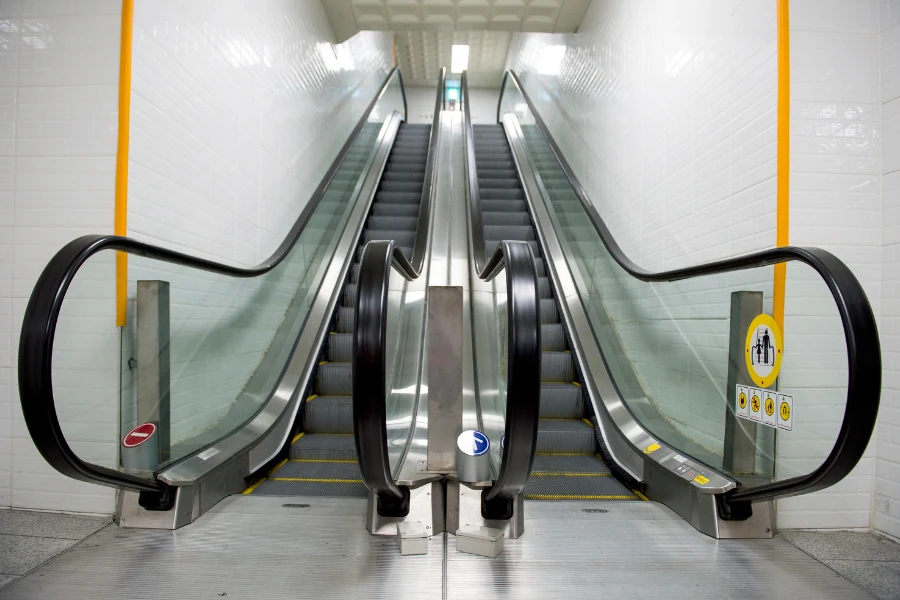
What Are the Main Escalator Safety Features?
Modern escalator safety systems typically combine devices that protect passenger interaction areas, monitor motion, detect mechanical deterioration, control stopping behavior, and prevent unsafe maintenance operation.
The exact configuration depends on applicable standards, escalator design, rise height, operating duty, installation environment, and project specifications.
| Escalator Safety Feature | Main Hazard Controlled | Typical Response |
|---|---|---|
| Emergency stop button | Immediate passenger or equipment hazard | Initiates stopping |
| Comb plate protection | Foreign object or abnormal force at the landing | Interrupts operation |
| Skirt protection | Entrapment near step edges | Reduces or detects hazardous conditions |
| Handrail entrance protection | Fingers, clothing, or objects entering the inlet | Stops the escalator |
| Handrail speed monitoring | Abnormal handrail-to-step speed relationship | Initiates a stopping response |
| Step sagging protection | Step running below its intended position | Stops operation before the affected step reaches a critical area |
| Missing step detection | Missing or incorrectly positioned step | Prevents continued passenger operation |
| Step chain protection | Chain breakage, excessive elongation, or abnormal movement | Interrupts operation |
| Main drive chain protection | Drive transmission failure | Stops the escalator |
| Overspeed and underspeed protection | Abnormal operating speed | Activates protective stopping logic |
| Unintentional reversal protection | Unexpected change in running direction | Stops movement |
| Brake monitoring | Incorrect brake release or operation | Prevents unsafe starting or continued operation |
| Additional brake | Serious drive or braking failure | Provides a secondary braking layer |
| Landing plate protection | Open maintenance access area | Prevents normal operation |
| Inspection controls and interlocks | Unsafe maintenance movement | Restricts operation to controlled procedures |
| Water level monitoring | Water accumulation in lower machinery spaces | Stops affected outdoor equipment |
These escalator safety features don’t function as isolated accessories. They form coordinated operational safeguards that monitor different failure modes and connect them to the escalator safety circuit, drive controls, and escalator braking system.
How Escalator Safety Systems Respond to Abnormal Conditions
The engineering principle behind escalator safety systems is straightforward. A hazardous condition must be detected early enough for the equipment to interrupt unsafe operation and control movement before the situation becomes more severe.
A typical response sequence is:
Abnormal Condition → Detection → Escalator Safety Circuit Response → Drive Interruption → Controlled Braking → Fault Lockout → Inspection and Reset
Not every fault follows exactly the same sequence. Some escalator protection devices prevent startup, while others stop moving equipment or require manual reset before passenger service resumes.
The quality of the overall protective strategy depends on more than the number of escalator safety sensors installed. Detection reliability, switch adjustment, braking performance, mechanical condition, fault diagnostics, maintenance accessibility, and restart procedures all influence long-term effectiveness.
A recurring nuisance shutdown illustrates this relationship. What first appears to be an escalator safety sensor problem may actually result from mechanical wear, contamination, incorrect clearance, component misalignment, or poor adjustment after maintenance.
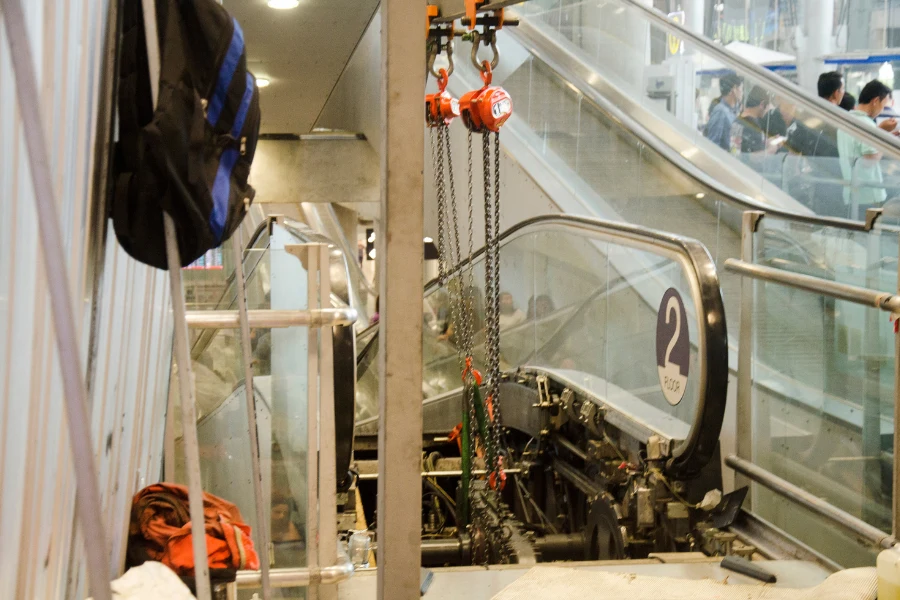
Passenger Protection Systems at Escalator Interaction Areas
Passengers interact directly with moving steps, handrails, landing transitions, and the narrow spaces beside the skirt panels. Escalator safety mechanisms in these areas combine physical barriers, visual guidance, mechanical safety devices, and safety monitoring devices.
Comb Plate Protection
The comb plate is located where moving steps enter or leave the landing. Foreign objects, damaged step components, or abnormal step alignment can generate force against the comb plate and create a potential entrapment or equipment damage risk.
Comb plate protective controls detect abnormal movement or impact and stop the escalator for inspection.
Repeated activation shouldn’t automatically be treated as an isolated foreign-object event. Maintenance teams should also inspect step alignment, comb teeth condition, engagement, landing component adjustment, and nearby mechanical clearances.
This is an important engineering distinction. A correctly functioning escalator protection device can identify the symptom, but maintenance must still determine the root cause.
Purchase Escalator Comb Plate >>
Skirt Panels, Skirt Brushes, and Entrapment Risk
The moving step-to-skirt interface is another critical passenger interaction area.
Skirt brushes guide passengers away from step edges and reduce exposure to the narrow space beside the skirt panel. They are primarily a passenger guidance and risk-reduction measure rather than a substitute for controlled skirt clearances or active protective mechanisms.
Depending on the escalator design, additional devices may detect abnormal force or displacement associated with objects becoming trapped near the skirt.
Project evaluation should therefore consider the complete passenger protection system. Smooth skirt surfaces, correct clearances, step alignment, skirt brushes, inspection procedures, and active monitoring functions must work together.
Purchase Escalator Skirt Brushe >>
Handrail Entrance Protection
The handrail entrance is the point where the moving handrail enters the balustrade structure. Fingers, clothing, debris, or other foreign objects can enter this area.
Protective devices at the inlet detect abnormal pressure or displacement and interrupt escalator operation.
Correct positioning is essential. Contamination, physical damage, or switch misalignment can change the response of the protective control, particularly in high-traffic environments where cleaning and maintenance activities are frequent.
Step Visibility and Passenger Guidance
Not every escalator safety feature relies on an active sensor.
Step demarcation, landing lighting, visible step edges, and step gap illumination help passengers identify moving boundaries and prepare for entry and exit.
These measures can be particularly valuable in buildings serving older passengers, mixed passenger groups, or changing lighting conditions. They complement passenger protection systems by reducing exposure to hazards before a mechanical or electrical device needs to respond.
Escalator Safety Mechanisms for Motion and Speed Monitoring
Abnormal speed or unexpected direction changes can indicate faults involving the drive system, transmission components, controls, or braking performance.
Escalator safety systems therefore use several safety monitoring devices to verify that motion remains within the intended operating conditions.
Overspeed and Underspeed Protection
Overspeed protection detects movement above the permitted operating range. Underspeed monitoring can identify significant loss of speed associated with abnormal resistance, drive faults, transmission problems, or other conditions requiring investigation.
When defined trigger conditions are reached, the escalator safety circuit interrupts operation and initiates the required stopping response.
Speed monitoring shouldn’t be viewed as a substitute for maintaining the drive and transmission systems. Its engineering purpose is to identify abnormal operation before continued movement develops into a more serious event.
Unintentional Reversal Protection
Unexpected reversal can create a significant passenger stability risk, especially on an upward-moving escalator carrying a high load.
Passengers adjust their posture according to the expected direction of travel. A sudden change can disturb balance while also indicating a serious transmission, drive, or escalator braking system problem.
Unintentional reversal protection detects the abnormal direction change and stops movement.
This function is particularly important in high-traffic transportation projects. Operating duty, braking capacity, detection reliability, and inspection procedures should be evaluated together rather than treating reversal detection as an isolated specification item.
Handrail Speed Monitoring
The moving handrail should maintain a controlled speed relationship with the steps.
Handrail drive wear, incorrect tension, contaminated friction surfaces, slippage, or component deterioration can create abnormal speed differences. Escalator safety sensors monitor this relationship and initiate a stopping response when defined criteria are exceeded.
Frequent handrail speed faults are often maintenance symptoms rather than isolated sensor failures. Before replacing the monitoring device, technicians should inspect the handrail drive, tension, friction surfaces, alignment, and component wear.
Step, Chain, and Drive Integrity Protection
The moving step system operates under continuous cyclic loading. Steps, rollers, guide tracks, step chains, and drive components are exposed to wear, contamination, lubrication conditions, alignment changes, and fatigue.
Mechanical safety devices and safety monitoring devices help detect abnormal conditions, but preventive inspection remains the first line of lifecycle control.
Step Sagging and Missing Step Detection
Roller wear, roller failure, step deformation, axle problems, or other mechanical damage can cause a step to move below its intended running position.
Step sagging protection detects this abnormal position and stops the escalator before the affected step reaches the landing transition.
Missing step detection addresses a different failure mode. It prevents continued passenger operation when the step sequence is incomplete because of maintenance errors, incorrect assembly, component damage, or other mechanical events.
Both escalator safety mechanisms are closely connected to maintenance quality. After activation, technicians should identify the mechanical cause and verify the step system before restoring passenger service.
Step Chain and Main Drive Chain Protection
The step chain moves the steps through the truss, while the main drive chain transmits power within the drive system.
Wear, inadequate lubrication, contamination, incorrect tension, alignment problems, fatigue, or abnormal elongation can affect long-term reliability.
Chain-related escalator protection devices detect specified abnormal conditions and interrupt operation. However, they shouldn’t replace chain elongation measurements, lubrication records, wear trending, alignment checks, and planned replacement.
In long-hour transportation projects, maintenance teams may identify deterioration through inspection trends before a protective switch is activated. That is the preferred outcome because condition-based maintenance can prevent a fault from reaching the shutdown threshold.
Purchase Escalator Step Chain >>
Escalator Braking System and Stopping Protection
Detection is only one part of safe operation. Once a serious abnormal condition is identified, the escalator braking system must control movement and bring the equipment to rest according to the performance requirements of the applicable design and safety standard.
Braking reliability depends on system configuration, adjustment, friction component condition, contamination, loading, operating temperature, and maintenance quality.
Working Brake and Brake Monitoring
The working brake participates in normal stopping and primary safety stopping functions.
Many designs use a fail-safe principle in which electrical power releases the brake and loss of power applies braking force. During relevant safety events, drive power is interrupted and the working brake contributes to stopping the moving step system.
Brake monitoring can verify whether the brake releases correctly during startup or identify abnormal stopping behavior.
Repeated brake-related shutdowns shouldn’t be resolved through reset alone. Friction components, adjustment, contamination, operating duty, mechanical wear, and stopping performance should be investigated.
Additional Brake and Safety Redundancy
An additional brake provides another braking layer when required by the escalator configuration, operating duty, rise height, project specification, or applicable standard.
It isn’t the same as the working brake. The additional system is intended to strengthen protection against serious drive, transmission, or primary braking failures.
Greater redundancy creates an engineering trade-off.
More braking components can improve fault tolerance, but they also increase inspection points, maintenance requirements, troubleshooting complexity, spare parts needs, and lifecycle cost.
For metro stations and other heavy-duty transportation projects, stronger braking redundancy may be justified by sustained passenger loads and the consequences of failure. Ordinary commercial projects should still be evaluated according to actual operating conditions rather than assuming the most complex configuration is universally preferable.
Escalator Safety Features for Maintenance and Inspection
Maintenance work introduces hazards that don’t exist during normal passenger service. Technicians may remove landing plates, access machinery spaces, inspect moving components, or operate equipment from inspection controls.
Escalator safety systems therefore include electrical safety devices and interlocks that restrict operation during these activities.
Landing Plate Protection and Inspection Controls
Opening a landing plate or maintenance access cover exposes areas containing machinery and moving components.
Protective controls verify the position of these covers and prevent normal operation when access areas aren’t secured.
Inspection controls allow authorized technicians to move the escalator under restricted conditions. Manual controls, stop functions, safety contacts, and interlocks help prevent conflicting commands or uncontrolled movement.
Poor adjustment after maintenance can create repeated false shutdowns. This is why technicians should verify switch position, actuator clearance, wiring condition, and correct safety circuit response after replacing or adjusting nearby components.
Why Manual Reset Matters
Many significant faults shouldn’t disappear from the control logic simply because the triggering condition temporarily returns to normal.
Manual reset creates a barrier between fault detection and return to passenger service. It gives maintenance personnel an opportunity to identify the activated function, inspect related safety-critical components, correct the root cause, verify operating condition, and authorize restart.
This principle is especially important for faults involving chain integrity, abnormal speed, step position, braking performance, or maintenance access.
Outdoor Escalator Safety Features Require Environmental Engineering
Outdoor escalators face water ingress, humidity, dust, corrosion, temperature changes, freezing conditions, and other environmental pressures.
Water level monitoring can detect abnormal accumulation in lower machinery areas and stop the equipment before critical components are exposed.
However, an escalator safety sensor can’t compensate for inadequate drainage design.
Recurring water alarms often indicate drainage capacity, blocked outlets, waterproofing, civil engineering, or site maintenance problems rather than failure of the monitoring device itself.
Reliable outdoor escalator safety systems require coordinated drainage, truss corrosion protection, suitable electrical enclosures, weather-resistant components, lubrication planning, water monitoring, and inspection frequency.
A tropical coastal installation and a cold-climate outdoor project may require different material choices, environmental controls, and maintenance strategies even when the escalators have similar nominal specifications.
Do All Projects Need the Same Escalator Safety Systems?
No single safety configuration is ideal for every building.
Passenger traffic, operating hours, rise height, environmental exposure, maintenance capability, building use, and the consequences of downtime influence the appropriate combination of escalator safety features.
| Project Scenario | Operating Conditions | Safety and Maintenance Priorities |
|---|---|---|
| Shopping mall | Traffic peaks and mixed passenger behavior | Passenger interaction areas, visibility, reliable monitoring, and maintenance access |
| Hotel | Moderate traffic and high availability expectations | Reliable operation, smooth stopping, and planned maintenance |
| Airport | Long operating hours and frequent luggage traffic | Landing protection, fault diagnostics, component durability, and operational continuity |
| Railway station | High traffic peaks and restricted maintenance windows | Braking reliability, chain condition, rapid fault response, and maintenance planning |
| Metro station | Heavy-duty operation and sustained passenger loads | Braking redundancy, mechanical integrity, lifecycle monitoring, and component continuity |
| Outdoor facility | Water, corrosion, dust, and temperature exposure | Drainage, environmental protection, corrosion control, and frequent inspection |
The same escalator specification may perform differently in a shopping mall and a metro station because operating hours and maintenance windows change deterioration rates.
Heavy-duty configurations often provide stronger structural capacity, braking redundancy, and lifecycle resilience, but they can also increase procurement cost, maintenance complexity, and spare parts requirements.
The correct objective is project compatibility, not maximum specification complexity.
Why Escalator Safety Devices Cannot Replace Preventive Maintenance
Escalator protection devices are designed to respond when defined abnormal conditions occur. Preventive maintenance aims to identify deterioration before those conditions develop.
Sensors can become contaminated. Safety switches may move out of adjustment. Chains elongate. Brake friction components wear. Handrails slip. Mechanical clearances change. Corrosion and water ingress can affect safety-critical components.
Maintenance should therefore verify both equipment condition and the response of escalator safety mechanisms.
Important activities include testing the escalator safety circuit, checking mechanical clearances, monitoring chain wear, verifying braking performance, inspecting handrail movement, reviewing fault records, maintaining lubrication systems, and confirming correct adjustment after component replacement.
More monitoring functions also create another trade-off.
Additional escalator safety sensors can improve fault coverage, but every device introduces another adjustment point, wiring connection, inspection requirement, and potential source of nuisance shutdowns.
The goal isn’t to reduce protective coverage. It is to combine suitable monitoring with disciplined commissioning, preventive maintenance, clear fault records, accessible components, and technicians capable of diagnosing the root cause of repeated activations.
How Should Buyers Evaluate Escalator Safety Features?
Project buyers shouldn’t evaluate an escalator by counting the safety devices listed in a technical specification.
A stronger procurement process examines whether the escalator safety systems match the building, passenger traffic, operating duty, installation environment, maintenance resources, and long-term service strategy.
Key evaluation points include:
- Applicable safety standards and project specifications
- Building type and expected passenger traffic
- Nominal speed, step width, and rise height
- Indoor, semi-outdoor, or outdoor installation conditions
- Passenger protection systems at steps, skirts, landings, and handrail entrances
- Overspeed, underspeed, reversal, and handrail monitoring
- Step, chain, and drive integrity protection
- Escalator braking system configuration
- Additional brake requirements and stopping performance
- Escalator safety circuit design and fault diagnostics
- Mechanical safety devices and electrical safety devices
- Manual reset and safe restart procedures
- Maintenance access and inspection controls
- Preventive maintenance requirements and fault records
- Component standardization and spare parts availability
- Long-term technical and component supply continuity
Supplier evaluation should also consider how project configuration decisions are made.
An escalator intended for moderate commercial use shouldn’t automatically be specified for a metro station because its speed, step width, and rise height appear suitable. Operating hours, structural duty, braking requirements, maintenance windows, passenger density, and expected service life can change the appropriate engineering configuration.
EKCNE evaluates escalator projects according to building use, traffic conditions, operating duty, installation environment, safety requirements, maintenance access, and long-term component continuity.
For contractors, developers, distributors, and infrastructure procurement teams, this project-oriented approach connects escalator safety features with the actual conditions under which the equipment will be installed, operated, inspected, maintained, and eventually modernized.
Final Thoughts
Modern escalator safety features work through layered protection rather than isolated components.
Passenger protection systems reduce exposure to entrapment hazards. Escalator safety sensors and safety monitoring devices identify abnormal motion or mechanical conditions. The escalator safety circuit interrupts unsafe operation, while the escalator braking system controls stopping behavior. Inspection interlocks and preventive maintenance support safe operation throughout the equipment lifecycle.
The most advanced escalator safety systems still depend on correct project configuration, building compatibility, component condition, maintenance quality, fault diagnosis, and spare parts continuity.
For buyers, the right question isn’t simply how many escalator protection devices are installed.
The better question is whether the complete system matches the traffic load, operating duty, building conditions, maintenance strategy, and lifecycle requirements of the project.
EKCNE supports project-oriented escalator configuration and coordinated vertical transportation procurement for commercial buildings, transportation facilities, infrastructure projects, and other applications requiring long-term system compatibility.












