
Quick Answer
A moving walkway, also called a travelator, moving sidewalk, moving pavement, or passenger conveyor, commonly operates around 0.50–0.75 m/s in the project references used for this article. Some specialized systems may operate around 0.90 m/s, while accelerating moving walkways use separate acceleration and deceleration zones to achieve higher travel speeds.
The appropriate speed is not necessarily the highest available. Passenger boarding behavior, walkway inclination, travel distance, traffic demand, accessibility, equipment design, and operating conditions all affect speed selection.
For most projects, the engineering objective is to balance travel time with safe boarding and continuous passenger flow.
[IMAGE POSITION 1 — Cover image showing passengers using a horizontal moving walkway in a modern airport terminal
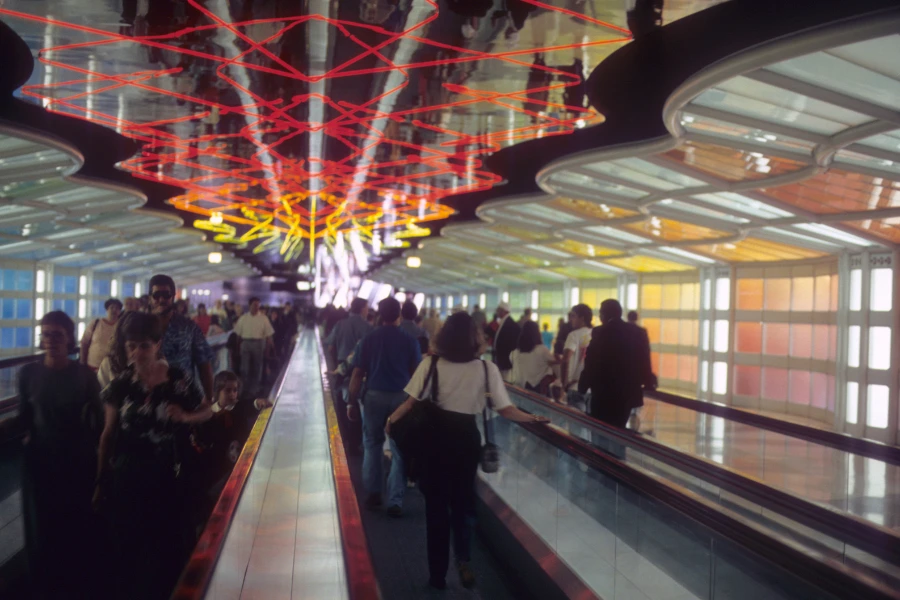
Why Aren’t Moving Walkways Faster?
Increasing speed reduces travel time, but it can also make boarding and exiting more demanding.
Unlike elevators, moving walkways transport passengers continuously. If passengers hesitate before stepping onto the moving surface, larger gaps can develop between users.
The result can be:
Higher speed → More difficult boarding → Greater passenger spacing → Lower utilization of theoretical capacity
This is why speed and passenger throughput should not be treated as the same metric.
Mechanical requirements also change with speed. The pallet system, chains, drive equipment, controller, braking system, handrail, and other components need to maintain coordinated operation throughout acceleration, normal travel, and stopping.
Higher operating speeds can also increase the importance of:
-
Vibration control
-
Component alignment
-
Braking performance
-
Wear monitoring
-
Maintenance condition
-
Passenger stability
The design objective is therefore not maximum speed but stable transportation under the expected operating conditions.
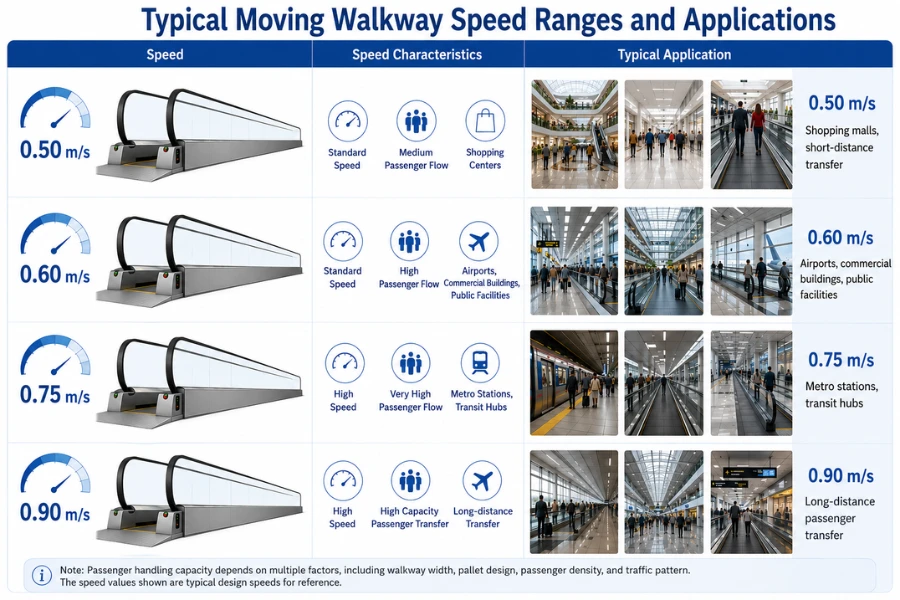
Typical Moving Walkway Speeds
The following values provide a preliminary planning reference based on the project material for this article.
| Application | Typical Planning Speed | Main Consideration |
|---|---|---|
| Shopping mall | 0.50–0.65 m/s | Frequent boarding and mixed passenger behavior |
| Supermarket | Around 0.50 m/s | Cart handling and passenger stability |
| Airport | 0.65–0.75 m/s | Longer travel distances and luggage |
| Metro and public transit | 0.65–0.75 m/s | Peak passenger movement |
| Inclined moving walkway | Around 0.50 m/s or project-specific | Stability on inclined travel |
| Specialized system | Up to around 0.90 m/s in the source material | Dedicated engineering application |
These figures are planning references rather than universal specifications. Final rated speed should follow the selected equipment, applicable requirements, passenger characteristics, and project conditions.
[IMAGE POSITION 2 — Technical comparison showing typical moving walkway speeds for supermarket, shopping mall, airport, transit, and inclined applications]
What Determines Moving Walkway Speed?
Passenger Flow
Passenger flow affects how effectively a particular speed can be used.
Locations with steady pedestrian movement and long travel distances may benefit from higher travel speeds.
Locations with frequent boarding, family groups, luggage, carts, or passengers requiring more boarding time may benefit from a more moderate speed even when faster equipment is technically available.
Travel Distance
The value of higher speed increases as travel distance becomes longer.
Over a short distance, increasing speed may save relatively little passenger time while still changing boarding and braking requirements.
Over a long airport corridor, the travel-time difference can become more meaningful.
This makes distance an important variable when evaluating whether additional speed provides useful transportation value.
Building Function
Different facilities create different operating priorities.
Airports
Long corridors and luggage movement make travel time and continuous passenger flow important.
Shopping malls
Mixed passenger groups and frequent entry and exit place greater emphasis on comfortable boarding.
Supermarkets
Shopping carts can make stability and usable walkway width more important than maximum speed.
Hospitals
Accessibility and predictable passenger movement may take priority over reducing travel time.
Transit facilities
Short periods of concentrated passenger demand require speed to be considered together with width, landing capacity, and surrounding pedestrian circulation.
Inclination
Inclination changes passenger stability and boarding conditions.
An inclined moving walkway is not simply a horizontal walkway installed at an angle. Passengers may be carrying luggage, pushing carts, or standing differently because of the slope.
Speed selection therefore needs to consider inclination together with passenger behavior and equipment configuration.
Equipment and Control System
Speed stability depends on the complete drive and control system.
Relevant components can include:
-
Drive motor
-
Gearbox
-
Controller
-
Inverter
-
Braking system
-
Pallet or belt system
-
Handrail drive
-
Safety devices
The system needs to maintain coordinated movement rather than simply achieve the specified nominal speed.
Speed vs. Passenger Throughput
A faster moving walkway does not automatically produce proportionally higher practical capacity.
Passenger throughput depends on at least three interacting variables:
Speed × Usable passenger density × Boarding efficiency
If speed increases while boarding efficiency falls, the expected capacity gain can be reduced.
[IMAGE POSITION 3 — Engineering diagram showing moving walkway speed, passenger spacing, boarding efficiency, and practical throughput]
Consider two simplified situations.
Moderate Speed With Efficient Boarding
Passengers enter continuously with relatively consistent spacing.
The moving walkway may use a large proportion of its available transportation capacity.
Higher Speed With Boarding Hesitation
Passengers pause or increase spacing before stepping onto the walkway.
The equipment moves faster, but fewer passengers occupy each section of the moving surface.
This explains why entrance design, passenger guidance, walkway width, and surrounding circulation can sometimes improve practical throughput more effectively than an increase in speed.
Speed vs. Width
Speed and width influence capacity in different ways.
Increasing Speed
Potential benefits include:
-
Shorter travel time
-
Higher theoretical throughput
-
Greater value on long corridors
Potential trade-offs include:
-
More demanding boarding
-
Greater attention to braking
-
Passenger stability considerations
-
Potentially greater mechanical demands
Increasing Width
Potential benefits include:
-
More usable passenger space
-
Better luggage accommodation
-
Greater potential passenger occupancy
-
More flexibility for walking and standing behavior
Potential trade-offs include:
-
Larger installation footprint
-
Greater structural requirements
-
Higher equipment and installation cost
[IMAGE POSITION 4 — Side-by-side engineering comparison of increasing moving walkway speed versus increasing walkway width]
The correct choice depends on the bottleneck.
If passengers with luggage cannot efficiently occupy the walkway, additional width may create more practical value than additional speed.
If the walkway covers a long distance and passenger loading is already efficient, travel speed may become more important.
Horizontal vs. Inclined Moving Walkways
Horizontal and inclined moving walkways can use similar core mechanical systems, but their operating conditions differ.
| Factor | Horizontal Moving Walkway | Inclined Moving Walkway |
|---|---|---|
| Travel direction | Primarily horizontal | Between different elevations |
| Speed priority | Travel time and passenger flow | Passenger stability and controlled movement |
| Boarding condition | Level approach | Transition to inclined travel |
| Common passenger factors | Luggage, long walking distances | Carts, luggage, strollers, slope stability |
| Typical applications | Airports, transit corridors, public passages | Shopping malls, supermarkets, parking facilities |
Inclined systems require particular attention to passenger stability because gravity and slope affect how passengers and wheeled items behave during travel.
[IMAGE POSITION 5 — Technical side-view comparison of horizontal and inclined moving walkways with passengers and luggage or carts]
Speed selection should therefore follow the complete operating condition rather than the moving walkway category alone.
Can Moving Walkways Go Faster?
Yes, but substantially higher travel speed requires a different approach to passenger boarding.
An accelerating moving walkway can separate the journey into three stages:
Low-speed boarding → Accelerated travel → Controlled deceleration and exit
Passengers enter at a manageable speed before being transferred into a faster travel section.
[IMAGE POSITION 6 — Three-stage accelerating moving walkway diagram showing low-speed boarding, high-speed travel, and controlled deceleration]
This configuration addresses one of the fundamental limitations of a conventional moving walkway.
The passenger does not need to step directly onto the highest-speed section.
However, the system also introduces additional engineering requirements, which can include:
-
More complex mechanical arrangements
-
More sophisticated control
-
Additional transition space
-
Greater installation requirements
-
More demanding maintenance
The potential travel-time benefit therefore needs to justify the additional system complexity.
How Travel Distance Changes the Value of Speed
Speed should be evaluated together with distance because the same speed increase produces different practical value on short and long walkways.
Travel time can be approximated as:
Travel time = Distance ÷ Speed
For example, ignoring boarding and exiting time:
| Travel Distance | At 0.50 m/s | At 0.75 m/s | Approximate Time Saved |
|---|---|---|---|
| 30 m | 60 sec | 40 sec | 20 sec |
| 60 m | 120 sec | 80 sec | 40 sec |
| 100 m | 200 sec | 133 sec | 67 sec |
This illustrates why higher speeds can provide more noticeable travel-time benefits in long airport or transit corridors.
It does not mean 0.75 m/s is automatically preferable. Boarding conditions, applicable requirements, passenger characteristics, and equipment design still need to support the selected speed.
[IMAGE POSITION 7 — Moving walkway travel-time chart comparing 0.50 m/s and 0.75 m/s over 30 m, 60 m, and 100 m distances]
Moving Walkway Speed Selection by Project Type
Building type provides useful context but should not be treated as a fixed speed specification.
| Project Type | Typical Operating Priority | Speed Selection Consideration |
|---|---|---|
| Airport | Reduce walking time over long distances | Balance travel speed with luggage and passenger flow |
| Metro or transit | Handle concentrated passenger movement | Coordinate speed with width, entrances, and downstream circulation |
| Shopping mall | Comfortable continuous use | Account for mixed passenger groups and frequent boarding |
| Supermarket | Stable transport with carts | Prioritize boarding and cart stability |
| Hospital | Accessibility and predictable movement | Consider passenger mobility and operating comfort |
| Convention center | Variable event traffic | Design around temporary peak demand |
A project-specific traffic analysis provides a stronger basis for selection than assigning a fixed speed solely from the building category.
Speed, Energy, and Lifecycle Requirements
Rated speed is only one part of operating performance.
Project evaluation may also consider:
-
Operating hours
-
Energy consumption
-
Mechanical wear
-
Maintenance intervals
-
Spare-parts availability
-
Equipment reliability
-
Downtime requirements
-
Expected service life
Higher speed should therefore create a useful operational benefit before its additional requirements are justified.
Variable-frequency control can also allow some moving walkways to adjust operation according to passenger demand.
Depending on the system, this may include reduced-speed or standby operation during low-demand periods.
This does not increase maximum capacity. Its purpose is to adapt equipment operation to changing demand and potentially reduce unnecessary operation.
Common Moving Walkway Speed Planning Mistakes
Assuming Faster Always Means Better
Higher speed reduces travel time but can make boarding more demanding.
The correct comparison is overall passenger movement, not speed alone.
Assuming Speed Alone Determines Capacity
Capacity also depends on:
-
Walkway width
-
Passenger spacing
-
Boarding efficiency
-
Luggage
-
Entrance design
-
Exit capacity
A speed increase cannot correct a bottleneck elsewhere in the passenger-flow system.
Selecting Speed by Building Type Alone
Two airports can have very different corridor lengths, passenger volumes, luggage patterns, and transfer flows.
Building type provides context but does not replace project-specific traffic analysis.
Ignoring Travel Distance
Increasing speed on a very short walkway may produce limited time savings.
The same speed difference becomes more meaningful over a long corridor.
Ignoring Maintenance Condition
Speed stability depends on the condition and adjustment of the mechanical and control systems.
Abnormal wear, poor alignment, drive problems, or control issues can affect vibration, ride quality, and operating performance even when the nominal speed specification remains unchanged.
Moving Walkway Speed Selection Workflow
A practical selection process is:
1. Establish the Travel Distance
Determine whether reducing passenger travel time is a significant project objective.
2. Evaluate Passenger Characteristics
Consider luggage, carts, accessibility requirements, family groups, and typical boarding behavior.
3. Determine Peak Passenger Demand
Establish the practical transportation requirement rather than selecting speed independently.
4. Evaluate Width and Circulation
Check whether walkway width, entrance design, and landing areas create capacity constraints.
5. Compare Suitable Speed Options
Evaluate travel-time savings against boarding, braking, comfort, and equipment requirements.
6. Verify the Equipment Configuration
Confirm that the selected moving walkway, control system, braking system, and safety arrangement support the required operating conditions.
7. Review Lifecycle Requirements
Consider operating hours, energy use, maintenance, equipment reliability, and future traffic changes.
[IMAGE POSITION 8 — Seven-step moving walkway speed selection workflow diagram]
Conclusion
Most moving walkway projects in the source material for this article use speeds around 0.50–0.75 m/s, while specialized systems may operate at higher speeds.
The more important engineering question is not simply how fast a moving walkway can move.
It is whether the selected speed improves transportation performance under the actual passenger and building conditions.
A practical decision sequence is:
Travel distance → Passenger characteristics → Traffic demand → Width and circulation → Speed → Equipment verification → Lifecycle evaluation
This approach prevents speed from becoming an isolated specification and connects it instead to the overall passenger transportation system.












