
Why Airport Moving Walkway Systems Matter
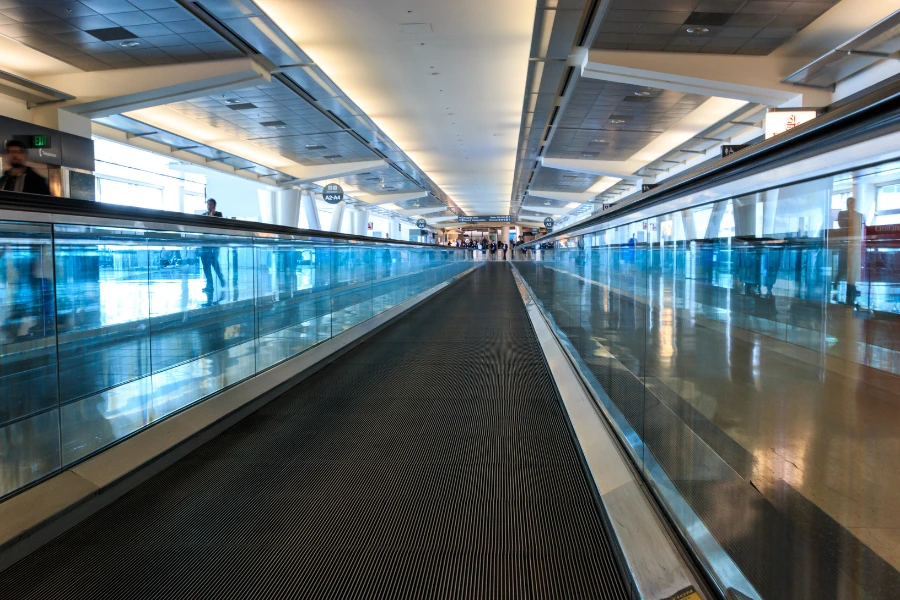
As airport terminals expand, passenger walking distances can extend from several hundred meters to more than a kilometer. Satellite concourses, multiple security checkpoints, retail areas, automated people mover stations, and rail connections can create long and complex passenger journeys.
For airport operators, long walking distances affect more than passenger comfort. They influence passenger circulation, connection times, accessibility, congestion, and terminal operating efficiency, particularly during concentrated peak periods.
Airport moving walkway systems provide continuous horizontal or gently inclined transportation along these routes. They are especially useful where passengers carry luggage, use airport carts, or need to cover long distances between terminal functions.
Selecting an airport moving walkway is therefore a transportation-planning decision rather than a simple equipment purchase. Walkway width, operating speed, passenger behavior, duty cycle, installation location, maintenance access, and future expansion all need to be evaluated together.
Airport Passenger Flow Challenges
Airport transportation planning begins with understanding how passengers move through the terminal. Unlike shopping malls or office buildings, airport pedestrian traffic changes rapidly in response to flight schedules, security procedures, transfer activity, and baggage movement.
Long Walking Distances Across Expanding Terminals
A typical departing passenger journey may include:
Check-in → Security Screening → Immigration → Moving Walkway → Departure Concourse → Boarding Gate
Transfer passengers may follow a longer sequence:
Arrival Gate → Immigration → Moving Walkway → Transfer Security → Moving Walkway → Departure Gate
Long routes can become more demanding for elderly travelers, families, passengers carrying heavy luggage, and travelers with limited connection time.
Strategically located moving walkways can reduce the physical effort required to cover these distances while maintaining continuous pedestrian circulation.
Peak-Hour Passenger Density
Passenger traffic is not evenly distributed throughout the day. Morning departure banks, international arrival periods, and overlapping connections can create concentrated flows within a short period.
Capacity planning should therefore consider:
-
Peak-hour passenger volume
-
Passenger density
-
Connection-time requirements
-
Flight schedule overlap
-
Future passenger growth
These variables influence not only walkway capacity but also width, speed, number of sections, and installation location.
Luggage Changes Passenger Behavior
Airport passengers use circulation space differently from shoppers or office workers.
Suitcases, airport trolleys, oversized baggage, strollers, and mobility aids require additional space. Passenger walking speed also varies according to destination, connection time, and familiarity with the terminal.
For this reason, walkway width should be selected according to passenger behavior rather than theoretical passenger count alone.
Accessibility Is Part of Passenger Flow
Accessibility is part of overall circulation planning rather than a separate consideration.
Moving walkways can reduce the physical effort required along long terminal routes for older travelers, families, passengers with temporary mobility limitations, and people carrying heavy luggage.
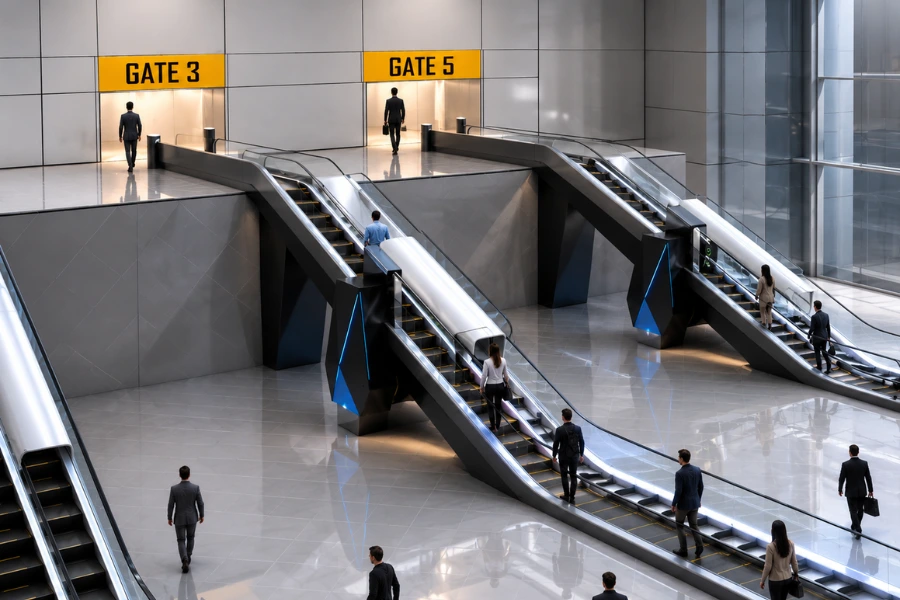
They should complement elevators, escalators, and accessibility lifts as part of an integrated airport mobility network rather than replace them.
[IMAGE POSITION 2 — Airport passenger-flow diagram showing departing, arriving, and transfer passenger routes with moving walkways]
Planning for Future Airport Growth
Airport transportation infrastructure may remain in service for decades while terminal layouts and passenger volumes change.
New routes, additional gates, terminal extensions, satellite concourses, and intermodal connections can alter pedestrian circulation. A system sized only around current demand may therefore become a bottleneck as the airport expands.
Project teams should consider:
-
Passenger growth forecasts
-
Planned terminal extensions
-
Additional boarding gates
-
Future airline operations
-
New rail or metro connections
-
Space for future maintenance and modernization
The objective is not simply to shorten today’s walking distances. It is to create a transportation network that can continue to support changing passenger flows.
What Makes Airport Moving Walkway Systems Different?
Moving walkways used in airports operate under different conditions from those installed in typical retail buildings.
The main differences involve duty cycle, passenger loading, luggage, maintenance requirements, and expected operating life.
| System Type | Typical Application | Daily Operating Reference | Primary Design Objective |
|---|---|---|---|
| Commercial moving walkway | Shopping malls, supermarkets, retail buildings | Around 12 hours | Convenience and cost efficiency |
| Public transit moving walkway | Airports, railway stations, metro terminals | Around 20 hours | Continuous operation and high passenger throughput |
| Heavy-duty moving walkway | Major transportation hubs with extremely heavy traffic | Nearly continuous | Durability under sustained loading |
The source material classifies most airport projects within the public transit category, while heavy-duty systems may be considered for exceptionally busy transportation hubs.
The important procurement principle is to select equipment according to operating conditions rather than visual similarity or initial purchase price.
Key Engineering Specifications for Airport Moving Walkways
Walkway speed, width, configuration, duty classification, and installation arrangement interact with passenger behavior and terminal operations.
The following values from the project material can be used as engineering starting points, not fixed specifications.
| Airport Type | Reference Width | Reference Speed | Potential System Category | Primary Focus |
|---|---|---|---|---|
| Regional airport | 1,000 mm | 0.5 m/s | Commercial or public transit | Cost efficiency and moderate passenger flow |
| International airport | 1,200 mm | 0.5–0.65 m/s | Public transit | Passenger comfort and reliability |
| Mega hub airport | 1,400 mm | 0.65–0.75 m/s | Public transit or heavy duty | High passenger throughput and long corridors |
| Airport rail/transit hub | 1,200–1,400 mm | 0.65–0.75 m/s | Heavy duty | Continuous transportation and multimodal connectivity |
These figures need to be refined using passenger forecasts, architectural constraints, luggage behavior, operating hours, and project objectives.
[IMAGE POSITION 3 — Airport moving walkway engineering comparison showing width, speed, duty classification, and passenger use]
Why Operating Speed Is More Than a Capacity Decision
Operating speed affects travel time, but it also changes boarding and disembarking conditions.
The source material identifies approximately 0.5 m/s as a reference for lower-speed applications and 0.65–0.75 m/s for higher passenger volumes and longer transfer distances.
Higher speed can shorten travel time through long concourses, but passengers carrying multiple suitcases or pushing carts may require more stable boarding conditions.
The relevant question is therefore not:
How fast can the walkway operate?
It is:
What speed can the expected passenger population use effectively and comfortably throughout the operating day?
Why Walkway Width Affects Passenger Flow
Walkway width affects how passengers with different movement patterns share the same surface.
The source material uses the following examples:
-
1,000 mm for lower-demand applications where most passengers travel with hand luggage
-
1,200 mm where one passenger can stand with luggage while another moves past
-
1,400 mm where airport carts, oversized luggage, and simultaneous pedestrian movement create greater space requirements
The value of additional width is therefore not simply that more passengers can stand on the walkway. It can allow standing passengers, walking passengers, luggage, and carts to coexist with less interference.
Horizontal vs. Inclined Moving Walkways
Most airport moving walkways are horizontal because terminal circulation typically extends along long corridors.
Inclined systems become relevant where moderate elevation changes must be overcome while passengers remain with luggage carts or other wheeled loads. Applications can include connections between terminal buildings, parking structures, airport rail stations, and transportation hubs.
The configuration should follow the building circulation requirement rather than architectural preference.
Designing Practical Walkway Lengths
Long continuous walkways are not automatically the most reliable solution.
Very long installations can increase maintenance complexity and extend the operational impact of equipment downtime. Dividing a long route into coordinated sections can provide:
-
Easier preventive maintenance
-
Reduced disruption during servicing
-
Greater flexibility during terminal expansion
-
Simplified modernization
-
Easier component replacement
Several appropriately sized sections can therefore provide greater operational flexibility than one extremely long installation.
[IMAGE POSITION 4 — Long airport corridor divided into multiple coordinated moving walkway sections]
Planning Airport Moving Walkway Locations
Equipment selection and location selection need to be considered together.
A high-performance moving walkway provides limited value if passengers bypass it or if the surrounding corridor remains the actual bottleneck. Location planning should therefore begin with the complete passenger journey.
Airport Passenger Journey Analysis
Typical routes include:
Departing passenger
Check-in → Security → Escalator if required → Moving Walkway → Departure Concourse → Boarding Gate
Arriving passenger
Arrival Gate → Moving Walkway → Immigration → Baggage Claim → Moving Walkway → Airport Rail Station or Parking
Transfer passenger
Arrival Gate → Transfer Security → Moving Walkway → Satellite Terminal → Boarding Gate
The purpose is to identify the longest or most operationally important walking segments rather than distribute moving walkways evenly throughout the terminal.
Long Departure Concourses
Departure concourses are a common application because modern international terminals can extend hundreds of meters beyond central processing areas.
Moving walkways allow passengers to continue walking or standing while reducing the effort associated with long distances. They also avoid the waiting cycle associated with shuttle transportation.
Location planning should account for:
-
Seating areas
-
Retail spaces
-
Emergency routes
-
Gate waiting areas
-
Pedestrian crossings
-
Entrance and exit space
The moving walkway should improve the circulation network without creating a new obstruction.
Terminal Connections and Transfer Corridors
Transfer passengers may have limited connection time and less familiarity with the terminal layout.
Moving walkways between terminals, satellite concourses, and automated people mover stations can provide more predictable travel times while reducing passenger fatigue.
For long transfer routes, multiple coordinated sections can also maintain partial transportation service while another section is undergoing maintenance.
Baggage Claim to Ground Transportation
Passenger movement does not end at the aircraft.
Routes between baggage claim and railway stations, metro connections, rental car centers, parking structures, or shuttle facilities can involve passengers carrying their heaviest luggage.
Where moderate elevation changes exist, inclined moving walkways may provide a practical connection for passengers with luggage carts without requiring repeated transfers to elevators.
Failure Chain: Poor Location Selection
A poorly positioned system can produce limited operational value:
Incorrect walkway location → Passengers bypass the system → Low utilization → Congestion remains elsewhere → Lower infrastructure value
The more useful planning question is therefore:
Where will a moving walkway remove the greatest passenger-flow bottleneck?
[IMAGE POSITION 5 — Airport terminal plan highlighting high-value moving walkway locations and passenger bottlenecks]
Airport Moving Walkway Systems vs. Escalators
Moving walkways and escalators often operate within the same airport but solve different transportation problems.
| Engineering Consideration | Airport Moving Walkway | Escalator |
|---|---|---|
| Primary purpose | Horizontal or gently inclined transportation | Vertical transportation |
| Reference inclination | 0°–12° | Approximately 30°–35° |
| Wheeled airport carts | Suitable for relevant applications | Limited |
| Long-distance corridor travel | Suitable | Not suitable |
| Floor-to-floor transportation | Limited | Suitable |
| Typical airport locations | Concourses, transfer corridors, rail links | Security levels, terminal floors, parking structures |
When Moving Walkways Are Appropriate
Moving walkways are particularly relevant to:
-
Long terminal corridors
-
International transfer routes
-
Satellite concourse connections
-
Airport rail links
-
Extended walking routes with luggage
-
Continuous horizontal passenger circulation
When Escalators Are Appropriate
Escalators remain more suitable when significant vertical movement is required, including:
-
Security level changes
-
Terminal mezzanines
-
Parking structures
-
Airport railway platforms
-
Multi-story terminal connections
The two systems should therefore be selected according to movement direction and passenger requirements rather than treated as interchangeable products.
Why Airports Combine Multiple Transportation Modes
A complete airport mobility network may combine:
Elevators + Escalators + Moving Walkways + Accessibility Lifts + Conventional Pedestrian Routes
For example:
Check-in → Security → Escalator → Moving Walkway → Departure Gate
or:
Arrival Gate → Moving Walkway → Immigration → Baggage Claim → Moving Walkway → Airport Rail Station → Escalator
Each system handles a different movement requirement.
[IMAGE POSITION 6 — Airport mobility network diagram showing elevators, escalators, moving walkways, and pedestrian routes]
Safety, Reliability, and Lifecycle Performance
Airport reliability is an operational issue because moving walkway downtime can affect passenger circulation and create congestion.
Design evaluation should therefore consider:
-
Operating hours
-
Structural loading
-
Passenger loading
-
Environmental conditions
-
Maintenance accessibility
-
Future expansion
-
Safety functions
-
Component durability
The source material identifies airport moving walkways as systems that may operate for around 20 hours per day, making duty-cycle considerations particularly important.
Safety Is Part of System Design
Safety should be integrated into the complete transportation system rather than treated as emergency-stop equipment alone.
Important design considerations include:
-
Stable pallet movement
-
Controlled vibration
-
Handrail synchronization
-
Smooth entry and exit transitions
-
Braking performance for inclined systems
-
Appropriate clearances
-
Clear visibility around boarding and disembarking areas
Maintenance Strategy and Lifecycle Cost
Airport maintenance planning can include:
-
Scheduled inspections
-
Component condition monitoring
-
Lubrication management
-
Chain tension verification
-
Handrail inspection
-
Brake testing
-
Electrical diagnostics
The objective is to identify deterioration before it causes unplanned downtime.
Maintenance planning should therefore be evaluated during procurement rather than added after equipment selection.
Maintenance Accessibility
Maintenance access can materially affect lifecycle cost.
If technicians cannot reach drive units, controllers, braking systems, chain drives, or inspection areas efficiently, routine servicing becomes slower and more disruptive.
Project planning should reserve:
-
Maintenance access panels
-
Safe technician working areas
-
Suitable equipment rooms
-
Component replacement routes
-
Access paths that minimize interference with passengers
[IMAGE POSITION 7 — Airport moving walkway maintenance access diagram showing drive unit, controller, inspection area, and component replacement route]
Operational Resilience
Airport passenger circulation should not depend entirely on one transportation route.
Moving walkways, elevators, escalators, and conventional pedestrian paths can provide alternative routes when individual equipment is unavailable for maintenance or unexpected repair.
For major terminals, this redundancy can be more valuable than maximizing the theoretical capacity of one moving walkway.
Energy Efficiency and Smart Airport Integration
Modern airport transportation equipment increasingly forms part of broader energy and building-management strategies.
Energy Efficiency
Potential efficiency measures include:
-
High-efficiency drive motors
-
Variable Frequency Drives
-
Low-friction transmission systems
-
LED lighting
-
Intelligent standby operation
-
Optimized mechanical efficiency
When an airport operates many moving walkways simultaneously, small efficiency improvements across individual systems can accumulate into significant operating-cost differences.
Condition Monitoring and Predictive Maintenance
Digital monitoring can track variables such as:
-
Motor temperature
-
Vibration
-
Chain condition
-
Running speed
-
Electrical performance
-
Fault history
Trend information can help maintenance teams identify changes from normal operating conditions and schedule inspection before a developing problem causes passenger disruption.
The value of monitoring is therefore not simply data collection. It is the ability to connect equipment condition with maintenance decisions.
BMS and Airport Operations Integration
Moving walkways can be integrated with:
-
Building Management Systems
-
Airport Operations Control Centers
-
Passenger information systems
-
Energy management platforms
-
Predictive maintenance software
This allows operators to view transportation equipment as part of the wider terminal operating system rather than as isolated mechanical equipment.
[IMAGE POSITION 8 — Smart airport architecture showing moving walkways connected to BMS, AOCC, energy management, and predictive maintenance]
Common Airport Moving Walkway Design Mistakes
1. Selecting Equipment Based Only on Purchase Price
Initial price does not represent total ownership cost.
Procurement should also consider:
-
Expected service life
-
Operating hours
-
Preventive maintenance
-
Energy consumption
-
Spare-parts support
-
Modernization capability
-
Technical service
2. Designing Only for Current Passenger Volume
Passenger growth, terminal extensions, new gates, satellite concourses, and rail connections can change future circulation.
Capacity planning should therefore be aligned with the airport’s development strategy.
3. Choosing Width Without Understanding Passenger Behavior
Passenger count alone does not determine the appropriate width.
The planning question is how passengers actually use the corridor, including whether they stand, walk, carry luggage, push carts, or travel in groups.
4. Ignoring Maintenance Accessibility
A technically suitable system can become expensive to operate if technicians cannot access critical components efficiently.
Maintenance space and replacement routes should be included in the architectural plan.
5. Applying One Specification Throughout the Airport
Different terminal zones have different passenger characteristics.
| Airport Area | Passenger Characteristic | Engineering Priority |
|---|---|---|
| Departure concourse | Long walking distance | Transportation efficiency |
| Transfer corridor | Time-sensitive passengers | Reliable passenger flow |
| Airport rail link | High luggage volume | Continuous transportation |
| Arrival hall connection | Mixed passenger speeds | Accessibility and comfort |
| Parking connection | Elevation changes | Inclined walkway integration |
Specification should therefore follow the operational role of each area rather than be standardized solely for procurement convenience.
How to Select the Right Airport Moving Walkway System
A practical selection process can follow six stages.
Step 1: Evaluate Passenger Flow
Identify:
-
Longest walking distances
-
Peak congestion points
-
Transfer passenger volumes
-
Luggage and cart usage
-
Future circulation changes
Step 2: Understand the Building
Evaluate:
-
Corridor length
-
Installation space
-
Floor elevation differences
-
Structural constraints
-
Maintenance access
-
Interfaces with elevators and escalators
Step 3: Match Specifications to Operating Conditions
| Evaluation Factor | Engineering Question |
|---|---|
| Passenger volume | What practical transportation capacity is required? |
| Walking distance | What travel distance and speed are appropriate? |
| Luggage usage | What pallet width is needed? |
| Operating hours | What duty classification is appropriate? |
| Expansion plans | What future capacity is required? |
| Maintenance resources | How will lifecycle servicing be performed? |
Step 4: Compare Lifecycle Value
Supplier evaluation should include:
-
Engineering capability
-
Customization experience
-
Manufacturing quality
-
Applicable compliance
-
Installation support
-
Spare-parts availability
-
Technical documentation
-
Long-term service capability
Step 5: Coordinate the Project
Airport moving walkways interact with structural, architectural, electrical, MEP, accessibility, and passenger-flow planning.
These interfaces should be resolved before installation rather than after equipment arrives onsite.
Step 6: Plan Commissioning and Lifecycle Support
The project should establish requirements for:
-
Installation
-
Testing
-
Commissioning
-
Preventive maintenance
-
Spare parts
-
Performance monitoring
-
Future modernization
[IMAGE POSITION 9 — Airport moving walkway project lifecycle from traffic analysis through engineering, installation, commissioning, maintenance, and modernization]
Airport Moving Walkway Project Lifecycle
A complete project can be summarized as:
Planning
Evaluate passenger forecasts, terminal mobility requirements, and development strategy.
↓
Traffic Flow Analysis
Map walking distances, transfer routes, congestion points, and future passenger flows.
↓
Engineering Selection
Determine system type, width, speed, inclination, configuration, and duty requirements.
↓
Project Integration
Coordinate structural, architectural, electrical, MEP, and passenger-flow interfaces.
↓
Installation and Commissioning
Verify equipment performance, safety functions, dimensions, and system integration.
↓
Lifecycle Maintenance and Modernization
Manage inspections, spare parts, performance trends, repairs, and future terminal changes.
This lifecycle approach is more useful than treating the moving walkway as a standalone procurement item.
Conclusion
Airport moving walkway systems are part of the terminal’s passenger transportation infrastructure. Their value depends on how effectively they connect long walking routes, transfer corridors, baggage areas, rail links, and other high-demand passenger zones.
The most important selection variables are not isolated product specifications. They include:
Passenger demand → Passenger behavior → Walking distance → Luggage and cart use → Width and speed → Installation location → Duty cycle → Maintenance access → Future expansion
Moving walkways and escalators solve different transportation problems, while elevators and accessibility systems provide additional capabilities. A well-planned airport therefore uses these systems as a coordinated mobility network.
For airport authorities, architects, EPC contractors, and procurement teams, the objective is to select equipment that fits the terminal’s actual passenger flow and remains serviceable as the airport develops.
At EKCNE, airport moving walkway projects can be evaluated across passenger flow, equipment configuration, building integration, installation, commissioning, maintenance, and future modernization rather than treating equipment supply as an isolated procurement activity.












