
Why Inclined Moving Walkways Are Used in Commercial Buildings
Modern commercial buildings need to move people between different levels while accommodating different types of passenger movement. An Inclined Moving Walkway, also called an Inclined Travelator, Moving Walk, Moving Sidewalk, or Power Ramp, is designed for situations where passengers need to travel with wheeled loads such as shopping carts or luggage trolleys.
Unlike escalators, inclined moving walkways use a continuous pallet surface rather than moving steps. This configuration makes them particularly relevant to shopping malls, supermarkets, airports, mixed-use developments, and other buildings where pedestrian circulation needs to accommodate wheeled equipment.
The key planning question is not whether an inclined moving walkway is better than an escalator in general. It is whether the building’s passenger profile, floor-to-floor travel, available installation space, and circulation requirements match the characteristics of an inclined system.
What Is an Inclined Moving Walkway?
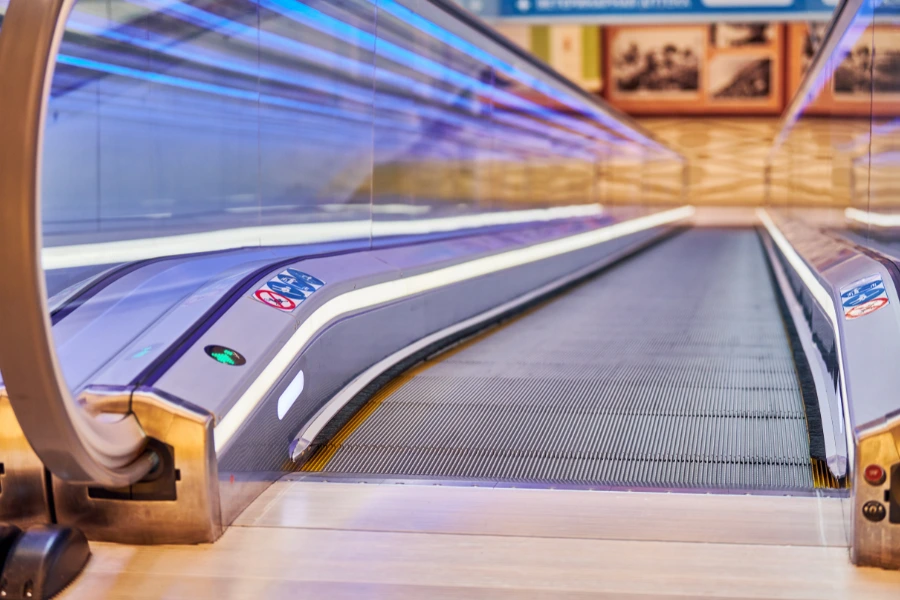
An inclined moving walkway is a fixed, electrically driven passenger conveyor that transports people along a sloped path using continuously circulating pallets.
Its defining feature is the combination of a relatively gentle inclination and a continuous flat pallet surface. The project reference for this article uses a maximum inclination of approximately 12°, allowing the system to accommodate passengers together with wheeled loads such as shopping carts, luggage carts, wheelchairs, and strollers.
The system therefore addresses a different transportation requirement from a conventional escalator. Instead of optimizing primarily for rapid pedestrian movement between floors, it combines passenger transportation with wheeled-load movement.
Inclined Moving Walkway vs. Escalator
Both systems provide continuous transportation, but their geometry and intended passenger use are different.
| Feature | Inclined Moving Walkway | Escalator |
|---|---|---|
| Passenger surface | Flat moving pallets | Moving steps |
| Typical inclination in this project reference | Up to 12° | Usually 30°–35° |
| Main application | Passengers and wheeled loads | Pedestrian transportation |
| Shopping cart compatibility | Suitable for applications requiring cart movement | Generally not designed for shopping carts |
| Luggage handling | Suitable for wheeled luggage in relevant applications | More limited |
| Typical buildings | Shopping malls, supermarkets, airports | Metro stations, office buildings, transit hubs |
The lower inclination is central to the inclined moving walkway concept. A gentler slope can provide a more suitable travel surface for wheeled equipment, but it also creates a longer horizontal footprint for the same vertical rise.
Where Are Inclined Moving Walkways Used?
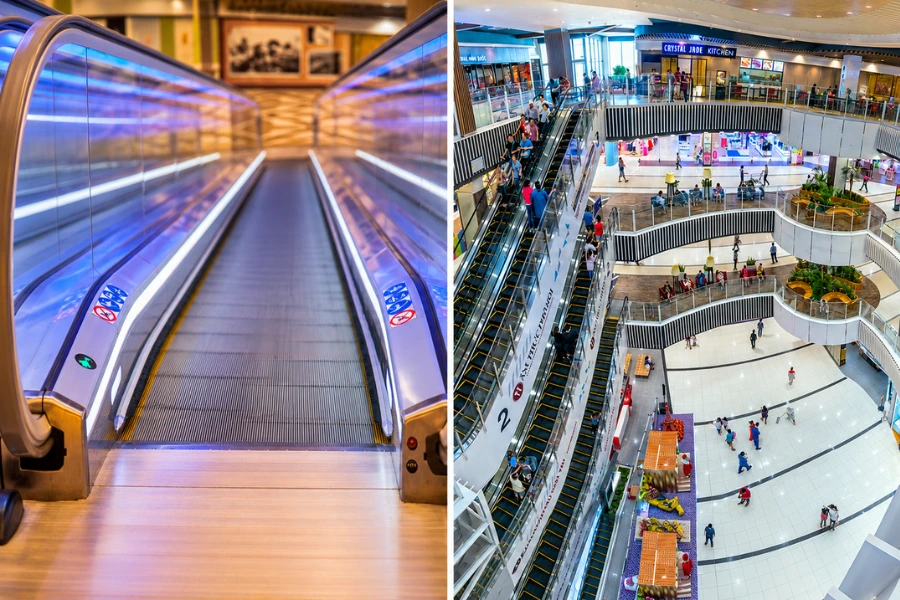
Shopping Malls and Supermarkets
Retail environments are a common application because customers may need to move between levels without leaving shopping carts behind.
The flat pallet surface provides a continuous transportation path for pedestrians and wheeled shopping equipment, making the system particularly relevant where cart movement forms part of the normal circulation pattern.
Airports
Airports combine passenger movement with luggage and long walking distances.
Inclined moving walkways can be used to connect areas such as parking structures, terminals, baggage-related areas, and commercial spaces where passengers need to move between levels with wheeled luggage.
Hospitals and Healthcare Facilities
Healthcare facilities may need to accommodate visitors and users with different mobility requirements.
Where an inclined moving walkway is appropriate for the project, the ability to transport passengers together with wheeled equipment can provide an alternative to conventional pedestrian-only circulation systems.
Convention Centers and Mixed-Use Developments
Convention centers and mixed-use developments often connect parking, retail, offices, entertainment areas, and other public spaces.
An inclined moving walkway can provide continuous circulation between these areas when the available floor height, footprint, passenger demand, and wheeled-load requirements are compatible with the system.
Why Choose an Inclined Moving Walkway?
The main distinction is its ability to combine passenger movement with wheeled-load transportation.
This can reduce the need for passengers to transfer shopping carts or manually carry luggage when moving between connected levels. It can also support continuous pedestrian circulation without the waiting cycle associated with elevator transportation.
However, these benefits depend on the building layout. The system requires more horizontal space than an escalator to achieve the same vertical rise because of its gentler inclination.
For this reason, the decision should balance:
- Wheeled-load requirements
- Passenger traffic
- Floor-to-floor height
- Available footprint
- Accessibility requirements
- Installation conditions
- Maintenance access
How Does an Inclined Moving Walkway Work?
An inclined moving walkway combines structural, mechanical, passenger-interface, and control systems.
Drive System
The motor, gearbox, coupling, and braking system provide the mechanical power required to circulate the pallets and control movement.
Truss
The truss forms the main structural framework. It supports the guide system, drive components, return path, and passenger loads throughout the equipment’s operating life.
Pallets
Interconnected pallets create the continuous moving surface. Unlike escalator steps, the pallet surface remains essentially flat and is intended to accommodate both passengers and relevant wheeled equipment.
Handrail System
The handrail moves alongside the pallets to provide passenger support. Speed synchronization between the handrail and moving surface is important for passenger stability.
Control and Safety System
Sensors and control components monitor operating conditions and initiate protective functions when abnormal conditions are detected.
A simplified system relationship is:
Motor → Drive System → Pallets → Passenger Movement → Monitoring and Safety Response
The safety system is therefore integrated with the mechanical system rather than functioning as a separate component.
Key Technical Specifications
Project requirements determine the final equipment configuration, but several parameters have a direct influence on performance.
Operating Speed
The project reference for this article identifies nominal speeds between 0.5 m/s and 0.75 m/s.
Higher speed can reduce travel time, but speed should be evaluated together with passenger behavior, boarding conditions, equipment design, and applicable requirements.
Pallet Width
Pallet width affects both passenger space and the available area for wheeled equipment.
A wider pallet does not automatically produce a proportional increase in passenger throughput. If additional width is primarily being used for shopping carts or luggage, the practical capacity benefit may differ from a conventional passenger-flow calculation.
Duty and Operating Conditions
Shopping centers and retail environments can have different operating patterns from airports or public transit facilities.
High-duty applications may require equipment designed for longer operating hours, heavier passenger loads, and more demanding maintenance conditions.
Energy Management
Modern systems can incorporate operating strategies such as:
- Standby stop
- Reduced-speed standby
- Variable-speed operation
- Regenerative energy recovery
These functions primarily affect energy consumption and operating efficiency. They should be evaluated separately from the basic passenger capacity of the moving walkway.
Safety Features
Inclined moving walkways require safety systems that address both passenger interaction and mechanical operation.
Depending on the equipment configuration, key protection functions can include:
- Emergency stop devices
- Overspeed protection
- Comb plate obstruction detection
- Drive-chain monitoring
- Missing or displaced pallet detection
- Brake monitoring
- Handrail speed monitoring
- Anti-reversal protection where applicable
Inclination makes unintended reverse movement an important consideration because passengers and equipment loads are subject to gravity along the slope.
Safety selection should therefore follow the equipment configuration and applicable requirements rather than relying on a generic list of devices.
When Should You Install an Inclined Moving Walkway?
An inclined moving walkway becomes relevant when a building regularly needs to transport passengers together with shopping carts, luggage, strollers, or other wheeled equipment.
It is particularly worth evaluating when:
- Wheeled loads form a significant part of passenger circulation
- The vertical rise is relatively modest
- Continuous passenger movement is preferred
- Sufficient installation length is available
- Accessibility and wheeled-load movement are important design considerations
It may be less suitable when vertical travel is substantial or horizontal space is severely restricted.
The reason is geometric. A gentler inclination requires a longer travel path to achieve the same elevation.
For example, if two systems need to overcome the same vertical rise, an inclined moving walkway with a lower angle requires substantially more horizontal development than a steeper escalator.
This creates an important project trade-off:
Gentler inclination → More suitable for wheeled movement → Longer footprint
Steeper inclination → Shorter footprint → Primarily pedestrian transportation
The final choice therefore depends on which constraint is more important to the building.
Inclined Moving Walkway vs. Elevator vs. Escalator
An inclined moving walkway does not need to replace every other vertical transportation system.
Different systems solve different circulation problems.
| System | Primary Strength | Typical Limitation |
|---|---|---|
| Inclined moving walkway | Continuous movement with wheeled loads | Requires longer footprint |
| Escalator | Efficient pedestrian movement over greater vertical rises | Limited suitability for wheeled loads |
| Elevator | Flexible vertical transportation and accessibility | Waiting time and batch-style passenger movement |
Large commercial developments may therefore use a combination of elevators, escalators, and moving walkways.
For example, an escalator may handle high-volume pedestrian movement while elevators provide accessible vertical transportation and inclined moving walkways connect retail or parking areas where shopping carts and luggage are common.
The appropriate combination depends on the building’s circulation model rather than the performance of any single equipment type.
Design Considerations Before Installation
A successful project begins with passenger-flow analysis and building coordination rather than equipment appearance.
Passenger and Wheeled-Load Demand
Estimate how many passengers will use the system during normal and peak periods and how frequently users will arrive with carts, luggage, strollers, or other wheeled equipment.
Available Installation Space
Confirm the horizontal footprint required for the selected inclination and floor-to-floor height.
This is particularly important when comparing an inclined moving walkway with an escalator because the lower angle can significantly increase the required travel length.
Building Layout
Coordinate:
- Entrance and exit locations
- Landing areas
- Pedestrian circulation
- Adjacent elevators and escalators
- Structural openings
- Maintenance access
A high-capacity moving walkway can still become a circulation bottleneck if the landing area or surrounding corridor is undersized.
Operating Hours and Duty Cycle
Equipment selection should reflect expected operating hours and passenger loading.
Airport and transit applications may require substantially different duty characteristics from a small retail installation.
Environmental Conditions
Outdoor or semi-exposed installations require additional consideration of:
- Rain and moisture
- Dust and debris
- Corrosion
- Drainage
- Electrical enclosure protection
- Temperature variation
Maintenance and Lifecycle Cost
The evaluation should extend beyond the purchase price.
Consider:
- Preventive maintenance
- Spare parts
- Energy consumption
- Component wear
- Service access
- Expected operating life
- Future modernization
These factors can materially affect the total cost of ownership.
Inclined Moving Walkway Selection Checklist
Before finalizing the system, project teams should confirm:
- Floor-to-floor height
- Required horizontal footprint
- Peak passenger demand
- Wheeled-load frequency
- Pallet width
- Rated speed
- Entrance and exit layout
- Accessibility requirements
- Structural integration
- Safety configuration
- Operating hours
- Environmental exposure
- Maintenance access
- Energy consumption
- Lifecycle cost
- Future building changes
The checklist helps distinguish a system that technically fits the building from one that also fits its actual operating requirements.
Conclusion
Inclined moving walkways are designed for a specific passenger-flow problem: moving people between levels while accommodating relevant wheeled loads on a continuous pallet surface.
Their main trade-off is closely tied to their geometry. A gentler inclination can support wheeled movement and passenger comfort, but it requires more horizontal space than a steeper escalator for the same vertical rise.
The selection process should therefore consider:
Wheeled-load demand → Passenger flow → Floor-to-floor height → Available footprint → Equipment configuration → Safety → Lifecycle requirements
For some buildings, the appropriate solution will be an inclined moving walkway. Others may be better served by an escalator, elevator, or combination of systems.
The objective is to match the vertical transportation system to the building’s actual circulation requirements rather than selecting equipment based on a single specification.












