
Center-opening and side-opening elevator doors differ in how their panels move and where those panels stack when the entrance opens. This geometry affects clear opening, panel travel, entrance packaging, door-cycle performance, and compatibility with the available hoistway.
Selection should therefore start with the required clear opening and available entrance and hoistway dimensions, followed by panel arrangement, traffic demand, and operating requirements.
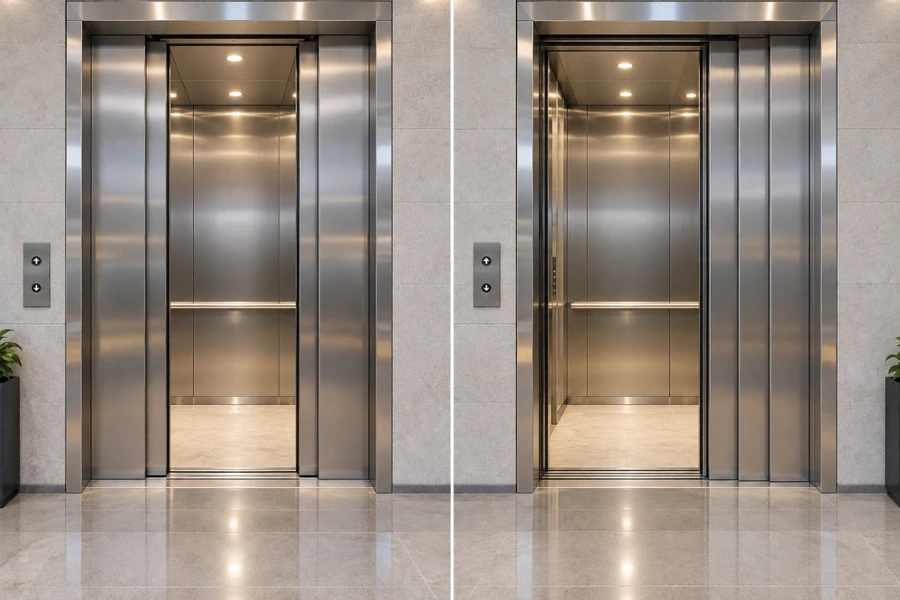
Center Opening vs. Side Opening Elevator Doors at a Glance
Center opening and side opening describe panel movement direction, not panel count.
| Factor | Center Opening Doors | Side Opening Doors |
|---|---|---|
| Opening movement | Panels move from the center toward opposite sides | Panels move toward the same side |
| Panel arrangement | Two-panel or multi-panel configurations | Single-panel or telescopic multi-panel configurations |
| Panel stacking | Distributed on both sides of the entrance | Concentrated toward one side |
| Clear opening | Determined by entrance geometry and panel arrangement | Determined by entrance geometry and panel arrangement |
| Panel travel | Divided toward opposite sides | Concentrated toward one side |
| Traffic consideration | Often evaluated where frequent passenger exchange and door-cycle performance matter | Effective where one-sided stacking better fits the entrance |
| Space consideration | Needs usable geometry on both sides | Needs sufficient stacking space on the selected side |
A side-opening system can therefore use multiple panels, while center-opening systems can also use multi-panel or telescopic arrangements.
How Center Opening Elevator Doors Work
A center-opening door creates the entrance by moving panels from the middle toward opposite sides. In an automatic elevator, the door operator normally drives the car door, while the car-door mechanism couples with the landing-door mechanism when the car reaches the permitted landing zone.
During closing, the operator returns the car-door panels while the coupled mechanism closes the landing doors. Door locks and electrical safety circuits must establish the required closed and locked condition before normal elevator travel continues.
Center opening is therefore a movement configuration rather than one fixed panel design. Two-panel and multi-panel arrangements can both use this opening principle.
How Side Opening Elevator Doors Work
Side-opening doors move their panels toward one side of the entrance. The stacking direction can be selected to suit the available entrance layout.
A single-panel arrangement moves one panel through the distance required to expose the opening. Where one large panel cannot be packaged efficiently, telescopic, or two-speed, panels can stack on the same side.
Single-Panel and Telescopic Side Opening
Panel width, travel distance, and available side space are directly related in a single-panel arrangement because one panel must clear the required opening.
A telescopic system instead coordinates multiple panels with different travel distances and speeds. In a two-panel arrangement, the faster and slower panels reach their required open positions together, allowing a compact stack to produce the specified clear opening.
This distinction matters during specification. Side opening defines movement direction, while panel count and telescopic arrangement define how that movement is packaged.
How Door Configuration Changes Space Requirements
Saying that side-opening doors “save space” is incomplete until the constrained dimension is identified. Entrance width, usable clear opening, car width, hoistway width, and panel stacking space are related but not interchangeable.
Entrance Width and Clear Opening
Architectural entrance width is not the same as usable clear opening. Door panels, frames, structural elements, and panel storage consume part of the available width.
The relevant engineering test is whether a proposed panel arrangement can produce the specified clear opening within the available entrance geometry.
Panel Stacking Space
Center-opening doors divide panel travel and stacking between both sides of the entrance. Side-opening configurations concentrate the open panels on one side.
One-sided stacking can suit an entrance with usable clearance on one side but restricted geometry on the other. Telescopic panels provide another packaging option because several panels can overlap in the open position rather than requiring one panel to occupy the entire opening width.
Hoistway Geometry
Hoistway width alone is insufficient for selecting the door configuration. Car width, entrance position, wall conditions, side clearance, panel stacking, and required opening must be considered together.
This is particularly important in modernization projects, where existing shaft and landing dimensions may be difficult or expensive to alter. The selection problem becomes specific: Where is the dimensional constraint, and which panel arrangement can provide the required opening within it?
Which Configuration Provides a Wider Clear Opening?
Neither center nor side opening guarantees a wider clear opening.
Center-opening systems can use space on both sides of the entrance, while telescopic side-opening systems can overlap multiple panels on one side. Different configurations can therefore achieve the same specified clear opening while requiring different panel packaging within the entrance and hoistway.
Specify the required clear opening before selecting the door configuration. This is particularly important when wheelchairs, stretchers, carts, luggage, or equipment must pass through the entrance because usable width, rather than opening direction, determines whether the entrance meets the project’s movement requirement.
How Door Type Affects Opening Time and Passenger Flow
Door operation forms part of the elevator stop cycle: opening, passenger exchange, dwell, closing, and departure. Panel geometry can influence this cycle, but it is only one of several variables.
Panel Travel Matters
Center-opening doors distribute movement toward opposite sides. For a given configuration, this can shorten the travel required from an individual panel compared with creating the opening entirely toward one side.
Actual door time also depends on panel count, operator performance, acceleration and deceleration, clear opening, and control settings. A telescopic side-opening system uses panels with different travel distances and coordinated speeds to create the opening while stacking compactly on one side.
Passenger Flow Depends on More Than Door Speed
Shorter mechanical opening time does not automatically produce greater elevator handling capacity. Passengers also need enough usable entrance width to enter and leave without delaying the stop.
In peak office traffic, entrance width and door-cycle settings can influence stop time. In hospital or service applications, moving a stretcher, bed, cart, or equipment through the opening may make clear width more important than a small reduction in door travel.
Overall handling performance also depends on car capacity, passenger arrival patterns, stops, dispatching strategy, and the number of elevators in the group.
Maintenance and Door Mechanism Differences
Maintenance exposure depends on the complete door mechanism, including:
- Door operators and drive components
- Hanger rollers and tracks
- Belts, cables, or linkages
- Telescopic synchronization mechanisms
- Door guides and sills
- Car-to-landing-door coupling mechanisms
- Landing-door interlocks
- Entrance protection devices
- Panel alignment and adjustment
Telescopic systems require coordinated panel movement, while center-opening systems require alignment and synchronization across both sides. Panel count, mechanism design, component condition, adjustment requirements, and duty cycle are therefore more useful maintenance indicators than the opening direction itself.
Does Opening Type Affect Elevator Safety?
The movement geometry changes between center- and side-opening doors, but the primary safety functions remain in the entrance protection and interlock system.
Landing doors must remain closed and locked when the car is outside the appropriate landing zone. At the landing, the car-door mechanism couples with the landing-door mechanism so the corresponding landing door can open under controlled conditions.
During closing, light curtains or other entrance protection devices can detect passengers or objects and trigger reopening. Interlock operation, coupling, alignment, installation, and protection-device performance are therefore more relevant safety variables than opening direction.
Center Opening vs. Side Opening Doors by Project Type
Building category alone is not enough to select a door. The project condition determines which configuration deserves evaluation.
| Project Condition | Configuration Consideration |
|---|---|
| Frequent passenger turnover | Center opening is often worth evaluating where entrance geometry and door-cycle requirements support it |
| Asymmetrical or constrained entrance | Side opening can suit layouts where one-sided stacking uses the available geometry more effectively |
| Modernization project | Existing shaft, car, and landing entrance dimensions become primary selection constraints |
| Hospital or service application | Required clear opening for beds, carts, stretchers, or equipment should take priority |
| Standard passenger project | Car and shaft geometry, entrance width, traffic, and stacking space should determine the configuration |
Two elevators serving similar buildings can therefore require different door arrangements when their shaft and entrance conditions differ.
How to Choose Between Center and Side Opening Elevator Doors
Use project constraints to determine the configuration rather than specifying the door type first.
- Define the required clear opening. Identify the passengers, mobility devices, stretchers, carts, or equipment that must pass through it.
- Confirm car, entrance, and hoistway dimensions. Establish the geometry available for the complete entrance system.
- Locate available stacking space. Determine whether usable space exists on both sides or is concentrated on one side.
- Compare panel arrangements. Evaluate single-panel, center-opening, and telescopic configurations against the available geometry.
- Evaluate traffic and door-cycle requirements. Consider passenger exchange and stop performance rather than nominal opening speed alone.
- Check installation and maintenance constraints. Existing structures, modernization limits, component accessibility, and expected duty cycle can change the preferred arrangement.
The decision sequence is therefore required opening → available geometry → panel arrangement → operating requirements → final door configuration.
Conclusion
Center- and side-opening elevator doors package panel movement differently, affecting clear opening, stacking space, door travel, stop-cycle performance, and installation feasibility.
Door configuration should therefore follow the building’s dimensional and operating constraints. EKCNE can evaluate these requirements as part of the elevator system and its interface with the building.












