
An elevator door operator controls the opening and closing of the car door and coordinates with the landing-door system during each door cycle. Its performance depends on the drive motor, transmission, door alignment, position feedback, coupling mechanism, safety devices, and elevator control system.
For project engineers and procurement teams, operator selection therefore involves more than motor capacity. The configuration must match the door geometry, panel load, traffic frequency, available installation space, control architecture, and long-term service requirements.
What Is an Elevator Door Operator?
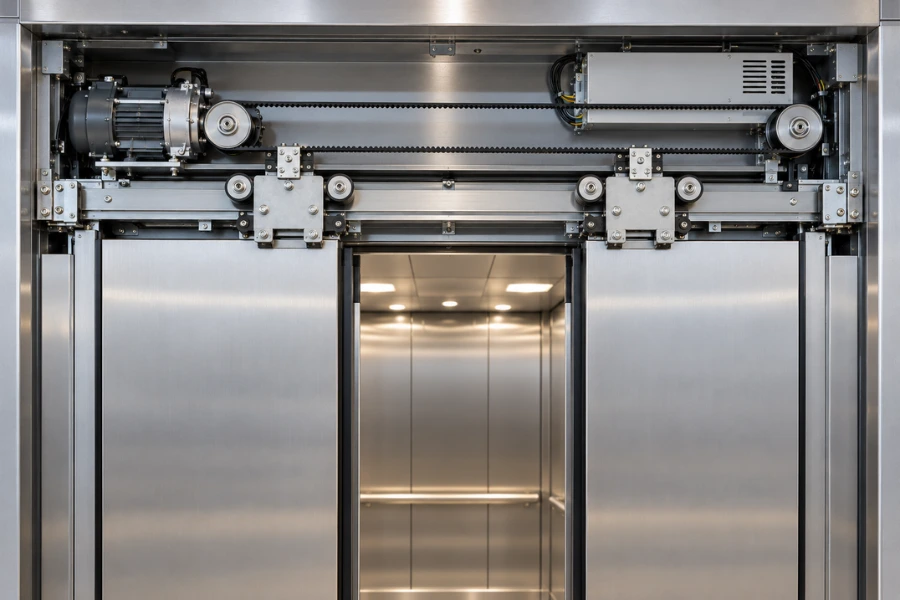
An elevator door operator is the powered mechanism that moves the elevator car door in response to commands from the elevator control system. It normally combines a drive motor with transmission and control components that regulate door speed, direction, acceleration, deceleration, and stopping position.
The operator is only one part of the complete elevator door system. Other elements include the car and landing doors, hangers, rollers, tracks, coupling mechanism, landing-door locks, and entrance protection devices.
This distinction matters during diagnosis. A door that does not open, close, or move smoothly may have a problem in the operator, door mechanics, coupling system, safety devices, or control circuit.
How Does an Elevator Door Operator Work?
When the elevator reaches a landing and the control system permits door operation, the door operator controller receives an opening command and drives the motor through a defined motion profile.
The motor transfers rotation through a belt, pulley, linkage, or other transmission arrangement. In feedback-controlled systems, an encoder or other position-feedback device provides information used to regulate door movement as the panels accelerate, travel, decelerate, and stop.
During closing, the same system controls the reverse motion while the door safety system monitors the entrance. The elevator control and safety system must confirm the required door conditions before normal travel is permitted.
How Does the Car Door Open the Landing Door?
The operator normally drives the car door rather than independently powering the landing door. When the car reaches the appropriate landing position, a coupling mechanism on the car door engages the landing-door mechanism.
Depending on the design, a door vane or clutch interacts with rollers associated with the landing-door lock mechanism. This allows the landing door to be released under the intended operating conditions and move together with the car door.
The mechanical sequence can be simplified as:
Door motor → transmission → car door → door vane or clutch → landing-door roller and lock mechanism → landing door
This sequence explains an important diagnostic distinction. If the car door moves but the landing door does not, the operator motor may be functioning normally. The coupling mechanism, landing-door lock, rollers, or their adjustment may require inspection instead.
Main Operator Components and Related Door Mechanisms
Exact construction varies by manufacturer and elevator design, but door operator systems generally combine drive, transmission, control, and feedback functions.
| Component or mechanism | Main function |
|---|---|
| Door motor | Produces the torque needed to move the door |
| Door controller | Receives commands and controls motor speed, direction, and motion profile |
| Belt, pulley, or transmission | Transfers motor movement to the door mechanism |
| Encoder or position feedback | Provides position or speed information where used |
| Door hangers and rollers | Support and guide door-panel movement |
| Door vane or clutch | Couples the car door with the landing-door mechanism |
| Wiring and interfaces | Connect the operator with the elevator control system |
Light curtains, safety edges, landing-door interlocks, and door contacts also interact with door operation. They belong to the broader door and safety system rather than automatically being treated as internal operator components.
This distinction helps prevent an incorrect component replacement when the actual problem lies elsewhere in the door system.
What Types of Door Operators Are Used?
Door operators can be classified from different engineering perspectives. Opening configuration describes how the panels move, while drive and control technology describes how that movement is produced and regulated.
By Door Opening Configuration
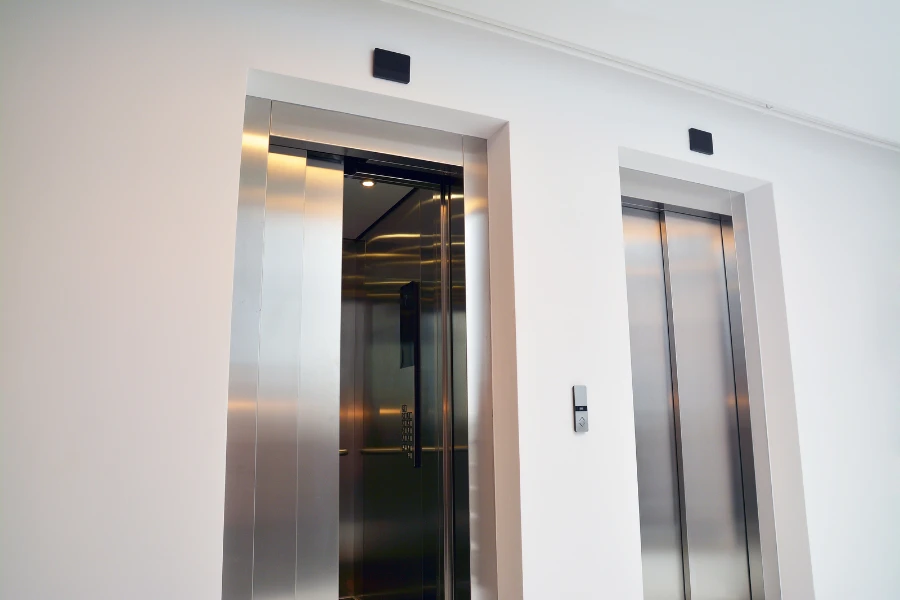
Center-opening doors use panels that move away from the center in opposite directions. This arrangement is widely used for passenger elevators where the entrance and shaft dimensions support a symmetrical opening.
Side-opening doors move toward one side. They can suit layouts where the available entrance or shaft arrangement makes a center-opening configuration less practical.
Telescopic doors use multiple panels that move in the same general direction through a coordinated mechanism. They can provide the required clear opening where lateral space is restricted, although the additional moving elements require appropriate synchronization and adjustment.
The selection depends on entrance dimensions, available shaft space, required clear opening, panel arrangement, and building use rather than on the opening configuration alone.
By Drive and Control Technology
Older elevators may use conventional AC or DC door-drive arrangements. Modern systems can use variable-speed control and feedback-based motion regulation to manage acceleration, operating speed, deceleration, and stopping position.
Permanent magnet synchronous or brushless motor designs may also be used depending on the operator architecture. Motor technology alone does not determine whether an operator is suitable for a particular project.
For example, center-opening describes door geometry, while a variable-frequency operator describes drive and control technology. These are separate selection dimensions.
How to Choose the Right Door Operator
Selection should begin with the complete door and elevator configuration rather than motor power alone. The operator must move the actual door assembly, fit the available installation space, communicate with the elevator control system, and meet the expected operating duty.
| Selection factor | Engineering relevance |
|---|---|
| Door opening type | Determines the required linkage and motion arrangement |
| Clear opening width | Determines panel travel and affects the motion profile |
| Number of panels | Changes transmission and synchronization requirements |
| Door-panel mass | Influences torque and motion-control requirements |
| Door travel | Determines how far the panels must move |
| Traffic frequency | Influences duty-cycle requirements |
| Available installation space | Limits the physical operator arrangement |
| Controller interface | Must match the elevator control architecture |
| Feedback method | Affects position and motion control |
| Safety interface | Must coordinate with applicable protection devices |
| Operating environment | Dust, moisture, temperature, and contamination can affect components |
| Existing door equipment | Determines compatibility during replacement or modernization |
Building use changes the relative importance of these factors. A busy commercial elevator may require frequent door cycles, while hospital applications can place greater emphasis on entrance dimensions and controlled movement for beds and medical equipment. Freight applications can involve larger door assemblies and more demanding operating conditions.
For modernization projects, the existing car door, landing-door mechanism, controller interface, available installation space, and safety circuits should be checked before specifying a replacement operator.
Common Door Operator Problems and Troubleshooting
Troubleshooting should distinguish the operator from the surrounding door mechanics and safety circuits. Replacing the motor or controller before checking mechanical resistance, coupling, or protection devices can leave the original problem unresolved.
| Symptom | Possible causes | What to check |
|---|---|---|
| Door does not open | Control or motor fault, transmission problem, mechanical binding | Controller status, motor, belt or linkage, track |
| Door does not close | Obstruction signal, safety-device activation, mechanical resistance | Light curtain, safety edge where fitted, rollers, track |
| Door repeatedly reopens | False obstruction detection, excessive resistance, misalignment | Entrance protection, track, rollers, door alignment |
| Jerky door movement | Belt or transmission condition, worn rollers, feedback problem | Belt, rollers, pulleys, encoder or feedback |
| Abnormal noise | Contamination, worn rollers, loose components, poor alignment | Track, rollers, fasteners, transmission |
| Car door moves but landing door does not | Coupling or landing-door lock problem | Door vane or clutch, rollers, landing-door lock mechanism |
| Door closes too hard or too slowly | Parameter error, excessive resistance, feedback problem | Controller settings, mechanical drag, feedback system |
A practical diagnostic sequence starts with visible mechanical conditions before moving deeper into electrical diagnosis. Check for debris, damaged components, abnormal friction, roller condition, transmission condition, and alignment. If those conditions are satisfactory, review control signals, feedback, wiring, and controller faults.
The exact procedure should follow the elevator and door-operator manufacturer’s service documentation. Safety-related components should not be bypassed to force normal operation during diagnosis.
What Should Be Checked During Door Operator Maintenance?
Door operator maintenance should cover mechanical condition, control performance, and interaction with the safety system.
Mechanical Checks
Inspect the door track, hanger rollers, transmission belt or linkage, fasteners, and door vane or clutch arrangement. Increasing resistance or misalignment can change door movement and increase mechanical loading before a complete failure occurs.
Electrical and Control Checks
Inspect relevant wiring and connectors, motor condition, controller fault information, and encoder or position-feedback signals where fitted. Changes in door travel can indicate a feedback or adjustment problem rather than a failed motor.
Safety and Door-System Checks
Entrance protection devices, door contacts, and landing-door interlocks must operate correctly with the door system. Inspection and testing should follow the elevator manufacturer’s maintenance instructions and applicable local requirements.
Should a Door Operator Be Repaired or Replaced?
Not every door problem requires complete operator replacement. Worn rollers or belts, loose connections, alignment problems, and certain adjustment or calibration issues may be repairable while the existing operator remains serviceable.
Replacement or modernization becomes more relevant when faults recur across multiple components, the controller or operator is obsolete, compatible replacement parts are difficult to obtain, or the existing system cannot integrate with the planned elevator modernization.
The surrounding door system should be assessed at the same time. A new operator will not automatically correct worn landing-door mechanisms, poor track alignment, damaged rollers, or incompatible locks.
Conclusion
Reliable elevator door operation depends on the interaction between the operator, car-door mechanics, landing-door coupling, feedback system, and safety devices. A door-related problem can therefore originate in several parts of the system rather than in the operator itself.
For new installations and modernization projects, EKCNE evaluates door configuration together with the wider elevator mechanical and control system to support project-compatible vertical transportation solutions and long-term component compatibility.












