
Elevator energy saving technologies should be selected around how an elevator operates. Drive efficiency, car load, travel distance, traffic frequency, standby time, and control strategy shape the elevator energy consumption profile.
A high-rise office elevator making frequent long trips has different energy-saving opportunities from a residential elevator that remains idle for hours. Identifying where energy is consumed helps determine which technologies are worth evaluating.
Where Does Elevator Energy Consumption Come From?
Elevator energy use can be divided broadly into running energy and standby energy.
Running energy comes mainly from the traction system and equipment active during a trip. Travel distance, car load, direction, motor and drive efficiency, door operation, and traffic frequency influence this demand.
Elevator standby power comes from controllers, communication equipment, displays, lighting, ventilation, and other systems that remain energized while the car is idle. In low-use elevators, these continuous loads can become an important part of total consumption.
This distinction helps project teams determine whether to prioritize drive efficiency, energy recovery, standby reduction, or traffic optimization.
How Elevator Load and Counterweight Affect Energy Use
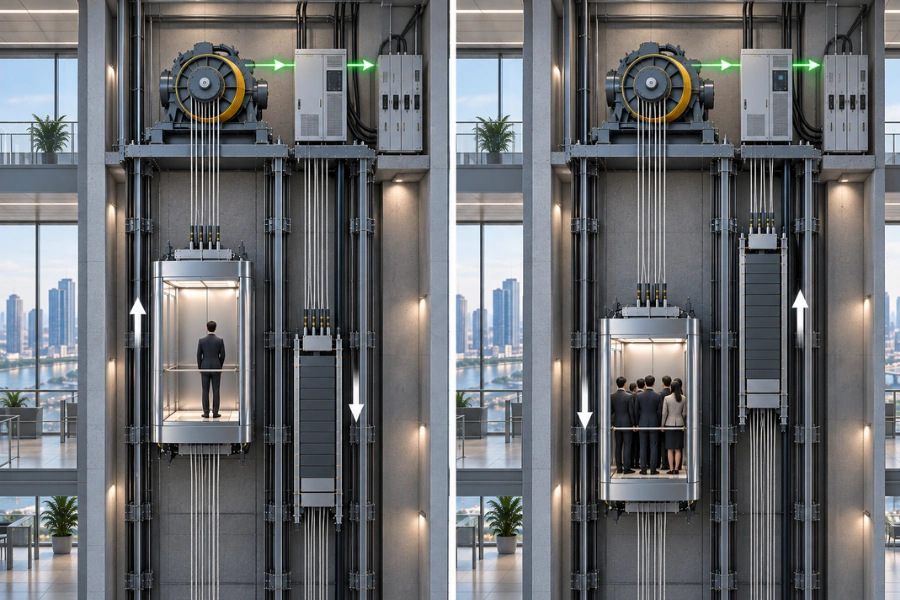
A traction elevator doesn’t simply lift the entire weight of the car on every upward trip. The car and counterweight are connected through the traction system so that one side partially balances the other.
A typical counterweight balances the empty car plus part of its rated load. The traction machine primarily manages the imbalance between the two sides, together with friction and other system losses.
This arrangement also explains why a traction elevator can generate energy.
When a lightly loaded car travels upward, the heavier counterweight can help pull it up. When a heavily loaded car travels downward, gravity can drive the car. Under suitable conditions, the motor is mechanically driven and operates as a generator.
Traditional drive arrangements may dissipate this braking energy through resistors as heat. Regenerative drives provide a way to recover usable electrical energy instead.
Key Elevator Energy Saving Technologies
Energy-saving elevator technologies target different sources of consumption, from mechanical and drive losses to braking energy, idle loads, and unnecessary elevator trips.
Permanent Magnet Gearless Traction Machines
Permanent magnet synchronous motors, or PMSMs, are widely used in modern gearless traction elevators.
Traditional geared machines transmit motor torque through a gearbox before reaching the traction sheave. A gearless system removes this intermediate transmission stage, reducing mechanical transmission losses and eliminating gearbox lubrication requirements.
PMSMs also support precise torque and speed control when integrated with modern drives. Their compact structure makes them suitable for many conventional and machine-room-less traction systems.
Actual energy performance still depends on motor sizing, rated load, roping, travel, traffic, and control strategy. In modernization projects, compatibility must also be checked beyond the traction machine itself.
VVVF Drive Control
Variable voltage variable frequency, or VVVF, control manages elevator motor operation through acceleration, travel, deceleration, and leveling.
Older two-speed systems switch between fixed motor speeds. During the transition from high to low speed, the motor can enter a regenerative braking condition, while resistive or reactive components limit braking current.
VVVF drives instead regulate the voltage and frequency supplied to the motor. This provides more precise control of motor speed and torque, enabling smoother speed curves and accurate leveling.
VVVF shouldn’t be confused with regenerative energy recovery. A VVVF drive can control motor operation without necessarily returning generated electricity to the building.
Regenerative Drives
Regenerative drives recover energy when the traction system enters a generating condition.
With a lightly loaded car traveling upward, a heavier counterweight can descend and mechanically drive the motor. A heavily loaded car descending can create another generating condition.
In a conventional braking system, generated electrical energy may be converted into heat through a braking resistor. A regenerative energy recovery system can instead process usable power and return it to the building electrical system, depending on the drive and electrical configuration.
This also reduces heat that would otherwise be released through braking resistors.
When Regenerative Drives Make the Most Sense
The value of regeneration depends on how often generating conditions occur.
High-rise elevators with long travel, frequent operation, and suitable load patterns may provide more opportunities to recover braking energy than low-use residential elevators.
Traffic frequency, travel height, load distribution, operating hours, and electrical infrastructure should therefore be evaluated before specifying regenerative technology.
Standby and Sleep Modes
Standby management targets energy consumed when the elevator isn’t moving.
Modern controllers can place selected systems into reduced-power states after a defined idle period. Lighting, ventilation, displays, and compatible auxiliary equipment can be switched off or reduced until another call is received.
This control logic is especially relevant where elevators spend long periods idle, because elevator standby power represents a larger share of their overall energy consumption.
Destination Dispatch and Group Control
In buildings with multiple elevators, energy consumption also depends on how passenger demand is distributed among cars.
Destination dispatch and intelligent group control analyze calls and traffic patterns to assign elevators more strategically. Better elevator traffic management can reduce unnecessary trips and stops while improving passenger handling.
The opportunity varies with building traffic. Office towers may have concentrated arrival and departure peaks, hotels combine guest and service traffic, and mixed-use developments may have several traffic patterns operating simultaneously.
Traffic analysis can determine whether dispatch optimization is likely to improve handling efficiency and reduce unnecessary elevator movement.
LED Lighting and Efficient Auxiliary Systems
Component-level upgrades can reduce electricity demand outside the main traction system.
LED lighting reduces cabin lighting power and generally provides longer service life than older lighting technologies. Efficient ventilation equipment, door drives, indicators, and other auxiliary devices can provide additional incremental reductions.
Because these changes require less intervention than traction-system replacement, they are practical options for limited-scope elevator modernization.
Energy Storage Systems
Regenerated elevator energy doesn’t always have to be returned immediately to the building electrical network.
Energy storage systems such as supercapacitors can capture electrical energy during generating conditions and make it available for later supported functions or elevator operation.
Local storage suitability depends on the operating profile, drive architecture, storage capacity, power requirements, and electrical infrastructure. Grid regeneration and local storage should therefore be evaluated as different energy management strategies.
Which Technologies Fit Different Building Types?
The appropriate elevator energy saving technologies depend on the building’s traffic and operating profile.
| Building Condition | Main Energy Consideration | Technologies to Evaluate |
|---|---|---|
| High-rise office | Frequent trips and long travel | PMSM, VVVF, regenerative drive, destination control |
| Residential tower | Variable traffic and idle periods | Gearless traction, VVVF, standby management, LED |
| Hotel | Passenger and service traffic | Efficient drives, group control, standby management |
| Low-use residential | Long idle periods | Standby control, LED, efficient auxiliary systems |
| Existing older elevator | Legacy drive and controls | Drive and controller modernization, standby functions, LED |
| Multi-elevator development | Car allocation and traffic flow | Group control, destination dispatch, efficient traction |
These are evaluation directions rather than fixed specifications. Building height, rated load, number of stops, traffic demand, shaft conditions, electrical infrastructure, and lifecycle requirements determine the final system configuration.
Energy Saving in New Elevators vs Modernization
New elevator projects allow the traction machine, VVVF drive, controller, standby functions, traffic strategy, and electrical interface to be coordinated during system design.
Elevator modernization begins with existing equipment and interfaces. Before changing the traction or drive system, project teams should evaluate the motor, controller, encoder, brake, electrical supply, shaft arrangement, remaining equipment life, and maintenance requirements.
An older installation with inefficient drive and control equipment may justify broader modernization, while another system may achieve useful improvements through standby management and auxiliary upgrades without replacing the complete traction system.
How to Evaluate Elevator Energy Efficiency for a Project
Energy-saving decisions should begin by establishing the building’s elevator energy consumption profile.
Key factors include:
- Building height and travel distance
- Rated load and expected passenger loading
- Number of elevators and stops
- Daily trips and operating hours
- Peak and off-peak traffic
- Existing traction and drive systems
- Average idle periods
- Electrical infrastructure
- Installation or modernization constraints
- Maintenance and lifecycle requirements
These inputs identify whether the main opportunity lies in traction efficiency, braking energy recovery, standby reduction, or elevator traffic management.
The objective is to match the energy-saving strategy to the operating conditions rather than maximize the number of efficiency features installed.
Elevator Energy Efficiency Is a System-Level Decision
Elevator energy saving technologies should be evaluated against the building’s traffic profile, travel, load conditions, standby periods, and existing system architecture. High-traffic projects may provide greater opportunities for regenerative recovery and traffic optimization, while low-use elevators may benefit more from standby reduction.
For new construction or modernization, EKCNE can help project teams evaluate these operating conditions and system interfaces to determine an elevator configuration suited to the building’s actual requirements.












