
An elevator dispatching algorithm determines which car should respond to a passenger request and how that request fits into existing stops. In a multi-elevator building, each assignment changes not only the current passenger’s wait but also car availability for subsequent calls.
This makes dispatching sensitive to traffic conditions. The same office elevator group may face concentrated lobby departures in the morning, inter-floor movement at midday, and down-peak traffic in the evening, requiring the controller to continually reevaluate how calls are served.
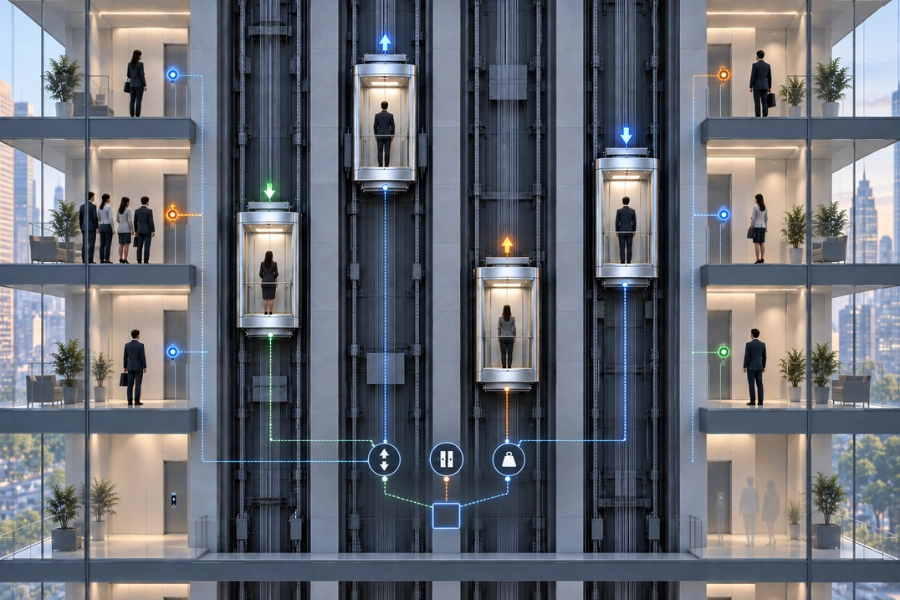
What Does an Elevator Dispatching Algorithm Do?
Elevator dispatching algorithms, also discussed as elevator scheduling algorithms, prioritize and assign passenger requests.
In a group system, the controller may determine:
- Which elevator should answer a new hall call
- Whether a moving car should accept another stop
- Which calls should receive priority
- When a car should continue or reverse direction
- Where idle cars should wait for future demand
- How cars can avoid duplicating service
Dispatching is different from motion control. The dispatching layer selects the service action, while the drive and control systems execute it through acceleration, travel, deceleration, leveling, and door operation.
A simplified control flow is:
Passenger request → dispatching decision → car assignment → elevator movement → stop and door operation → updated system state
For elevator groups, this supervisory layer becomes part of the building’s elevator traffic management strategy.
Why Elevator Dispatching Is a Multi-Objective Problem
Average waiting time alone cannot describe dispatching performance. A controller may also need to consider journey time, long-wait frequency, intermediate stops, car loading, handling capacity, elevator utilization, energy consumption, and fairness between calls.
These objectives can conflict. A strategy that repeatedly serves easy-to-reach calls may lower the average response time while allowing less convenient calls to accumulate excessive waits.
Some optimization methods therefore penalize long waits more heavily rather than treating every additional second equally. The dispatching objective becomes a balance between passenger service and elevator-group efficiency rather than the minimization of one isolated metric.
Traffic Patterns Change the Dispatching Problem
Passenger demand varies in both volume and direction.
Up-peak traffic concentrates movement from the main lobby toward upper floors, while down-peak traffic concentrates movement toward the exit floor. Inter-floor traffic occurs mainly between upper floors, and mixed traffic combines several origin-destination patterns.
These categories are useful for traffic analysis but do not create rigid operating periods. During transitions, several patterns can overlap, so a strategy optimized around one fixed pattern may lose effectiveness when the passenger distribution changes.
Classical Elevator Dispatching Algorithms
Traditional dispatching uses rules or heuristics that make decisions from a limited set of system states.
| Algorithm | Basic Logic | Main Advantage | Main Limitation |
|---|---|---|---|
| FCFS | Serve requests in arrival order | Preserves request order | Ignores travel efficiency |
| SSTF / Nearest Car | Favor the closest suitable request or car | Reduces immediate travel distance | Can produce long waits for other calls |
| SCAN | Continue serving calls in one direction before reversing | Provides directional service logic | Can involve unnecessary travel |
| LOOK | Reverse when no further request exists ahead | Avoids travel to an unused endpoint | Still follows fixed directional rules |
| ETA-Based Dispatch | Compare predicted arrival times of candidate cars | Accounts for scheduled movement | Depends on prediction accuracy |
Physical distance alone is often insufficient for car assignment. A car one floor away may already have several scheduled stops, while a farther car with a clearer route can reach the passenger sooner.
ETA-based dispatch addresses this difference by estimating actual arrival time rather than comparing floor distance alone. SCAN and LOOK address another dimension by organizing calls around travel direction, providing useful foundations for understanding elevator scheduling.
How Elevator Group Control Changes Dispatching
A single elevator mainly needs to determine its next service action. An elevator group must also decide which car should receive each request without reducing the future availability of the group.
For example:
- Car A is nearby but already has several stops
- Car B is farther away but lightly loaded
- Car C is moving in the opposite direction
Assigning Car A because it is nearest may increase rather than reduce the passenger’s actual wait.
An Elevator Group Control System can evaluate car position, direction, assigned stops, car calls, hall calls, and other available operating information. This higher-level coordination is often described as group supervisory control.
The number of possible assignments grows as floors, cars, calls, and operating states increase. New passengers also arrive while existing assignments are being executed, so each decision affects the state in which later decisions will be made.
Elevator group dispatching is therefore a sequential decision problem rather than a series of independent nearest-car selections.
Immediate Assignment vs. Delayed Assignment
Dispatching strategies can also differ in when a request becomes committed to a car.
Immediate Assignment
The controller assigns a car when the request is registered. The assignment becomes clear early, but subsequent calls and changes in car conditions have less opportunity to influence the decision.
Delayed Assignment
The controller retains assignment flexibility and continues evaluating the group until the last feasible point for changing the decision.
The engineering trade-off is assignment certainty versus optimization flexibility. Whether delayed reassignment is useful depends on the controller architecture, available passenger information, and how assignments are communicated to passengers.
How Destination Control Changes Elevator Dispatching
A conventional up-down hall call provides limited information. Before boarding, the controller normally knows the requested direction but not the passenger’s destination floor.
Destination control moves destination registration ahead of boarding:
Destination registration → passenger grouping → car assignment → stop sequence → passenger delivery
Knowing destinations earlier changes the information available to the dispatcher. Passengers traveling toward compatible floors can be grouped into the same car, allowing the controller to consider expected stops and trip distribution before the passengers enter.
Destination control can also interact with access-control systems when passenger credentials determine permitted floors. Its practical value therefore depends not only on dispatching logic but also on lobby operation, passenger behavior, building population, access requirements, and system integration.
Intelligent Elevator Dispatching Algorithms
As the number of possible elevator-group states increases, computational methods can evaluate relationships that are difficult to express through a small set of fixed rules.
Fuzzy Logic
Fuzzy control can combine variables such as waiting time, loading, traffic intensity, and distance without requiring hard thresholds for every condition. It is useful where dispatching decisions depend on degrees of urgency or suitability rather than binary rules.
Genetic Algorithms
Genetic algorithms search among candidate car-call assignments and evaluate them against defined objectives. Their role is to explore combinations that would be cumbersome to enumerate through fixed dispatching rules.
Neural Networks
Neural networks can approximate relationships between elevator-group states and expected dispatching outcomes. Their performance depends on how system state is represented and whether the required operating information is actually available.
Reinforcement Learning
Reinforcement learning models dispatching as repeated interaction between the controller and the elevator system:
System state → dispatching action → operating outcome → reward → policy improvement
Rather than evaluating only the immediate call, the learned policy can account for how a current assignment changes later system states. Research has also examined traffic-pattern-aware models intended to operate across changing or overlapping traffic conditions.
Why AI Does Not Automatically Mean Better Dispatching
Algorithm complexity cannot compensate for missing or unreliable operating information. A conventional hall call may indicate that somebody is waiting without telling the controller how many passengers are present, while a research simulator may expose passenger counts and arrival information directly.
Traffic prediction creates another limitation. Tenant schedules, access restrictions, events, and occupancy changes can alter passenger flows, and transition periods may not match the discrete traffic categories used during model development.
Deployment also imposes constraints that simulation can simplify. An installed dispatcher must work with the actual sensors, controller, communication architecture, registered car calls, door states, car movement, and service obligations of the elevator system.
Dispatching performance therefore depends on the combination of control strategy, traffic data, elevator-group configuration, sensing capability, and system architecture. A more sophisticated algorithm is useful only when the installed system can provide the information and control flexibility it requires.
Which Dispatching Strategy Fits Different Buildings?
Building use changes both the traffic pattern and the dispatching objective.
| Building Type | Typical Traffic Challenge | Dispatching Priority |
|---|---|---|
| Residential | Random and mixed passenger movement | Balanced response across floors |
| Office | Concentrated arrival and departure peaks | Group coordination and traffic adaptation |
| Hotel | Lobby traffic plus inter-floor movement | Waiting time and stop management |
| Hospital | Passenger, staff, bed, and priority transport | Service priority and operational reliability |
| High-rise building | Long travel distances and concentrated demand | Group efficiency and traffic distribution |
These priorities do not prescribe a single algorithm. Two office buildings of similar height may need different strategies because of differences in population, floor distribution, elevator quantity, tenant schedules, or access-control requirements.
What Project Teams Should Evaluate
A dispatching strategy should be evaluated against the building transportation problem rather than selected by algorithm name.
Key project inputs include:
- Building height and served floors
- Number, capacity, and speed of elevators
- Population and origin-destination distribution
- Peak passenger arrival patterns
- Required handling capacity
- Acceptable waiting and journey times
- Destination control requirements
- Access-control integration
- Available passenger and load information
- Controller and communication architecture
- Modernization constraints
- Maintenance and long-term system support
For modernization projects, existing hardware can narrow the available options. Controllers, hall-call devices, position sensing, communication networks, and passenger-data availability determine whether advanced dispatching functions can be added directly or require broader control-system upgrades.
Final Takeaway
Effective elevator dispatching is a building traffic and control-integration problem, not simply an algorithm-selection exercise.
Classical heuristics, group control, destination dispatch, and learning-based approaches use different information and decision mechanisms. Their practical value depends on whether those mechanisms match the building’s passenger flows, elevator configuration, sensing capability, and control architecture.
For project owners, contractors, and distributors, dispatching should therefore be considered during overall vertical transportation planning. EKCNE supports project-oriented elevator configuration and building compatibility analysis based on traffic demand, control requirements, installation conditions, and long-term operation.












