
Key Takeaways
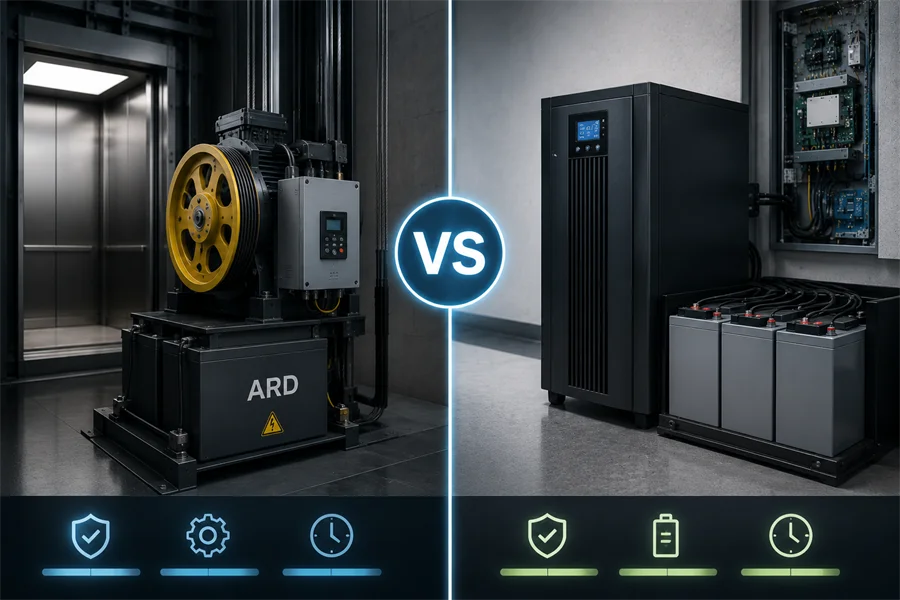
- Elevator ARD systems and UPS systems are not direct replacements for each other. They operate at different layers of building emergency power architecture.
- ARD systems focus on controlled passenger rescue during power interruption, while UPS systems mainly support temporary electrical continuity for selected control and monitoring circuits.
- In modern high-rise buildings, ARD systems and UPS infrastructure are often coordinated together rather than treated as competing solutions.
- UPS-supported continuity commonly maintains PLC logic, controller stability, relay coordination, communication systems, and monitoring infrastructure during outage transition.
- Emergency backup strategy depends on building type, outage risk, generator coordination, modernization compatibility, and emergency transportation priorities.
Why Elevator Backup Power Strategy Matters
Modern buildings depend heavily on continuous vertical transportation.
When a power interruption occurs, elevators may stop operating immediately, creating transportation disruption throughout the building.
In smaller low-rise buildings, the operational impact may remain manageable for short periods.
In high-rise towers, hospitals, airports, hotels, transportation hubs, and mixed-use developments, electrical interruption can quickly affect:
- Passenger circulation
- Accessibility continuity
- Emergency evacuation behavior
- Building operation stability
- Transportation coordination
- Emergency response efficiency
In some large commercial buildings, emergency transportation continuity becomes part of overall building resilience planning rather than a simple elevator equipment issue.
This is where discussions around elevator ARD systems and UPS infrastructure become important.
Many building owners mistakenly assume these systems perform the same function.
In reality, they operate at different layers of emergency electrical architecture.
Get Elevator ARD Solution Now >>
What an Elevator ARD Actually Does
An elevator ARD, or Automatic Rescue Device, is designed to help the elevator complete controlled rescue operation during a power interruption.
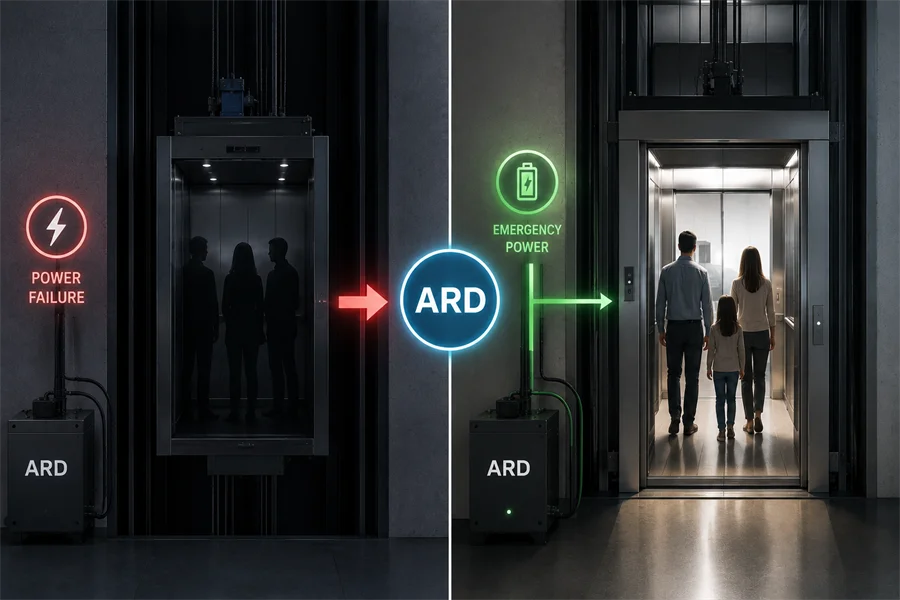
The system coordinates emergency movement behavior so passengers can exit the elevator safely after an outage.
Modern ARD systems typically coordinate:
- Rescue activation logic
- Emergency power switching
- Traction coordination
- Controlled low-speed rescue operation
- Leveling confirmation
- Door release control
The goal is not long-term elevator transportation operation.
The goal is controlled passenger evacuation under abnormal electrical conditions.
In modern installations, ARD functionality is often integrated directly into digital traction control architecture rather than treated as an isolated add-on device.
What a UPS Actually Does
A UPS, or Uninterruptible Power Supply, is designed to maintain temporary electrical continuity during utility power interruption.
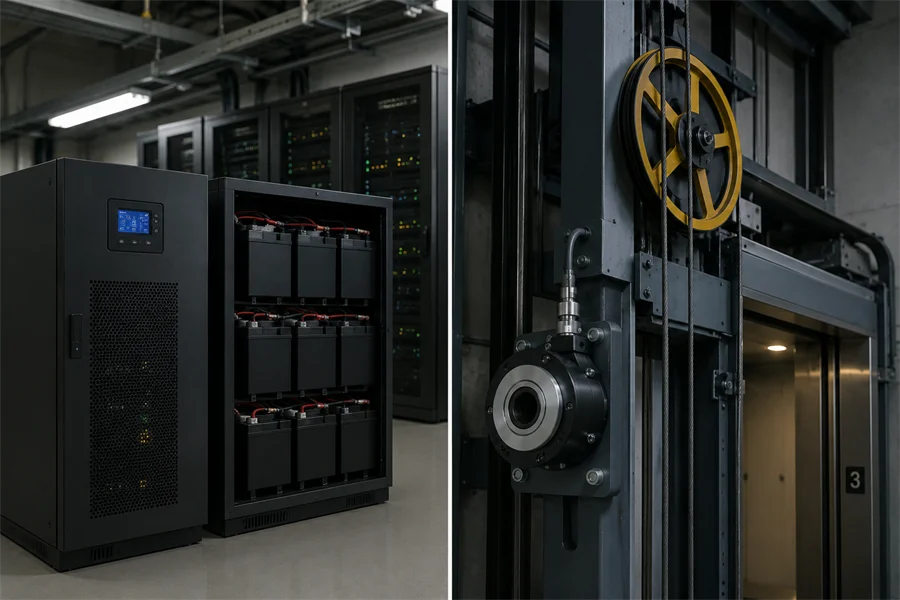
Unlike ARD systems, UPS infrastructure does not primarily focus on elevator rescue movement.
Instead, UPS systems commonly support:
- PLC controllers
- Elevator monitoring systems
- Communication circuits
- Emergency lighting
- Safety control circuits
- Network equipment
- Building monitoring infrastructure
In many buildings, UPS systems operate as transitional electrical support during the interval between utility power loss and emergency generator startup.
This distinction is critical.
UPS systems usually support control continuity rather than sustained traction propulsion.
A UPS may help keep selected elevator electrical systems active during outage transition, but that does not automatically mean the elevator can continue normal passenger transportation operation.
ARD vs UPS — Different Roles Inside Emergency Power Architecture
The most common misunderstanding is assuming ARD and UPS systems compete against each other.
In reality, modern buildings often use both systems together.
Their functions are different.
ARD Focus
ARD systems primarily handle:
- Passenger rescue coordination
- Controlled emergency movement
- Elevator evacuation logic
- Emergency traction behavior
UPS Focus
UPS systems primarily support:
- Temporary electrical continuity
- PLC stability
- Relay coordination
- Monitoring infrastructure
- Communication systems
- Transition bridging during outage events
This relationship becomes especially important in large buildings where electrical continuity strategy involves multiple emergency systems operating simultaneously.
Rather than replacing ARD systems, UPS infrastructure often supports portions of the overall rescue architecture.
Why UPS Usually Cannot Power Full Elevator Operation
One of the biggest industry misunderstandings is believing a standard UPS can simply keep elevators running normally during a power outage.
In reality, full elevator traction operation requires substantial electrical power.
Elevator traction motors, especially in high-rise systems, create much larger electrical loads than typical UPS systems are designed to support continuously.
For this reason, UPS infrastructure is commonly used for:
- Controller continuity
- PLC stability
- Logic protection
- Communication support
- Short-duration stabilization
rather than sustained traction movement.
In many installations, UPS-supported continuity focuses primarily on maintaining PLC logic stability and relay coordination during outage transition so the rescue system can complete controlled switching without controller interruption or communication reset.
The main traction power circuit may remain disconnected while the control system verifies:
- Power interruption status
- Safety circuit condition
- Relay coordination logic
- Emergency operation readiness
before rescue operation proceeds.
This selective backup strategy helps reduce:
- Battery sizing complexity
- System cost
- Thermal load
- Infrastructure footprint
- Long-duration maintenance burden
Control Circuits vs Traction Circuits — An Important Difference
Modern elevator emergency architecture separates control continuity from traction propulsion.
This distinction is extremely important.
During outage conditions, maintaining stable control logic may matter more initially than restoring traction movement immediately.
UPS-supported circuits commonly include:
- PLC logic
- Controller memory
- Relay circuits
- Monitoring systems
- Communication interfaces
- Alarm transmission circuits
Meanwhile, the main traction circuit may remain temporarily isolated until emergency conditions are verified.
In some older modernization projects, unstable relay switching or delayed contactor response can create additional transition problems during outage recovery.
This is one reason modern digital systems increasingly prioritize stable control continuity during emergency switching events.
Selective Backup Power Strategy in Modern Buildings
Modern emergency electrical design rarely attempts to provide backup power to every building system simultaneously.
Instead, engineers prioritize critical electrical loads.
During outage events, emergency electrical hierarchy becomes extremely important.
Typical priority systems may include:
- Fire protection systems
- Emergency communication
- Building monitoring
- Elevator rescue control
- Emergency lighting
- Access control systems
This selective strategy helps buildings maintain operational stability while controlling infrastructure complexity and emergency power demand.
In some high-rise projects, only designated elevators receive emergency rescue priority while other elevators remain temporarily unavailable until generator power stabilizes.
This type of prioritization is common in large transportation and commercial buildings.
How UPS Supports Elevator Control Continuity
UPS systems can still play an important role inside elevator infrastructure.
During outage transition, unstable voltage conditions may affect:
- PLC stability
- Controller logic
- Relay operation
- Monitoring communication
- Safety circuit continuity
UPS infrastructure helps maintain stable control behavior during this transition period.
In some systems, UPS-supported continuity helps prevent unnecessary controller restart sequences, communication interruption, or relay reset instability during short-duration power fluctuation.
This becomes especially useful in digitally integrated elevator systems where controller interruption may create longer recovery delays after utility power returns.
UPS-assisted continuity can also help maintain:
- Remote monitoring
- Fault logging
- Alarm communication
- Emergency dispatch communication
during outage conditions.
Utility Outage, UPS Bridging, and Generator Coordination
In larger buildings, emergency power infrastructure often involves more than ARD systems and UPS equipment alone.
A typical outage sequence may involve:
Step 1 — Utility Power Loss
The building loses normal utility electrical supply.
Step 2 — UPS Bridging Support
UPS systems temporarily maintain continuity for selected critical circuits.
This helps stabilize PLC logic, monitoring systems, and emergency control infrastructure during the transition period.
Step 3 — Generator Startup
Emergency generators begin startup procedures.
Generator synchronization and stabilization may require several seconds before full emergency distribution becomes available.
Step 4 — ATS Switching
Automatic Transfer Switches (ATS) redirect selected building loads to emergency generator supply.
Step 5 — Emergency Elevator Coordination
Designated elevator systems then continue operating according to the building’s emergency transportation strategy.
In some installations, the elevator may enter a controlled standby condition temporarily while the system verifies relay status, emergency supply stability, and operational readiness before rescue coordination begins.
This layered coordination architecture is common in high-rise commercial buildings, hospitals, airports, and public infrastructure projects.
Centralized vs Distributed Backup Architecture
Emergency backup strategy may also differ depending on whether the building uses centralized or distributed backup architecture.
Centralized Backup Strategy
Centralized systems may involve:
- Main UPS rooms
- Building-wide emergency panels
- Generator-fed emergency distribution
- Shared infrastructure management
These systems simplify centralized monitoring but may increase infrastructure complexity and installation cost.
Distributed Backup Strategy
Distributed systems may use:
- Elevator-specific rescue batteries
- Independent rescue modules
- Localized emergency support circuits
This approach may simplify elevator-specific rescue operation while reducing dependence on centralized infrastructure.
Different projects choose different strategies depending on:
- Building height
- Traffic density
- Infrastructure layout
- Maintenance philosophy
- Retrofit limitations
- Budget priorities
Modernization and Retrofit Challenges
Modernization projects often create additional complications for emergency power coordination.
Older elevator systems may contain:
- Relay-based controllers
- Outdated wiring architecture
- Limited cabinet space
- Incompatible control logic
- Aging rescue batteries
- Non-integrated electrical infrastructure
In some older buildings, emergency rescue systems may technically function correctly during testing while still developing intermittent switching instability during actual outage events because of aging relays, delayed contactor response, or degraded control continuity.
Retrofitting emergency power coordination may require:
- ATS modification
- Generator capacity review
- Electrical load reassessment
- PLC compatibility evaluation
- Additional monitoring integration
- Relay timing verification
In some projects, integrating modern UPS-supported control continuity into older elevator systems becomes more difficult than replacing portions of the traction equipment itself.
This is one reason emergency power planning should happen early during modernization design rather than after equipment selection has already been finalized.
Which Backup Strategy Is Better
There is no universal answer because ARD systems and UPS infrastructure solve different operational problems.
Buildings prioritizing passenger evacuation continuity typically require dedicated ARD functionality.
Buildings requiring broader electrical continuity may additionally deploy UPS infrastructure for:
- Communication stability
- Monitoring continuity
- PLC support
- Control circuit protection
- Generator transition stability
Large high-rise buildings often coordinate:
- ARD systems
- UPS infrastructure
- Emergency generators
- ATS switching
- Selective elevator prioritization
as part of a unified emergency electrical strategy.
The correct solution depends on:
- Building type
- Occupancy profile
- Elevator traffic conditions
- Electrical infrastructure
- Emergency operation expectations
- Modernization compatibility
Conclusion
Elevator ARD systems and UPS systems are not competing technologies.
They serve different functions inside modern building emergency infrastructure.
ARD systems focus on controlled passenger rescue operation during power interruption events.
UPS systems primarily support temporary electrical continuity for selected control and monitoring infrastructure during outage transition.
In modern buildings, these systems often work together alongside emergency generators, ATS switching systems, and selective backup power architecture.
As buildings become taller and elevator systems become more digitally integrated, emergency electrical coordination is becoming an increasingly important part of long-term building operational reliability.












