
Key Takeaways
- Elevator encoders and resolvers both provide motion feedback, but they support different traction control architectures and project priorities.
- Encoders integrate more naturally with modern VVVF systems, PM motors, and digital elevator controllers through direct digital feedback processing.
- Resolvers remain valuable in harsh operating environments where vibration, contamination, or unstable temperatures may affect long-term reliability.
- In modern passenger transportation systems, encoders are generally preferred because they improve digital integration, ride smoothness, and modernization flexibility.
- Resolver-based legacy systems can create additional retrofit complexity during PM motor upgrades and controller modernization projects.
Why Elevator Feedback Architecture Matters
Modern elevators rely on continuous motion feedback to maintain stable traction control.
The controller constantly compares commanded movement with actual motor behavior to regulate acceleration, deceleration, low-speed travel, and floor leveling correction.
When feedback becomes unstable, the entire traction system may begin behaving unpredictably.
Typical operational symptoms include:
- Repeated re-leveling near floor stops
- Low-speed vibration
- Jerky acceleration
- Delayed stopping response
- Unstable deceleration behavior
- Unexpected shutdowns caused by signal faults
These issues become especially noticeable in high-rise commercial buildings, hospitals, hotels, mixed-use developments, and transportation hubs where vertical transportation stability directly affects building operations.
Choosing between an elevator encoder and a resolver is therefore not simply a component comparison.
It is a decision about traction feedback architecture, system integration strategy, and long-term operational behavior.
Get Elevator Encoder Solution Now >>
What Encoders and Resolvers Actually Do in Elevator Systems
Both encoders and resolvers are used to detect:
- Motor speed
- Rotation direction
- Shaft position
- Real-time traction movement
The controller uses this feedback to regulate closed-loop traction behavior inside the elevator control system.
Modern elevators depend heavily on this feedback during:
- Distance-based deceleration
- Floor leveling correction
- PM motor synchronization
- Low-speed traction control
- Ride comfort optimization
Without stable feedback data, the controller cannot accurately maintain smooth acceleration curves or precise floor stopping behavior.
The primary difference lies in how the feedback information is generated and processed.
Elevator encoders generate digital pulse signals that can be processed directly by modern controllers and VVVF inverters.
Resolvers generate analog sine and cosine signals that must first pass through resolver-to-digital conversion hardware before the feedback can be used inside the traction control loop.
This difference affects:
- Integration complexity
- Commissioning behavior
- Signal processing architecture
- Modernization flexibility
- Environmental durability
- Lifecycle maintenance strategy
Encoder-Based Feedback Architecture
Modern elevator encoders rotate together with the traction motor shaft.
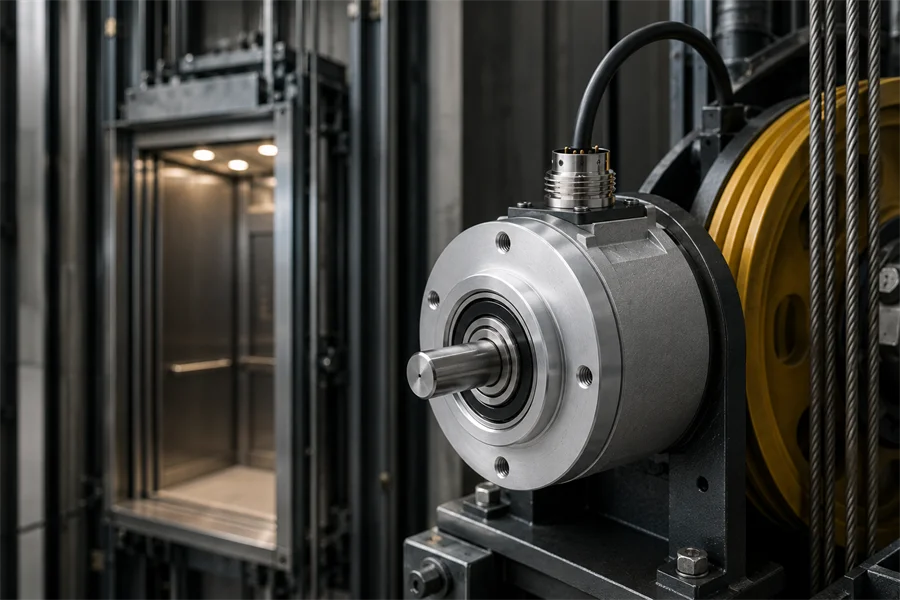
As the shaft rotates, optical or magnetic sensing elements generate digital pulse signals that allow the controller to calculate:
- Elevator speed
- Travel distance
- Car position
- Deceleration timing
- Leveling correction behavior
Because encoder output is already digital, modern VVVF systems can process the feedback directly without additional signal conversion stages.
This simplifies integration between:
- Inverter
- Elevator controller
- PM traction machine
- Digital monitoring system
Encoder-based systems are strongly associated with:
- High positioning precision
- Smooth low-speed operation
- Stable acceleration curves
- Precise leveling performance
- Improved passenger ride quality
Modern variable-frequency elevators can typically maintain floor leveling precision within approximately 5 mm when feedback quality remains stable.
This becomes especially important in accessibility-focused buildings and high-traffic commercial environments where stable passenger flow and smooth floor transitions matter operationally.
Resolver-Based Feedback Architecture
Resolvers work differently from encoder systems.
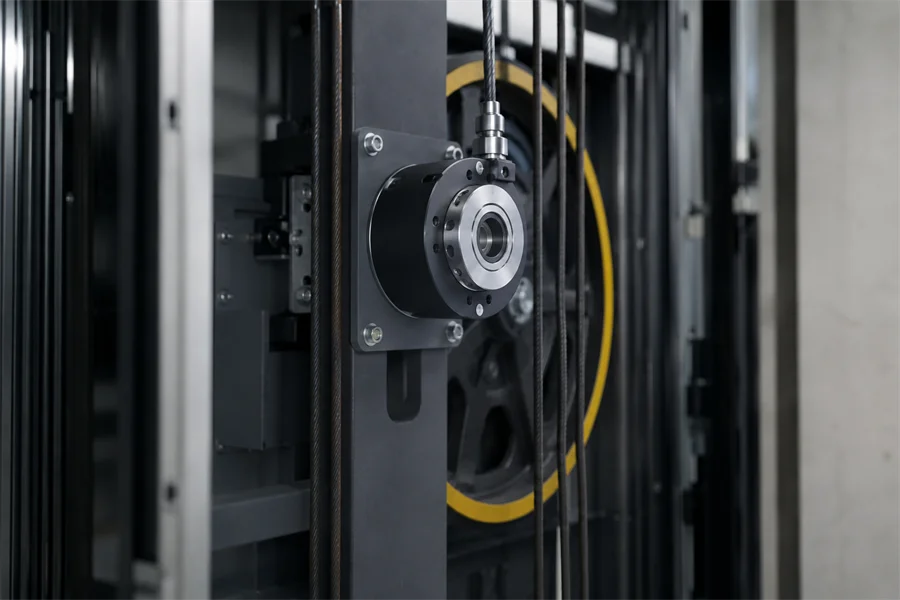
Instead of generating digital pulse signals, the resolver functions like a rotary transformer and produces analog sine and cosine signals according to shaft position.
Before the controller can process this information, the signals must pass through resolver-to-digital conversion hardware.
Resolver systems therefore involve:
- Additional conversion hardware
- More calibration during commissioning
- More tuning complexity inside digital control systems
However, resolver architecture provides a major advantage in environmental durability.
Because resolvers do not rely on delicate optical sensing structures, they tolerate:
- Vibration
- Oil contamination
- Dust exposure
- Temperature fluctuation
more effectively over long operating periods.
This is one reason resolvers still remain common in:
- Industrial freight elevators
- Heavy-duty lifting systems
- Outdoor lifting equipment
- High-contamination shaft environments
- Industrial mobility applications
In some industrial facilities, older resolver-based elevators continue operating reliably for years, which is one reason many building operators hesitate to fully migrate toward encoder-based architecture during modernization.
Encoder vs Resolver — Key Engineering Differences
| Factor | Elevator Encoder | Resolver |
|---|---|---|
| Signal Output | Digital pulse signals | Analog sine/cosine signals |
| VVVF Integration | Direct digital processing | Requires conversion hardware |
| PM Motor Compatibility | Excellent | Good but more complex integration |
| Positioning Precision | Higher-resolution feedback | Moderate positioning resolution |
| Ride Quality Optimization | Better low-speed refinement | Stable but less refined positioning |
| Commissioning Complexity | Simpler tuning and setup | Additional calibration required |
| Environmental Resistance | More sensitive to contamination | Extremely durable |
| Modernization Flexibility | Easier controller integration | Retrofit compatibility may be more complex |
| Typical Applications | Passenger elevators, MRL systems, high-rise projects | Industrial lifts, harsh environments |
The engineering trade-off is not simply “precision versus durability.”
The real difference involves how the feedback architecture fits into the overall elevator control strategy and operating environment.
Encoders simplify digital integration and motion refinement.
Resolvers prioritize environmental stability and long-term operational durability.
Why Modern PM Motor Elevators Usually Prefer Encoders
Most modern passenger elevators now use permanent magnet synchronous motors combined with encoder-based feedback systems.
This trend is closely related to the evolution of:
- Digital VVVF control
- Machine-room-less elevators
- Compact traction assemblies
- Advanced ride comfort requirements
- Building mobility optimization
Permanent magnet synchronous motors require highly accurate rotor position synchronization for stable electronic commutation.
Encoder feedback allows the inverter to continuously coordinate motor output with rotor position in real time.
This improves:
- Low-speed smoothness
- Deceleration stability
- Leveling precision
- Energy efficiency
- Passenger ride quality
In modern traction systems, even small feedback instability can affect low-speed operation near floor zones.
Some elevators continue operating normally at full travel speed while developing unstable leveling behavior during final deceleration. In many commissioning cases, engineers eventually trace the issue back to feedback instability rather than traction machine failure itself.
Because encoder systems integrate directly with digital control architecture, they also simplify communication between the inverter, controller, and traction machine.
This becomes increasingly important in high-rise passenger transportation systems where ride refinement and leveling consistency are heavily prioritized.
When Resolver Systems Still Make More Sense
Resolver-based feedback architecture still remains valuable in several elevator applications.
In harsh shaft environments, long-term durability may become more important than ultra-high positioning precision.
Resolvers are often preferred in projects involving:
- Severe vibration exposure
- Contaminated operating environments
- Large temperature variation
- Heavy industrial transportation
- Long-duration industrial operating cycles
In these environments, stable operation over long service periods may outweigh the advantages of higher-resolution encoder feedback.
Resolvers can also remain practical in some legacy modernization projects.
Older elevator systems were sometimes designed entirely around resolver architecture. Replacing only the traction machine may not eliminate compatibility constraints inside the inverter or control system.
As a result, modernization work may require broader evaluation of the existing feedback architecture than initially expected.
Elevator Modernization and Retrofit Challenges
Modernization projects often expose the largest practical differences between encoder and resolver systems.
In older elevators, engineers may encounter:
- Resolver-based legacy drives
- Incompatible controller protocols
- Outdated signal conversion hardware
- PM motor retrofit limitations
- Communication mismatch between old feedback systems and modern inverters
In some retrofit projects, replacing the feedback architecture becomes more difficult than replacing the traction machine itself.
This is especially common in older buildings where:
- Shaft space is limited
- Control cabinets are compact
- Machine room access is restricted
- Existing wiring infrastructure cannot easily support new architecture
Some modernization teams initially expect a simple traction upgrade, only to discover that the original resolver-based control system creates additional integration constraints.
These compatibility issues may increase:
- Commissioning time
- Tuning complexity
- Retrofit cost
- System downtime
- Long-term maintenance difficulty
This is one reason feedback architecture evaluation should happen early during modernization planning rather than after equipment selection.
Lifecycle Maintenance and Long-Term Reliability
Encoders and resolvers create different long-term maintenance requirements.
Encoder systems may require:
- Better environmental protection
- Cleaner installation conditions
- Stable grounding
- Proper cable shielding
- More attention to contamination control
Resolvers generally tolerate environmental stress more effectively over time.
However, resolver systems may also introduce:
- Additional signal conversion dependency
- More complicated troubleshooting
- Increased integration complexity
- More difficult modernization compatibility
Maintenance accessibility also becomes important.
In compact machine-room-less elevator systems, replacing feedback devices can become time-consuming because of limited access around integrated traction assemblies.
Long-term spare parts continuity is another important consideration for continuously operating commercial buildings where reducing downtime becomes operationally critical.
How to Choose Between an Elevator Encoder and Resolver
The correct choice depends on building conditions, traction architecture, modernization goals, and long-term operational requirements.
Elevator Encoder Is Usually Better If:
- The project uses modern VVVF traction control
- PM motors are involved
- High ride comfort is required
- Precise leveling matters
- Digital integration is prioritized
- Future modernization flexibility is important
Resolver May Be Better If:
- The environment involves severe vibration
- Shaft contamination is difficult to control
- Temperature fluctuation is significant
- Industrial durability is prioritized
- Existing resolver architecture must remain compatible
For most modern passenger transportation systems, encoders are generally preferred because they align more naturally with modern digital traction control architecture.
Resolvers remain highly valuable where environmental durability and long-term stability outweigh advanced positioning refinement.
Conclusion
Elevator encoders and resolvers perform the same core function, but they support different traction control priorities and project requirements.
Encoders provide high-resolution digital feedback that integrates efficiently with modern VVVF systems, PM motors, and advanced elevator control architecture.
Resolvers provide exceptional durability and stable operation in harsh environments where contamination, vibration, or temperature variation may affect long-term reliability.
In modern vertical transportation systems, the engineering question is not which technology is universally better.
The real question is which feedback architecture best matches:
- Building operating conditions
- Traction system design
- Modernization strategy
- Commissioning requirements
- Long-term maintenance planning
Evaluating feedback architecture early in a project can help reduce commissioning risk, simplify future modernization work, improve ride quality, and support long-term elevator lifecycle stability.












