
Key Takeaways
- Elevator encoders provide real-time motion feedback for modern traction control systems.
- In VVVF elevator systems, encoder stability directly affects ride comfort, floor leveling precision, and PM motor synchronization.
- Modern elevators use encoder signals not only for speed detection, but also for travel distance calculation, deceleration control, and real-time car positioning.
- Encoder installation errors, grounding problems, or signal interference can create repeated leveling correction, vibration, and unstable operation.
- In high-rise and machine-room-less elevator projects, encoder compatibility and long-term maintenance accessibility become increasingly important.
Why Elevator Encoders Matter in Modern Elevator Systems
Modern elevators depend heavily on closed-loop motion control.
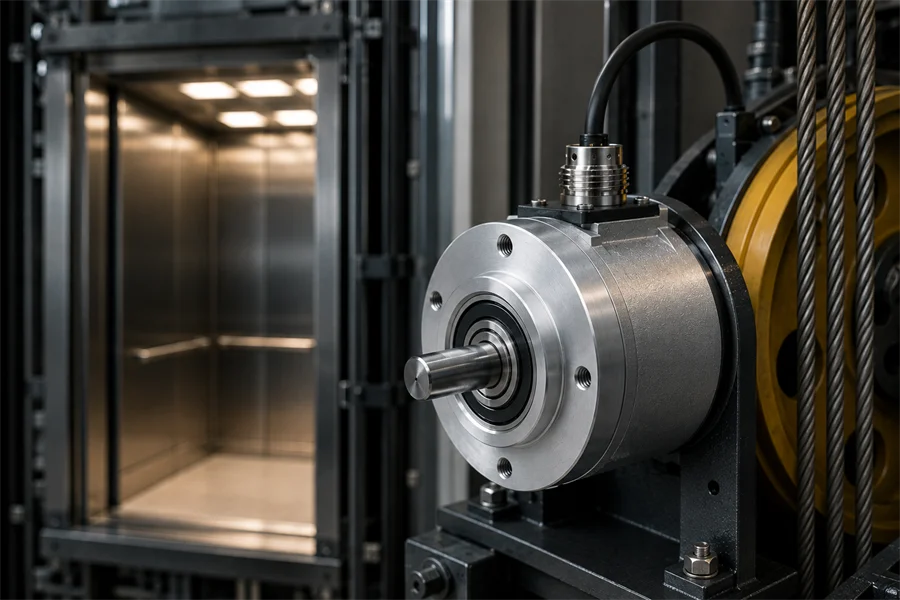
The controller continuously compares commanded movement with actual motor behavior. If the system cannot accurately detect motor speed and car position, smooth acceleration, stable deceleration, and precise floor stopping become difficult to maintain.
In many elevator projects, ride quality problems are not caused by the traction machine itself. The issue often originates from unstable feedback inside the motion control loop.
Typical operational problems include:
- Repeated re-leveling at floor stops
- Jerky startup or deceleration
- Delayed door opening caused by inaccurate leveling
- Increased motor current and overheating
- Passenger discomfort during low-speed travel
- Unexpected shutdowns triggered by feedback faults
These issues become more noticeable in hospitals, hotels, office towers, mixed-use buildings, and transportation hubs where traffic flow consistency directly affects building operations.
In practice, elevator performance is only as stable as the feedback system supporting it.
Get Elevator Encoder Solution Now >>
What Is an Elevator Encoder
An elevator encoder is a motion feedback device installed on the motor shaft or traction machine.
As the traction system rotates, the encoder generates electrical pulse or digital signals that allow the controller to calculate:
- Motor speed
- Rotation direction
- Travel distance
- Elevator car position
- Deceleration timing
- Floor leveling behavior
In older elevator systems, speed feedback was often handled through tachogenerators. Modern traction elevators now primarily use rotary encoders because they provide higher precision and better integration with VVVF control systems.
The encoder is not simply measuring rotation.
Inside a modern vertical transportation system, it functions as part of the elevator’s motion feedback infrastructure. The controller continuously relies on encoder signals to verify whether the elevator is actually following the intended acceleration curve, travel profile, and stopping logic.
This becomes especially important during distance-based deceleration and final floor leveling.
How Elevator Encoders Work
At the system level, the encoder converts mechanical movement into feedback signals that the elevator controller can interpret in real time.
Step 1 — Motor Rotation
When the traction motor rotates, the encoder rotates simultaneously through direct shaft coupling or integrated mounting.
Most elevator encoders are mounted coaxially with the motor shaft to maintain accurate synchronization between traction movement and signal generation.
Step 2 — Signal Generation
Inside the encoder, optical or magnetic sensing elements generate pulse signals according to shaft rotation.
Signal frequency changes continuously with motor speed.
The controller then analyzes:
- Pulse count
- Pulse frequency
- Signal phase relationship
to determine elevator movement behavior.
Step 3 — Motion Feedback Processing
The control system continuously processes encoder feedback to calculate:
- Elevator speed
- Real-time car position
- Travel distance
- Deceleration distance
- Leveling correction behavior
Unlike simple speed monitoring devices, elevator encoders also help the controller determine where the car is located inside the shaft at any given moment.
This real-time position calculation is critical for smooth floor stopping.
Step 4 — Closed-Loop Motion Correction
The inverter and controller continuously adjust motor output according to encoder feedback.
If actual speed differs from the target speed curve, the system immediately corrects motor behavior.
This closed-loop control process allows modern elevators to maintain:
- Stable acceleration
- Smooth deceleration
- Reduced vibration
- Accurate floor alignment
- Improved ride comfort
Without reliable feedback, modern VVVF elevator systems cannot maintain consistent traction control performance.
Why Encoder Accuracy Directly Affects Ride Comfort
Elevator passengers are highly sensitive to irregular motion.
Even small acceleration inconsistencies can become noticeable during startup, deceleration, or final floor stopping.
Modern traction systems therefore place strict requirements on:
- Speed regulation smoothness
- Deceleration curve stability
- Floor leveling precision
- Low-speed motion control
Encoder feedback plays a direct role in all of these areas.
In VVVF systems, the controller continuously compares encoder feedback with the programmed speed curve. If the feedback becomes unstable, the elevator may begin making repeated corrections near floor stops.
Passengers often notice this as:
- Slight bouncing during leveling
- Delayed stopping response
- Uneven deceleration
- Low-speed vibration
- Repeated re-leveling after doors open
Some elevators continue operating normally at full speed while showing unstable low-speed behavior near floor stops. In many projects, the issue is eventually traced back to encoder signal instability rather than traction machine failure itself.
This is one reason encoder installation quality becomes extremely important during commissioning.
Modern variable-frequency elevator systems can typically maintain leveling precision within approximately 5 mm when feedback quality remains stable.
In hospitals, accessibility-focused buildings, and high-traffic commercial environments, this level of positioning accuracy directly affects operational convenience and passenger flow continuity.
Elevator Encoders in VVVF and PM Motor Systems
Encoder importance increases significantly in modern permanent magnet synchronous motor systems.
Traditional asynchronous motor systems can tolerate limited feedback fluctuation. PMSM traction systems are much more dependent on precise rotor position synchronization.
The inverter continuously adjusts output voltage and frequency according to encoder feedback.
If rotor position data becomes unstable, the system may experience:
- Torque fluctuation
- Low-speed instability
- Increased current draw
- Reduced traction efficiency
- Repeated leveling correction
- Poor ride smoothness
In machine-room-less elevator projects, this dependency becomes even more noticeable because compact traction assemblies typically operate with tighter integration between the motor, inverter, and control system.
Permanent magnet synchronous motors offer several operational advantages:
- Higher power density
- Lower rotational inertia
- Improved energy efficiency
- Reduced mechanical losses
- Better low-speed smoothness
However, these systems also place greater demands on encoder stability and installation accuracy.
Even small installation deviations can affect traction behavior.
In practical commissioning environments:
- 1° encoder misalignment may create measurable efficiency loss
- 3° misalignment may reduce available motor torque by more than 13%
During startup tuning, engineers often spend significant time correcting feedback instability caused by coupling tolerance, grounding noise, shaft vibration, or improper cable routing rather than actual motor defects.
Types of Elevator Encoders
Different elevator systems use different encoder configurations depending on building requirements, control strategies, and installation environments.
Incremental vs Absolute Encoders
| Type | Characteristics | Typical Applications |
|---|---|---|
| Incremental Encoder | Generates pulse signals based on movement | Standard traction elevators and speed feedback systems |
| Absolute Encoder | Maintains unique position data after power loss | High-rise elevators, PMSM systems, advanced leveling control |
Absolute encoders are commonly preferred in modern high-performance elevator systems where accurate position memory and stable re-leveling behavior are important.
Optical vs Magnetic Encoders
| Type | Advantages | Suitable Applications |
|---|---|---|
| Optical Encoder | Higher resolution and positioning precision | High-speed passenger elevators |
| Magnetic Encoder | Better resistance to dust, vibration, and contamination | Industrial and harsh environments |
In dusty shafts, humid machine rooms, or vibration-prone freight applications, magnetic encoders often provide better long-term operational stability.
Rotary vs Linear Encoders
Rotary encoders measure rotational movement and are widely used in traction systems.
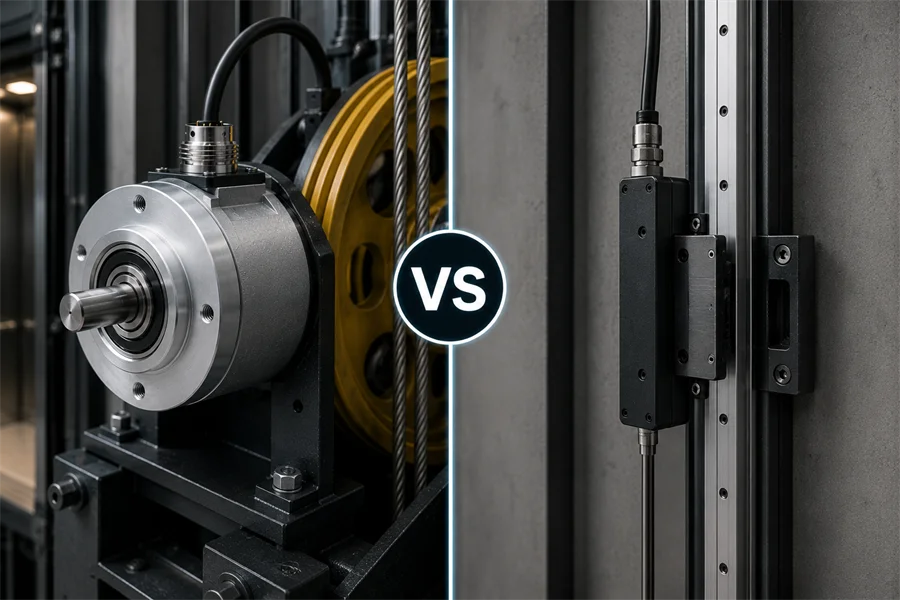
Linear encoders directly measure displacement and are generally used in specialized positioning applications requiring direct travel measurement.
Common Elevator Encoder Problems During Commissioning
Encoder-related problems often appear during installation and commissioning rather than during normal operation.
In real projects, these issues are frequently misdiagnosed as drive or traction machine failures.
Typical causes include:
- Encoder shaft misalignment
- Loose coupling installation
- Electrical grounding problems
- Shielding failure
- Inverter interference
- Signal instability caused by shaft vibration
- Moisture or contamination inside connectors
Low-speed operation usually exposes encoder problems more clearly than high-speed travel.
An elevator may appear stable during normal travel but develop vibration, delayed stopping, or repeated leveling correction near floor zones.
This happens because final deceleration and leveling require much higher feedback precision.
Some modernization projects become especially challenging when older controllers, legacy traction systems, and newer encoder technologies do not fully match communication protocols or feedback requirements.
How to Choose the Right Elevator Encoder
Encoder selection should match the traction system, building requirements, and long-term maintenance strategy rather than focusing only on specifications.
Practical Selection Considerations
If the project requires high leveling precision and stable position memory:
- Absolute encoders are usually preferred
If the project focuses on standard traction control and cost efficiency:
- Incremental encoders may be sufficient
If the installation environment includes vibration, dust, or humidity:
- Magnetic encoders may improve long-term reliability
If the project involves high-rise or high-speed transportation systems:
- High-resolution encoders are generally recommended
Key Engineering Factors
Important technical considerations include:
- Signal compatibility
- Resolution and pulse accuracy
- Environmental protection level
- Communication protocol compatibility
- Installation tolerance
- Long-term spare parts continuity
- Compatibility with inverter and controller architecture
In many elevator projects, overall system compatibility is more important than selecting a specific encoder brand.
Long-Term Maintenance and Modernization Considerations
Encoder problems do not always appear immediately.
In many buildings, feedback instability develops gradually because of:
- Mechanical wear
- Shaft vibration
- Connector oxidation
- Cable aging
- Environmental contamination
- Improper maintenance handling
Long-term maintenance accessibility also becomes important.
In older machine-room-less projects, encoder replacement sometimes becomes more time-consuming because of limited maintenance access around compact traction assemblies.
Modernization projects create additional challenges.
When older controllers, asynchronous motors, or legacy VVVF systems are upgraded, engineers often need to evaluate:
- Existing feedback compatibility
- Controller communication protocols
- Replacement feasibility
- Installation accessibility
- Lifecycle spare parts continuity
For large buildings operating continuously, reducing downtime during modernization becomes just as important as improving technical performance.
This is why encoder selection should be considered part of long-term elevator lifecycle planning rather than an isolated component decision.
Conclusion
An elevator encoder is far more than a simple speed sensor.
In modern traction elevators, it functions as a critical motion feedback device that directly affects speed regulation, ride comfort, floor leveling precision, and PM motor synchronization.
Modern VVVF elevator systems continuously rely on encoder feedback to calculate travel distance, car position, deceleration timing, and traction behavior in real time.
As vertical transportation systems become faster, more compact, and more dependent on advanced motion control, encoder stability becomes increasingly important for long-term operational reliability.
When evaluating elevator systems, building owners, contractors, modernization teams, and elevator engineering companies should consider not only encoder specifications, but also system compatibility, maintenance accessibility, commissioning stability, and long-term lifecycle support.
For complex projects, discussing traction control integration and feedback system compatibility early can help reduce commissioning risk, improve ride quality, and support long-term building mobility performance.












