
Key Takeaways
- An elevator ARD is an automatic rescue operation system designed to move trapped passengers to a safe landing during a power interruption.
- Modern ARD systems do much more than provide backup power. They coordinate traction control, emergency leveling, door operation, and passenger evacuation logic.
- ARD rescue movement intentionally operates at controlled low speed to prioritize traction stability and passenger safety under abnormal electrical conditions.
- In high-rise buildings, hospitals, hotels, airports, and public infrastructure, ARD systems help reduce emergency response pressure and building operation disruption during outages.
- Older elevators without properly coordinated rescue architecture may face modernization compatibility problems, delayed evacuation, or emergency operation instability.
Why Power Failure Response Matters in Modern Buildings
Modern buildings depend heavily on continuous vertical transportation.
When a power interruption occurs, elevators may stop suddenly between floors, leaving passengers trapped inside the cabin until rescue procedures begin.
In smaller low-rise buildings, the disruption may remain temporary and manageable.
In high-rise towers, hospitals, airports, transportation hubs, hotels, and mixed-use commercial buildings, the operational consequences become much more serious.
Even a short outage can quickly create:
- Passenger congestion
- Accessibility problems
- Emergency evacuation pressure
- Building operation disruption
- Safety concerns for elderly or disabled occupants
In some high-traffic commercial buildings, several elevators stopping simultaneously can rapidly increase lobby congestion and slow emergency circulation routes.
This is why elevator emergency rescue systems have become increasingly important in modern building transportation planning.
An elevator ARD is not simply a backup battery device.
It is a coordinated emergency operation subsystem designed to manage traction movement, emergency power switching, leveling logic, and passenger evacuation during abnormal power conditions.
Get Elevator ARD Solution Now >>
What Is an Elevator ARD
ARD stands for Automatic Rescue Device or Automatic Rescue Operation Device.
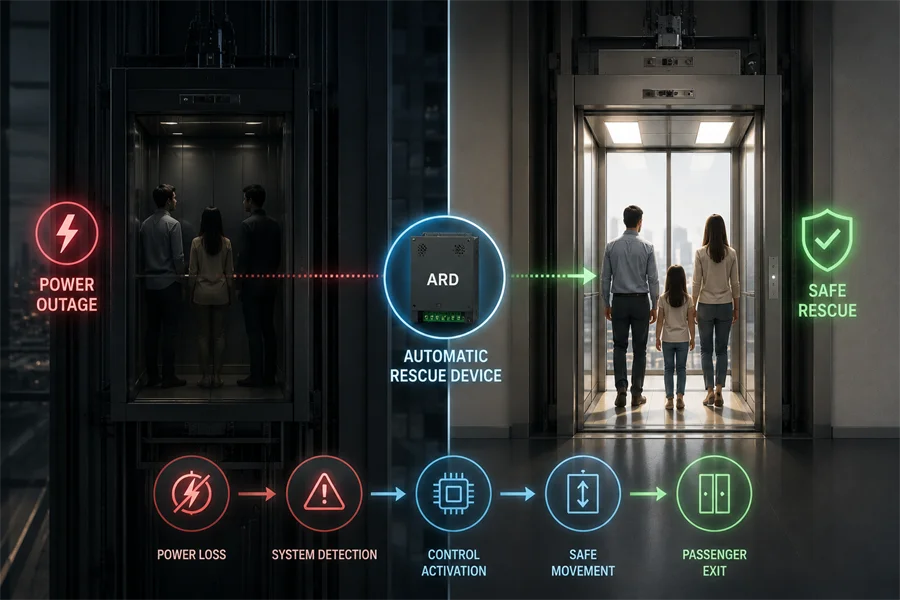
The system automatically moves the elevator car to a safe landing position after a power interruption so passengers can exit safely without waiting for manual rescue procedures.
Modern ARD systems typically coordinate multiple functions simultaneously, including:
- Power failure detection
- Main supply isolation
- Emergency power activation
- Traction control coordination
- Controlled low-speed rescue movement
- Leveling verification
- Door opening logic
- Passenger release sequencing
Unlike normal elevator operation, emergency rescue mode prioritizes controllability and evacuation safety rather than transportation efficiency.
This is one reason rescue movement speed is intentionally limited during ARD operation.
Modern rescue systems also avoid immediate activation during extremely short voltage fluctuation.
Temporary power dips lasting only a few seconds may recover naturally without requiring full rescue activation. Intelligent delay logic helps reduce unnecessary rescue switching and emergency system stress.
Why Modern Elevators Need ARD Systems
Older elevators often depended entirely on manual rescue procedures during outages.
If the cabin stopped between floors, maintenance personnel or emergency teams would manually move the car and release passengers.
This process could take considerable time, especially during large-scale building outages or peak passenger traffic periods.
Modern buildings place much higher expectations on emergency transportation continuity.
Without a properly coordinated ARD system, a power interruption may create:
- Long passenger entrapment periods
- Emergency evacuation delays
- Accessibility-related movement problems
- Building congestion
- Increased operational liability
Hospitals represent one of the clearest examples.
A stalled elevator may interrupt patient transportation, medical equipment movement, or emergency personnel access during critical operations.
In accessibility-focused environments, poor emergency leveling behavior may also create evacuation difficulty for wheelchair users, elderly occupants, or stretcher transport systems.
As buildings become taller and transportation systems become more digitally integrated, rescue coordination has become part of overall building operational reliability rather than an optional elevator feature.
How Elevator ARD Systems Work During a Power Failure
Modern ARD systems follow a controlled emergency operation sequence rather than simply activating backup power immediately.
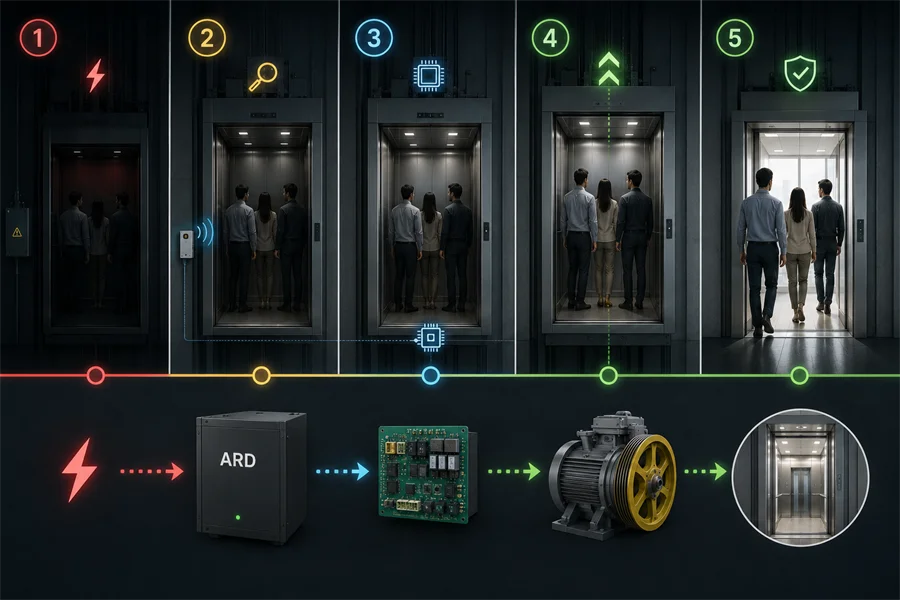
Step 1 — Power Failure Detection
The controller continuously monitors the incoming utility power supply.
Modern rescue systems typically verify that the abnormal power condition lasts beyond a short delay period before activating rescue mode.
This helps prevent unnecessary rescue operation during temporary voltage fluctuation or short-duration electrical disturbance.
Step 2 — Main Power Isolation
Once the outage condition is confirmed, the elevator isolates the normal utility supply.
This prevents unstable electrical interaction between emergency power and the main supply system during rescue operation.
Step 3 — Emergency Power Activation
The ARD system activates its emergency power source.
Depending on the rescue architecture, this may involve:
- Battery-based rescue systems
- UPS-assisted emergency circuits
- Emergency inverter coordination
- Backup supply switching modules
Step 4 — Controlled Low-Speed Rescue Movement
The traction system then moves the elevator toward a safe landing floor at intentionally limited rescue speed.
Emergency rescue movement prioritizes:
- Stable traction control
- Brake coordination
- Passenger safety
- Predictable stopping behavior
- Accurate leveling performance
rather than transportation speed.
Controlled low-speed rescue logic helps reduce risks involving:
- Brake instability
- Traction slipping
- Positioning error
- Sudden motion changes
- Unstable stopping behavior
The system must maintain stable movement behavior even while operating under abnormal electrical conditions.
Step 5 — Leveling Verification
Before opening the doors, the controller verifies floor position and leveling alignment.
Even during emergency rescue operation, leveling precision still matters because poor landing alignment may create evacuation difficulty for elderly passengers, wheelchair users, or medical transport equipment.
Step 6 — Door Opening and Passenger Release
Once the elevator reaches the designated landing position, the doors open automatically and remain open long enough for passengers to exit safely.
Only after passenger evacuation is completed does the rescue sequence terminate fully.
Why Rescue Speed Is Intentionally Limited
Many passengers assume emergency rescue should happen as quickly as possible.
In reality, modern ARD systems intentionally operate at low controlled speed.
Emergency rescue movement occurs under abnormal electrical conditions where traction controllability becomes more important than transportation efficiency.
The system must maintain predictable movement behavior while operating on emergency rescue power.
This becomes especially important in:
- Older modernization projects
- High-rise traction systems
- Heavy-load elevators
- Elevators with aging traction components
- Buildings with unstable electrical infrastructure
Controlled low-speed rescue logic helps reduce unexpected movement risk during emergency operation.
How ARD Coordinates with VVVF Elevator Systems
Modern elevators commonly use VVVF traction control systems combined with PM traction machines and digital controllers.
During rescue operation, the ARD system must coordinate closely with:
- Inverter operation
- Brake release logic
- Position feedback systems
- Motor control behavior
- Door sequencing logic
- Leveling verification
This coordination becomes more complicated in modernization projects involving older relay-based systems or outdated traction architecture.
Some older elevators may technically restart after a power interruption, but without properly coordinated ARD logic, passengers may still remain trapped inside the cabin until manual rescue teams arrive.
Modern digital rescue systems help reduce this operational uncertainty by integrating emergency movement logic directly into the traction control architecture.
ARD vs UPS — Different Roles in Emergency Power Strategy
ARD systems and UPS systems are often confused, but they serve different functions inside building emergency infrastructure.
A UPS primarily helps maintain temporary electrical continuity for selected systems during short-duration power interruption.
An elevator ARD actively coordinates traction movement, leveling behavior, and passenger evacuation.
The distinction is important.
A UPS may continue supplying power to control circuits, but it does not automatically guarantee controlled rescue movement or passenger release.
An ARD system specifically manages emergency elevator operation under outage conditions.
In some elevator designs, UPS equipment may support portions of the rescue architecture, but the evacuation logic still depends on dedicated ARD coordination.
The relationship between ARD systems and UPS infrastructure becomes increasingly important in modernization projects and high-rise emergency power planning.
Common Problems in Older Elevators Without ARD
Many older elevators were not originally designed around integrated emergency rescue architecture.
During modernization projects, engineers may encounter:
- Outdated relay control systems
- Non-compatible VVVF drives
- Aging battery systems
- Rescue logic instability
- Incorrect emergency wiring
- Inconsistent leveling during rescue movement
- Insufficient backup power capacity
Some installations may also develop coordination problems between inspection mode and emergency rescue mode.
In poorly configured systems, unintended rescue activation during maintenance procedures can create additional safety risks.
This is one reason modern rescue systems require careful coordination between:
- Main switch logic
- Inspection operation mode
- Emergency stop systems
- Rescue power circuits
- Traction control architecture
Some older elevators continue operating normally for years while still containing hidden rescue operation weaknesses that appear only during actual outage conditions.
Elevator Modernization and Retrofit Considerations
ARD integration has become a major part of elevator modernization planning.
Many modernization projects now involve:
- PM motor upgrades
- VVVF controller replacement
- Digital control integration
- Emergency rescue retrofitting
- Building safety upgrades
In some buildings, adding modern ARD functionality becomes more difficult than replacing the traction machine itself.
Common retrofit challenges include:
- Limited machine room space
- Compact control cabinet layouts
- Existing wiring limitations
- Legacy rescue logic
- Incompatible traction systems
Some modernization teams initially expect a straightforward equipment replacement, only to discover that the original elevator architecture cannot support modern rescue coordination efficiently.
As a result, emergency rescue compatibility evaluation should happen early during modernization planning rather than after major equipment decisions have already been finalized.
Maintenance, Battery Reliability, and Testing
ARD systems require regular inspection and testing to maintain reliable emergency performance.
Long periods without testing may create hidden risks involving:
- Battery aging
- Insufficient rescue capacity
- Control logic failure
- Wiring degradation
- Emergency relay malfunction
- Rescue activation delay
Routine testing generally focuses on:
- Rescue activation timing
- Battery condition
- Leveling accuracy
- Door opening sequence
- Emergency movement stability
In continuously operating commercial buildings, reducing emergency system failure risk becomes operationally important.
In some older residential buildings, elevator rescue systems may technically operate correctly during scheduled testing while still showing delayed door response during actual outages because of aging battery capacity or unstable emergency switching behavior.
Building operators increasingly view ARD reliability as part of long-term elevator lifecycle management rather than a secondary optional feature.
How to Choose the Right Elevator ARD System
The correct ARD configuration depends on:
- Building type
- Elevator traffic conditions
- Traction architecture
- Modernization requirements
- Emergency operation expectations
High-rise passenger buildings typically prioritize:
- Stable rescue coordination
- Fast recovery behavior
- Digital integration compatibility
- Long-term operational reliability
Industrial environments may prioritize:
- Environmental durability
- Stable low-speed operation
- Simpler rescue architecture
- Resistance to contamination and vibration
Hospitals and public infrastructure projects often require especially careful evaluation of accessibility-related evacuation continuity and emergency transportation reliability.
Choosing the wrong rescue architecture may increase:
- Downtime risk
- Commissioning complexity
- Retrofit cost
- Long-term maintenance difficulty
Conclusion
An elevator ARD is far more than a backup power device.
It is a coordinated emergency operation system designed to maintain controlled passenger evacuation during power interruption events.
Modern ARD systems coordinate traction control, emergency power switching, leveling verification, and door release logic to help buildings maintain safer emergency transportation behavior during outages.
As buildings become taller, more complex, and increasingly dependent on continuous vertical transportation, reliable rescue coordination becomes more important across both new installation and modernization projects.
Evaluating ARD compatibility early in project planning can help reduce modernization risk, improve emergency response performance, simplify future maintenance, and support long-term elevator operational reliability.













One comment
I am looking an ARD system for our community with 7 elevators , 3 with 17 floors na 4 with 9 fllors , can you send me information of your systems and prices, delivery time to Venezuela