
Elevator door safety depends on more than a sensor that reopens the doors when a passenger enters the doorway. A complete system combines obstruction detection, mechanical locking, electrical verification and access protection, with each device controlling a different failure mode.
This guide explains how these elevator door safety devices work together and what matters when specifying, maintaining or modernizing a door system.
How Elevator Door Safety Works as a System
An automatic elevator normally has two door assemblies. The car door travels with the elevator, while a landing door, also called a hoistway door, protects the shaft opening at each floor.
When the car reaches a landing, the door operator drives the car door. A mechanical coupling mechanism allows it to engage and operate the corresponding landing door.
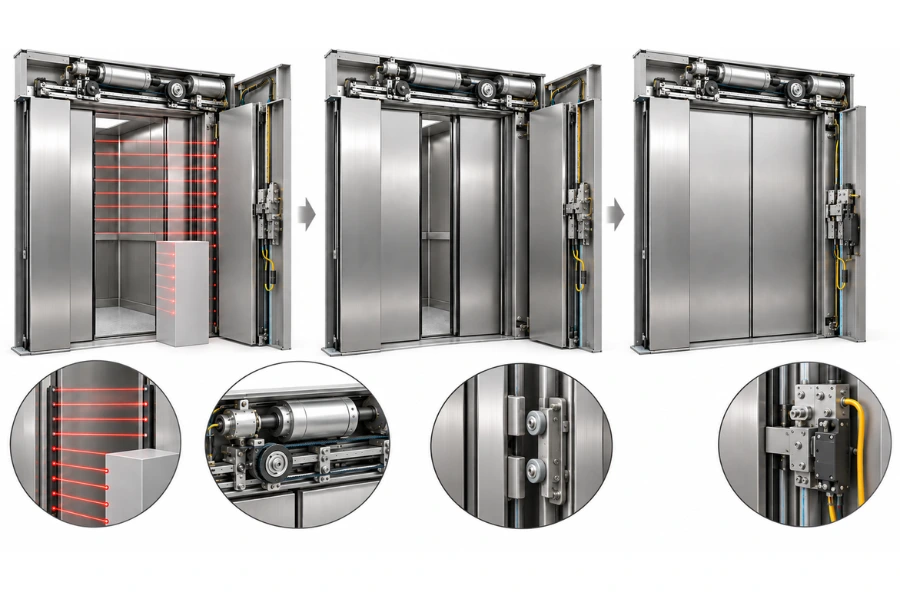
A typical door safety sequence works like this.
- A light curtain or other reopening device detects a person or object in the entrance.
- The door control system prevents closing or commands the doors to reopen.
- Once the entrance is clear, the car and landing doors complete their closing movement.
- The landing-door interlock mechanically secures the landing door.
- Electrical safety contacts verify the required closed or locked condition.
- The safety and control system permits normal elevator movement after the required door conditions are established.
- Additional monitoring can detect certain abnormal door-circuit states.
A light curtain therefore can’t replace a door interlock. The first protects passengers during closing, while the second helps prevent unsafe hoistway access and normal travel without the required locked-door condition.
Main Types of Elevator Door Safety Devices
Elevator door safety devices can be classified by the failure mode they control rather than treating every component as a door sensor.
| Device | Main Function | Protection Method | Main Risk Controlled |
|---|---|---|---|
| Mechanical safety edge | Detects physical contact during closing | Contact | Door striking a passenger or object |
| Infrared light curtain | Detects an obstruction in the entrance | Noncontact | Closing on a passenger or object |
| Approaching-object detection | Detects traffic approaching the entrance | Noncontact | Door closing as someone approaches |
| Landing-door interlock | Secures the landing door | Mechanical and electrical | Unsafe hoistway access or movement without the required locked condition |
| Door safety contact | Verifies the required door condition | Electrical | Normal movement with an unsafe door state |
| Door lock monitoring | Monitors defined door safety states | Electrical and control logic | Certain bypassed or inconsistent safety states |
| Door restrictor | Restricts car-door opening outside an allowed zone | Mechanical or electromechanical | Hoistway exposure between landings |
| Self-closing device | Returns a landing door toward its closed position | Mechanical | Landing door remaining open |
Door type, controller architecture, applicable code and whether the project involves a new installation or modernization determine the final configuration.
Safety Edge vs. Elevator Light Curtain
Mechanical Safety Edges
A mechanical safety edge responds when the moving door edge physically contacts a passenger or object. Movement of the edge activates a switch that initiates reopening, which means contact must occur before the device can respond.
Safety edges remain relevant on older installations, but their presence alone doesn’t establish compliance with current requirements.
Infrared Light Curtains
An infrared light curtain provides noncontact obstruction detection. Transmitters and receivers establish multiple infrared beams across the entrance, allowing the system to detect a person, mobility aid or other object before physical contact with the closing door.
Interrupting the required detection field signals the door control system to prevent closing or initiate reopening. Actual coverage depends on beam arrangement, mounting position and car and landing-door geometry.
A light curtain doesn’t mechanically lock the landing door, verify every door safety condition or replace the interlock system.
2D vs. 3D Elevator Door Detection
In common industry terminology, 2D detection usually refers to protection across the door path, while 3D detection commonly describes additional approaching-object detection on the landing side. Code-defined detection functions are more useful for engineering decisions than the 2D or 3D marketing label alone.
| Factor | Door-Path Detection | Approaching-Object Detection |
|---|---|---|
| Primary protected area | Closing doorway | Landing-side approach area |
| Main purpose | Detect an object entering the door path | Detect an object approaching the entrance |
| Typical implementation | 2D infrared light curtain | 3D or dedicated approach sensing |
| Main design concern | Beam coverage, mounting and door geometry | Detection zone, door geometry, environment and adjustment |
One device or a combination of devices may provide these functions depending on the elevator design.
Where 2D Detection Has a Limitation
A conventional light curtain primarily protects its doorway detection field. A passenger can therefore approach a closing landing door without yet entering the plane monitored by a car-door-mounted detector.
Approaching the elevator and entering the protected door path aren’t the same event. Door geometry and the relative position of the car and landing doors can further affect when detection occurs, so protection should be evaluated by detection coverage rather than beam count alone.
What Approaching-Object Detection Adds
Approaching-object detection, often described in the industry as 3D door protection, extends sensing toward the landing-side entrance. It can identify an approaching person or object before it reaches the conventional door-path detection field.
This function can be relevant where elevators regularly serve wheelchairs, walking aids, luggage carts, hospital equipment or passengers who require more time to enter.
ASME A17.1-2019/CSA B44-19 distinguishes between detection of approaching objects and detection of objects in the door path for applicable horizontally sliding door systems. Project requirements depend on the code edition adopted by the authority having jurisdiction.
A device marketed as 3D doesn’t automatically provide suitable protection for every entrance. Door geometry, detector position, environmental conditions, adjustment and system compatibility determine whether the required detection area can be achieved.
Elevator Door Interlocks and Electrical Safety Contacts
A light curtain determines whether something is obstructing the entrance. An interlock addresses whether a landing door is mechanically secured before normal elevator travel.
Landing-Door Interlocks
Every landing door protects an opening into the hoistway. The landing-door interlock keeps that entrance mechanically secured except when the elevator is within the permitted unlocking zone and the door is authorized to open.
During a normal door cycle, the coupling mechanism permits the corresponding landing door to operate when the car reaches the appropriate landing area. When the door closes, the locking mechanism engages again.
The locking state is tied to the elevator safety circuit.
- Mechanical protection prevents inappropriate opening of the landing door.
- Electrical protection verifies the required locking condition before normal car movement.
EN 81-20:2014 provides a specific example. Effective landing-door locking must precede car movement, and an electrical safety device proves the locked condition. That safety device must not be activated until the locking elements are engaged by at least 7 mm.
The 7 mm value applies to this EN 81-20 requirement and shouldn’t be generalized to every elevator or jurisdiction. Project specifications must follow the applicable standard and adopted edition.
Electrical Door Safety Contacts
Electrical safety contacts tell the safety circuit whether required door conditions have been established. A physically closed landing door may still prevent normal operation if lock adjustment, component wear or a contact problem prevents the expected electrical state.
This is why mechanical closure and electrical verification need to be diagnosed separately when an elevator refuses to run after the doors appear to close normally.
What Is Elevator Door Lock Monitoring?
Door Lock Monitoring, or DLM, doesn’t mechanically lock the door or replace the landing-door interlock. It monitors defined door and gate safety states to determine whether they are consistent with the elevator’s operating condition.
The interlock establishes the required locking condition, while DLM can identify certain bypassed, contradictory or otherwise unsafe monitored states.
Door Interlock vs. Door Lock Monitoring
| Function | Door Interlock | Door Lock Monitoring |
|---|---|---|
| Mechanically secures the landing door | Yes | No |
| Provides or works with a safety contact | Yes | Monitors defined states |
| Primary function is physical locking | Yes | No |
| Evaluates certain inconsistent safety states | Not its primary role | Yes |
| Relevant during modernization | Yes | Yes |
DLM isn’t a general-purpose fault detector. A worn roller, contaminated light curtain or mechanically resistant door requires separate diagnosis.
For an existing elevator, implementing DLM can involve the controller, existing door circuits and monitoring architecture. Requirements depend on the applicable code and its local adoption.
Door Restrictors and Protection Outside the Landing Zone
A door restrictor limits the ability to open the car door when the elevator is outside the permitted landing or unlocking zone. The hazard here isn’t a closing door but unintended exposure to the hoistway when the car is between floors or otherwise outside the appropriate opening position.
Restrictor design varies by elevator system and needs to remain compatible with normal landing access and authorized rescue and maintenance procedures.
Landing-Door Self-Closing and Emergency Unlocking Devices
Landing-Door Self-Closing Devices
A landing door may use a counterweight, tension spring or compression spring to return toward its closed condition when external opening force is removed. This controls the condition of the hoistway entrance rather than detecting a passenger and helps prevent a landing door from remaining open when shaft access shouldn’t be available.
Emergency Unlocking Devices
Emergency unlocking devices allow authorized rescue, inspection or maintenance personnel to release a landing-door lock under defined conditions, sometimes using a specialized unlocking key.
They aren’t passenger-operated emergency exit devices. After authorized access, the landing door must be returned to its normal closed and locked condition.
How Door Safety Devices Fail in Real Operation
A door that repeatedly reopens doesn’t automatically have a defective light curtain. Similar symptoms can originate in sensing, mechanical movement, locking, electrical safety or control functions.
| Fault Area | Possible Causes | Typical Effect |
|---|---|---|
| Detection | Contaminated optics, misalignment, cable damage, connector problems or environmental interference | False obstruction signal or unreliable detection |
| Door mechanics | Debris in sill, worn rollers, panel misalignment or excessive resistance | Slow, incomplete or irregular door movement |
| Interlock and coupling | Lock misalignment, wear or incorrect clutch/vane engagement | Failure to establish the required locked condition |
| Electrical safety | Contact adjustment, wiring or connection problems | Safety circuit doesn’t establish the expected state |
| Door control | Operator adjustment, drive behavior or controller input problems | Reopening, incomplete closing or irregular door cycles |
| Compatibility | Incorrect replacement component or interface mismatch | Intermittent or persistent operating faults |
Troubleshooting should start with the observed behavior and trace the door safety sequence. Replacing the most visible sensor first can leave the actual mechanical, electrical or control problem unresolved.
Door Safety Requirements Depend on the Project
Traffic behavior changes how long the entrance remains occupied, what passes through it and how the door system needs to respond.
| Building Type | Typical Entrance Condition | Engineering Implication |
|---|---|---|
| Hospital | Stretchers, wheelchairs and medical carts | Longer entrance occupancy and careful door timing |
| Senior living | Slower passenger movement and mobility aids | Closing timing and entrance-detection coverage require closer evaluation |
| Shopping mall | Children, strollers and shopping carts | Irregular entrance behavior and frequent obstruction |
| Hotel | Luggage and mixed guest and service traffic | Variable boarding time and repeated door cycles |
| Office | Concentrated peak passenger flow | Door timing affects traffic handling and waiting time |
| Freight facility | Pallets, carts and larger loads | Clearance, door durability and mechanical condition become critical |
| Residential building | Mixed ages, deliveries and variable traffic | Balanced timing and reliable everyday detection |
For example, a stretcher occupies a hospital elevator entrance longer and differently from a walking office passenger. Door timing, entrance width and detection coverage therefore need to be evaluated against actual traffic rather than selected from a sensor specification alone.
What to Check During Elevator Door Modernization
Modernizing door safety requires the replacement equipment to work with the elevator’s existing mechanical, electrical and control architecture.
Before changing the door protection system, review:
- Existing car and landing-door configuration
- Door operator and drive condition
- Light-curtain mounting and available detection area
- Landing-door interlocks and mechanical wear
- Door safety contacts
- Existing controller and safety-circuit architecture
- Wiring and signal compatibility
- Landing-zone and door-restrictor arrangement
- Applicable modernization requirements
- Maintenance access and replacement-part availability
A new light curtain won’t correct a worn landing-door interlock, while a new operator won’t resolve an incompatible or incorrectly configured safety circuit.
Door modernization is a system compatibility project, not simply a component replacement.
Information to Collect Before Selecting Door Safety Devices
New installations require a different decision process from modernization. Instead of determining what existing equipment can accept, the project team needs to define the entrance, traffic and operating conditions the new door system must handle.
Entrance configuration
- Center-opening or side-opening doors
- Clear entrance width and height
- Number and arrangement of door panels
- Car-to-landing-door configuration
Passenger and equipment traffic
- Expected passenger volume
- Wheelchair and mobility-aid use
- Stretchers
- Luggage and service carts
- Freight or pallet movement
- Peak traffic conditions
Operating environment
- Indoor or exposed installation
- Dust and contamination
- Entrance lighting and environmental conditions
- Expected door-cycle frequency
System requirements
- Door operator and controller architecture
- Required detection functions
- Interlock arrangement
- Maintenance accessibility
- Replacement-component and spare-parts availability
- Future modernization compatibility
Compliance framework
- Applicable elevator standard
- Adopted code edition
- Local authority requirements
- Inspection and testing requirements
For international projects, the applicable compliance framework needs to be established before the door system is finalized because a configuration accepted under one code system can’t automatically be assumed to satisfy another jurisdiction.
The selection objective is therefore not to maximize the number of safety devices. It is to match detection, reopening, mechanical locking, electrical verification and access protection to the building conditions and applicable safety requirements.












