
Elevator encoder failure should be investigated when poor leveling, jerking, abnormal vibration, repeated speed faults, or unexpected stops occur while the brake, door locks, and safety circuit show no corresponding fault.
The operating pattern helps narrow the cause. Vibration that appears only at normal speed suggests a different feedback problem from an elevator that starts, moves a few centimeters, and stops.
What Does an Elevator Encoder Do?
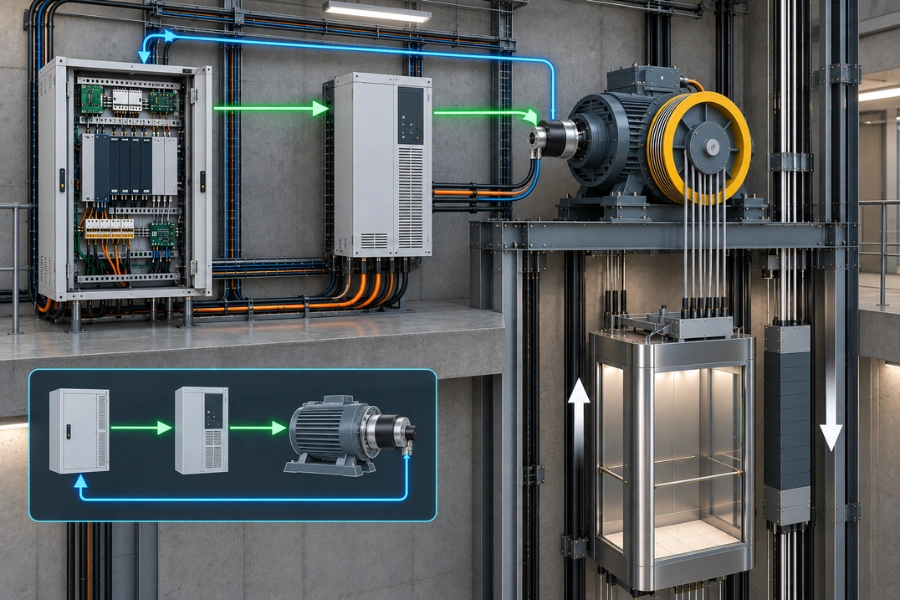
In a closed-loop VVVF elevator system, encoder feedback allows the controller and drive to compare commanded motor operation with actual movement and adjust motor control accordingly.
The relationship can be simplified as:
Traction machine → Encoder feedback → Controller and VFD → Motor control → Car movement
Depending on the elevator architecture, encoders may provide speed, position, or motor rotor feedback, using incremental or absolute signal technologies suited to the controller and traction system. Permanent magnet synchronous traction systems require accurate rotor position feedback for motor control.
When the encoder pulse signal becomes inaccurate, intermittent, or unavailable, the resulting control error can appear as jerking, vibration, inaccurate leveling, or speed-related protection.
6 Common Elevator Encoder Failure Symptoms
The symptom alone rarely identifies the fault. When it occurs, whether it repeats under the same operating condition, and how the controller responds afterward provide more useful diagnostic evidence.
Poor Leveling With Jerking During Travel
An elevator leveling problem combined with intermittent jerking can indicate unstable feedback. The car may stop above or below the landing while disturbances occur during acceleration, travel, or deceleration.
For optical encoders, dust or debris around the sensing area can interfere with pulse generation. Cleaning may restore operation when contamination is the cause. Persistent problems require further checks of signal quality, wiring, installation, brake behavior, and the leveling system.
Sudden Stop Followed by Automatic Leveling
A distinctive pattern occurs when the elevator suddenly stops during travel, automatically levels, and then returns to normal operation.
If the brake circuit, safety circuit, and door-lock circuit show no corresponding fault, intermittent encoder signal loss becomes a stronger diagnostic direction. Severe internal wear can cause missing encoder pulses during travel.
Because the signal may recover before inspection, fault history and the sequence immediately before and after the stop are particularly useful.
Strong or Periodic Car Vibration
An elevator may operate normally at inspection speed but develop strong, periodic up-and-down vibration during normal-speed travel, particularly across several floors.
One documented fault involved deformation around the PG installation that caused the motor shaft and PG sleeve to become nonconcentric. The resulting mechanical condition disturbed feedback and produced severe vibration.
This pattern points technicians toward encoder mounting, shaft alignment, coupling, and related mechanical conditions rather than the encoder electronics alone.
Elevator Moves a Short Distance and Stops
Another recognizable pattern is an elevator that accepts a floor command, starts, moves only a short distance, and stops.
In one documented case, the car traveled approximately 50 mm before stopping because of unreliable contact between the encoder and microprocessor control system.
When feedback disappears immediately after startup, connectors, terminals, and signal wiring should therefore be checked before replacing the encoder.
Repeated Underspeed or Overspeed Faults
Repeated speed-related protection can indicate an elevator speed feedback error.
A deformed rotating encoder component, for example, can produce inaccurate optical pulse signals. If measured feedback no longer agrees with the expected operating state or another monitored speed signal, the controller may trigger an underspeed, overspeed, or related protective fault.
Drive behavior, motor operation, brake performance, wiring, and other speed-monitoring devices can produce overlapping symptoms and should be differentiated during diagnosis.
Severe Abnormal Motion After Feedback Loss
Severe or complete feedback loss can produce abnormal vibration or unexpected movement before protective functions stop operation, depending on the control architecture and fault condition.
Encoder abnormalities during initial position or angle learning can also interfere with the information required for motor control. Such behavior should be treated as a safety-critical fault rather than cleared by a reset and returned directly to service.
Elevator Encoder Symptoms and Diagnostic Directions
The combination of symptom and operating condition helps determine where technicians should investigate first.
| Observed symptom | Possible encoder-related cause | Other areas to inspect |
|---|---|---|
| Poor or inconsistent leveling | Contaminated or unstable feedback | Leveling system, brake, control settings |
| Jerking during travel | Irregular encoder pulse signal | Drive, traction machine, mechanical condition |
| Periodic vibration at normal speed | Misalignment or unstable feedback | Mounting, shaft alignment, coupling |
| Sudden stop followed by leveling | Intermittent signal loss | Safety circuit, door locks, brake circuit |
| Moves briefly and stops | Loose or intermittent connection | Signal wiring, connector, controller interface |
| Repeated underspeed fault | Incorrect speed feedback | Drive, motor, brake, speed monitoring |
| Repeated speed protection | Missing or distorted pulses | Wiring and related monitoring devices |
What Causes Elevator Encoder Problems?
Most encoder-related problems fall into five practical categories:
- Contamination can obstruct optical sensing and distort pulse generation.
- Mechanical wear can produce intermittent or permanent signal loss.
- Misalignment can disturb the mechanical relationship between the encoder or PG assembly and motor shaft.
- Cable and connector faults can interrupt otherwise normal encoder output.
- Electrical interference, shielding, or grounding problems can corrupt feedback signals.
Distinguishing these causes matters because contamination, wiring faults, and installation errors may be corrected without replacing a functional encoder.
How Technicians Diagnose an Elevator Encoder Fault
Diagnosis should follow the service procedures for the specific controller, drive, traction machine, and encoder system.
1. Identify the Operating Pattern
Determine whether the fault occurs during startup, acceleration, normal-speed travel, deceleration, leveling, or randomly.
Normal inspection operation followed by vibration at higher speed, for example, points toward a different fault condition from immediate shutdown after startup.
2. Review Controller and Drive Fault Records
Check whether recorded events involve speed feedback, position, motor control, or related protection. Correlating fault records with the observed operating sequence helps narrow the feedback problem.
3. Rule Out Competing Systems
Depending on the symptom, check the brake, door locks, safety circuit, leveling devices, drive, traction components, and associated wiring.
A feedback diagnosis becomes more relevant when these competing causes do not explain the operating pattern.
4. Inspect the Complete Feedback Path
Check encoder mounting and alignment, contamination, connectors, signal cables, grounding, shielding, and visible mechanical wear.
This separates internal encoder damage from faults introduced between the encoder, traction machine, and controller.
5. Evaluate Encoder Feedback
Controller diagnostics and appropriate signal testing can reveal unstable output, missing encoder pulses, or discrepancies between commanded and measured motion.
Some manufacturer procedures may use controlled drive tests to isolate feedback faults from motor or drive problems. Because these tests can alter normal closed-loop behavior, they should only be performed by qualified personnel under the applicable service procedure and controlled maintenance conditions.
6. Correct the Cause and Validate Operation
Corrective action may involve cleaning, restoring a connection, correcting alignment, repairing wiring or grounding, or replacing the encoder.
After repair, testing should verify stable startup, acceleration, travel, deceleration, and repeated floor leveling under the required operating conditions.
When Should an Elevator Encoder Be Replaced?
Replacement is appropriate when diagnosis confirms internal wear, mechanical damage, persistent signal loss, or output that cannot be restored by correcting external conditions.
A replacement must also match the existing feedback architecture. Key compatibility factors include:
- Encoder type
- Resolution or pulse specification
- Output signal
- Operating voltage
- Shaft and mounting configuration
- Connector arrangement
- Traction machine requirements
- Controller and drive compatibility
Physical similarity alone is insufficient. Incorrect resolution, signal type, mounting, or controller compatibility can introduce new feedback and commissioning problems.
For modernization projects that retain the existing traction machine, controller, or drive, encoder selection should be evaluated against those retained systems rather than treated as an isolated spare-parts decision.
How to Prevent the Same Encoder Fault From Returning
Replacing the encoder without correcting the underlying cause can reproduce the same failure.
Persistent shaft misalignment can affect the replacement unit, contamination can interfere with its sensing system, and damaged wiring or grounding can continue corrupting feedback. Post-repair validation should therefore confirm both encoder performance and the surrounding installation conditions.
Diagnosing the Feedback System
Encoder troubleshooting is most effective when technicians connect the operating pattern with controller data and the complete feedback path rather than replacing a component based on one symptom.
For replacement and modernization projects, EKCNE can support compatibility evaluation across traction machines, drives, controllers, encoders, and related elevator components.












