
Choosing between an indoor and outdoor scissor lift starts with the jobsite, not the power source. The supporting surface, access route, terrain, working height, platform load, duty cycle, emissions requirements, and environmental exposure determine which configuration fits the work.
Indoor scissor lifts are generally optimized for smooth, hard surfaces and restricted spaces. Outdoor models place greater emphasis on traction, ground clearance, terrain capability, and exposed operating conditions.
The distinction is not simply electric versus diesel.
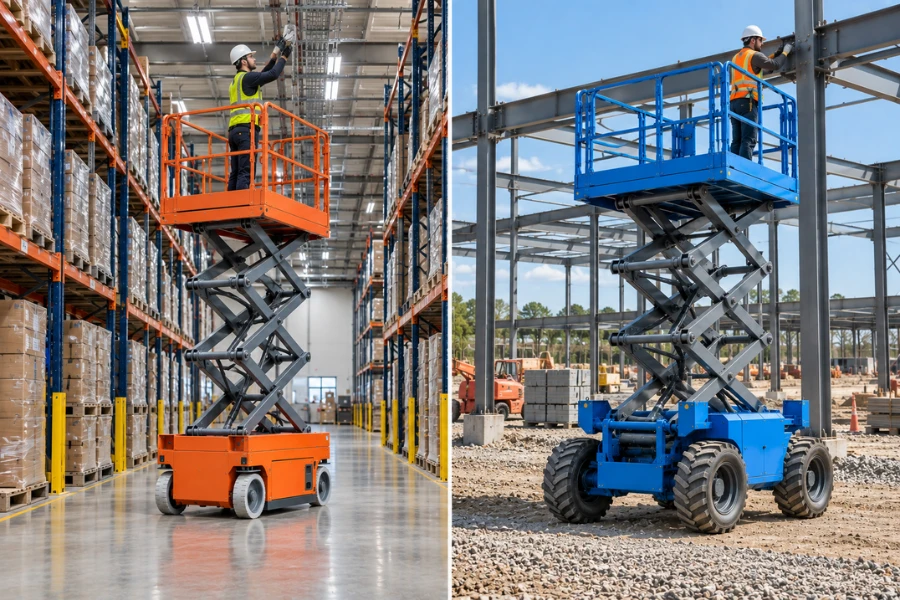
Indoor vs. Outdoor Scissor Lift at a Glance
Scissor lifts provide vertical access for workers, tools, and materials, but indoor and outdoor configurations are designed around different operating conditions.
| Factor | Indoor Scissor Lift | Outdoor Scissor Lift |
|---|---|---|
| Typical surface | Smooth, hard, level surfaces | Rough or unfinished terrain |
| Common power system | Battery electric | Diesel, electric, or hybrid |
| Tires | Often non-marking solid tires | Rough-terrain tires with deeper tread |
| Machine dimensions | Usually narrower and more compact | Usually wider and heavier |
| Ground clearance | Generally lower | Generally higher |
| Traction | Primarily designed for finished surfaces | Greater traction for demanding terrain |
| Noise | Generally low | Depends on power configuration |
| Local exhaust emissions | None from battery-electric drive | Depends on power configuration |
| Platform capacity | Usually lower | Often higher |
| Working height | Commonly moderate | Often available in greater ranges |
| Typical applications | Warehouses, factories, retail, facility maintenance | Construction, exterior installation, infrastructure |
These are typical characteristics, not fixed boundaries. The specifications and operating limits of the individual machine determine whether it is suitable for a project.
What Makes an Indoor Scissor Lift Different?
Indoor scissor lifts are generally designed around three constraints: restricted access, finished supporting surfaces, and occupied or enclosed operating environments.
Compact Access and Finished Floors
Warehouses, factories, shopping centers, and commercial buildings commonly provide concrete or other hard supporting surfaces.
Indoor machines often combine compact chassis dimensions with tires suited to finished floors. Selection should consider:
-
Machine width
-
Stowed height
-
Doorway clearance
-
Aisle dimensions
-
Turning space
-
Floor loading
-
Final working-position clearance
Working height alone doesn’t determine usability. A lift that reaches the required elevation is still unsuitable if it cannot pass through the building or maneuver into the work position.
Electric Power and Indoor Duty Cycles
Battery-electric drive is common indoors because it supports low-noise operation and produces no engine exhaust at the point of use.
Battery capacity still has to match the work cycle. Evaluate charging access, shift duration, operating intensity, travel frequency, and available charging periods when determining whether the machine can support the required duty.
Common Indoor Applications
Typical applications include:
-
Warehouse and facility maintenance
-
Lighting and electrical installation
-
HVAC and MEP work
-
Factory equipment maintenance
-
Retail fit-outs
-
Ceiling and interior finishing
-
Inspection and repair
These applications typically combine controlled vertical access with hard supporting surfaces and restricted movement through buildings.
What Makes an Outdoor Scissor Lift Different?
Outdoor and rough-terrain scissor lifts are designed for sites where the supporting surface, travel route, and environmental conditions are less controlled.
The main design priorities shift toward traction, ground clearance, terrain mobility, and operation under exposed conditions.
Terrain, Traction, and Ground Clearance
Construction and infrastructure sites may include compacted soil, gravel, dirt, and unfinished surfaces.
Rough-terrain scissor lifts typically use larger tires with deeper tread and greater ground clearance than compact indoor models. Depending on the machine, four-wheel drive or other traction features may improve mobility on demanding surfaces.
However, terrain capability needs to be interpreted correctly.
Gradeability describes travel capability. It doesn’t automatically define the slope on which the platform may be elevated.
A machine may be capable of traveling up or down a grade while still requiring the chassis to be within a much smaller inclination range before elevation. Verify the manufacturer’s travel and elevated-operation limits separately.
Platform Capacity and Working Height
Outdoor machines often use larger chassis and platforms, and many product ranges provide greater working heights or rated capacities than compact indoor models.
These are tendencies rather than universal rules. Select capacity and height from the specifications of the actual machine.
Platform load should include:
Workers + tools + materials + other permitted equipment
Additional capacity can require a larger and heavier machine, so capacity must be considered together with access, transport, and ground-bearing conditions.
Wind and Exposed Conditions
Outdoor operation introduces wind, weather changes, and potentially changing ground conditions.
An outdoor rating doesn’t mean the machine can operate in unrestricted weather. Allowable wind speed, chassis inclination, platform configuration, and other environmental limits vary by model.
Compare the manufacturer’s operating limits with actual site conditions before raising the platform.
What Actually Determines the Right Scissor Lift?
The indoor or outdoor label narrows the equipment category. Final selection should then follow the physical conditions of the jobsite.
1. Start With the Supporting Surface
Determine where the machine will travel, position, and elevate.
Smooth concrete, asphalt, gravel, compacted soil, and unfinished construction ground create different requirements for tires, traction, ground clearance, machine weight, and surface bearing capacity.
Don’t select rough-terrain capability simply because the work is outdoors. Likewise, don’t assume an indoor machine is suitable because the work area is covered.
2. Check the Entire Access Route
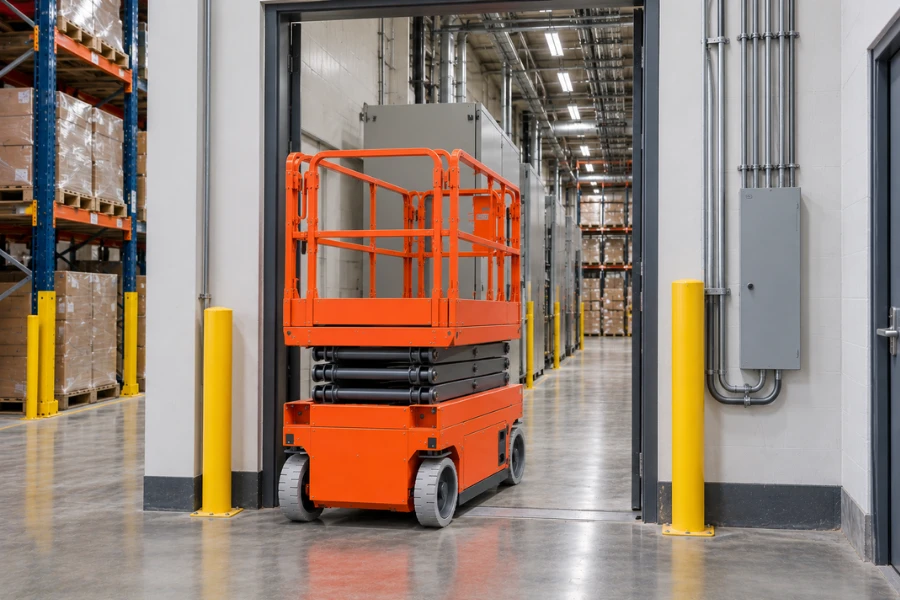
Measure the route from unloading or storage to the actual work position.
For restricted sites, check:
-
Machine width
-
Stowed height
-
Doorways
-
Aisles and corridors
-
Turning areas
-
Ramps and transitions
-
Floor capacity
-
Final positioning space
Maximum working height has little value if the machine cannot physically reach the work area.
3. Define the Required Working Height
Determine the actual elevation at which the task will be performed.
Check how the manufacturer defines platform height and working height, because they aren’t interchangeable specifications.
Avoid adding unnecessary height as a default safety margin if doing so moves the project into a substantially larger, heavier, or less maneuverable machine class.
4. Calculate the Complete Platform Load
Rated capacity must cover the complete working load, not only the operators.
Include personnel, tools, materials, and other permitted equipment expected on the platform simultaneously.
A larger platform or higher rated capacity may improve productivity for some installation work, but it can also increase chassis dimensions and machine weight. Capacity therefore needs to be balanced against access and supporting-surface constraints.
5. Match Power to the Duty Cycle
Power source should follow the operating environment and work cycle rather than determine the indoor/outdoor classification by itself.
Battery-electric configurations are useful where low noise and no engine exhaust at the point of use are important. Their suitability depends on battery capacity, charging opportunities, shift duration, travel requirements, and operating intensity.
Diesel can support demanding outdoor duty where fuel supply and site conditions permit. Electric rough-terrain and hybrid configurations provide alternatives where terrain capability is required but noise or emissions are also considerations.
6. Verify Environmental and Operating Limits
Before final selection, confirm:
-
Indoor or outdoor rating
-
Allowable wind conditions
-
Chassis level requirements
-
Permitted travel gradients
-
Elevated travel restrictions
-
Temperature or other environmental limits specified by the manufacturer
These limits determine where the machine can actually work, regardless of its nominal height, capacity, or power source.
Can One Scissor Lift Work Indoors and Outdoors?
Yes, if the machine is rated and configured for both sets of operating conditions.
Mixed environments occur in warehouses with exterior loading yards, partially completed buildings, and projects that transition from exterior construction to interior installation.
Depending on the site, an indoor/outdoor-rated machine, electric rough-terrain scissor lift, or hybrid configuration may reduce the need for separate equipment.
The key distinction is:
Electric doesn’t automatically mean indoor-only.
Outdoor doesn’t automatically mean diesel.
Surface capability, tires, traction, chassis design, machine dimensions, environmental rating, and manufacturer-defined operating limits must still match each work area.
Common Scissor Lift Selection Mistakes
Choosing by Power Source Alone
Selecting “electric for indoors” and “diesel for outdoors” ignores electric rough-terrain and hybrid equipment and fails to account for surface conditions, access, noise, emissions, and duty cycle.
Better approach: Determine the jobsite conditions first, then select a compatible power system.
Confusing Gradeability With Elevated Operation
A machine’s ability to travel on a slope doesn’t prove that it can safely elevate the platform on the same slope.
Better approach: Check travel gradeability and chassis-level requirements as separate specifications.
Prioritizing Height Over Access
A machine may provide more than enough working height but still be too wide, tall, heavy, or difficult to maneuver into position.
Better approach: Verify the complete access route before comparing maximum height.
Underestimating Platform Load
Calculating only operator weight can leave tools and materials outside the capacity assessment.
Better approach: Calculate the maximum simultaneous working load expected on the platform.
Assuming Outdoor-Rated Means All-Weather
Outdoor capability doesn’t remove wind, inclination, temperature, or other operating restrictions.
Better approach: Compare the actual environmental conditions with the machine-specific operating limits.
How to Choose Between an Indoor and Outdoor Scissor Lift
Use the jobsite conditions to narrow the configuration in this order:
-
Identify the supporting surface
Determine whether the machine will travel and work on finished concrete, asphalt, gravel, compacted soil, unfinished ground, or another surface. -
Measure the access route
Check doorway width, stowed dimensions, aisles, turning areas, ramps, floor loading, and the final positioning space. -
Define the working height
Establish the actual work elevation and compare manufacturer specifications using the same definition of working or platform height. -
Calculate the platform load
Include workers, tools, materials, and other permitted equipment expected on the platform simultaneously. -
Determine the required terrain capability
Evaluate traction, tires, ground clearance, surface stability, slopes, and travel routes. -
Match power to the operating cycle
Consider ventilation, noise, charging access, fuel availability, shift duration, and operating intensity. -
Verify machine-specific limits
Confirm environmental rating, wind limits, chassis inclination, travel restrictions, and other manufacturer-defined operating conditions.
This sequence prevents one attractive specification—such as maximum height, capacity, or engine power—from overriding the conditions that actually determine whether the machine can complete the work.
Indoor or Outdoor Scissor Lift: Which Configuration Fits the Jobsite?
An indoor scissor lift generally fits projects with hard, stable supporting surfaces, restricted access, finished flooring, and requirements for low noise or no engine exhaust at the point of use.
An outdoor or rough-terrain scissor lift is generally more appropriate when the site requires greater traction, ground clearance, or mobility across unfinished surfaces.
For mixed environments, indoor/outdoor-rated, electric rough-terrain, or hybrid equipment may provide the required combination of access and terrain capability.
EKCNE can help project buyers evaluate working height, platform capacity, power configuration, access, terrain, and operating conditions when determining the required scissor lift configuration.
The selection target isn’t the largest or most powerful machine. It is the machine that can reach the work position, carry the required load, travel over the actual surface, pass through the available access route, and remain within its rated operating limits.












