
Scissor lifts serve two fundamentally different functions: elevated personnel access and material lifting or positioning. Applications range from ceiling installation and facility maintenance to pallet handling, production-line positioning, and loading operations.
The correct configuration depends less on the industry name than on the task. Working height, load, platform dimensions, mobility, supporting surface, operating environment, and duty cycle determine whether a mobile scissor lift, rough-terrain model, stationary lift table, or another lifting system fits the application.
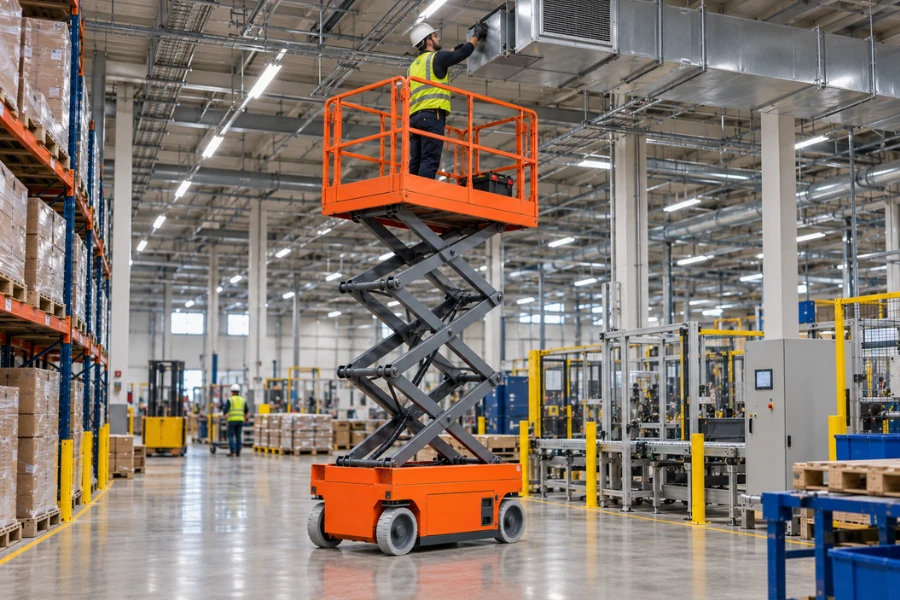
What Are Scissor Lifts Commonly Used For?
Most scissor lift applications fall into two categories.
Personnel access: Mobile scissor lifts raise workers, tools, and light materials for installation, inspection, maintenance, cleaning, and other work at height.
Material lifting and positioning: Stationary scissor lift tables raise loads between working levels, position components, support loading operations, or connect material-handling processes.
The distinction matters because the design priorities differ. A mobile electric scissor lift used for ceiling maintenance requires maneuverability and access, while a stationary hydraulic lift table cycling beside a production line must be evaluated for load handling, positioning, and operating frequency.
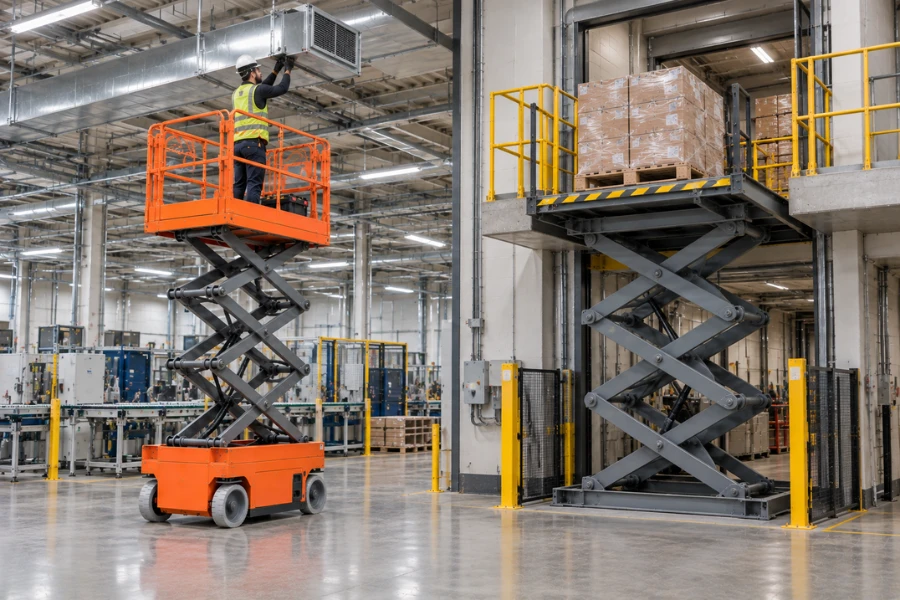
Common Scissor Lift Applications by Industry
Construction and Installation
Construction projects use mobile scissor lifts for electrical work, HVAC installation, fire protection systems, ceiling installation, painting, finishing, and signage.
Indoor construction commonly favors compact electric equipment where doorway clearance, maneuverability, noise, floor compatibility, and local exhaust emissions matter. Outdoor sites may require greater traction, ground clearance, and capability on less uniform surfaces.
Scissor lifts are best suited to tasks where access is primarily vertical and the machine can be positioned close to the work. Tasks requiring substantial horizontal outreach or access over obstacles may require a boom-type platform instead.
Warehousing and Logistics
Warehouses use scissor lifts for both elevated access and material handling.
Compact mobile lifts can reach lighting, utilities, storage infrastructure, and maintenance points in aisles or other restricted areas. Stationary lift tables instead raise pallets, goods, or equipment between working heights.
The operating pattern determines the configuration. Frequent relocation favors mobile equipment, while repetitive transfer at a fixed position favors a stationary platform designed around load size, lifting travel, and cycle frequency.
Manufacturing and Production
Manufacturing applications include equipment maintenance, machine installation, component positioning, assembly support, welding, fabrication, and ergonomic work positioning.
Stationary lift tables are particularly useful where loads repeatedly move between defined heights. Bringing components to an appropriate working level can reduce unnecessary bending and reaching during repetitive production tasks.
Industrial selection also requires more than checking rated capacity. Load distribution, cycle frequency, positioning accuracy, platform geometry, and integration with machinery or conveyors can determine whether a standard or customized lift is required.
Facility Maintenance
Factories, hospitals, schools, airports, stations, and commercial buildings contain lighting, HVAC equipment, utilities, signs, and other systems above normal working height.
Mobile scissor lifts provide vertical access for inspection, repair, cleaning, installation, and replacement. Electric models are commonly considered for indoor work where noise, maneuverability, ventilation, and exhaust emissions influence equipment choice.
Building access can be the limiting condition. A lift with sufficient working height is unusable if it cannot pass through the required doorway, corridor, or turning area or if the supporting floor cannot accommodate it.
Loading and Material Handling
Some scissor lifting systems are designed primarily for materials rather than personnel.
Stationary hydraulic lift tables can:
-
Raise loads between elevations
-
Position pallets or components at a working height
-
Support loading and unloading operations
-
Interface with conveyors
-
Connect processes operating at different levels
For these applications, platform dimensions and vertical travel often need to correspond with surrounding equipment. Dock edges, conveyors, production machinery, floor openings, and transfer heights can therefore influence the lift configuration.
Retail and Commercial Buildings
Retail stores, shopping centers, exhibition facilities, and other commercial buildings may use mobile lifts for lighting maintenance, signage, ceiling work, and display installation.
The main constraint is often physical access rather than maximum working height. Equipment must pass through the building, maneuver into position, operate on the available floor, and provide sufficient clearance around fixtures and structures.
Low-noise operation and suitable tires may also be required where work takes place around occupants or on finished flooring.
Aviation and Transportation Facilities
Airports, aircraft maintenance facilities, railway facilities, and transportation hubs use lifting equipment for inspection, installation, servicing, and maintenance.
Large structures don’t necessarily mean that the largest platform is appropriate. Aircraft, rail vehicles, terminal equipment, structural elements, and restricted service areas can limit how a platform approaches the actual maintenance point.
Where standard rectangular platforms cannot provide suitable positioning, platform geometry or equipment configuration may need to be adapted to the task.
Outdoor Infrastructure and Specialized Applications
Scissor lifts can also support solar installation and maintenance, municipal work, utilities, landscaping, and outdoor event setup.
Outdoor applications introduce variables such as ground firmness, irregular surfaces, slopes, traction, weather exposure, and site access.
Rough-terrain capability may be appropriate where these conditions require it, but outdoor use alone doesn’t justify a rough-terrain machine. The actual surface, travel route, load, working height, and site constraints should determine the configuration.
Which Scissor Lift Fits Each Application?
Industry provides context, but the operating task determines the equipment.
| Application | Typical Configuration | Main Selection Priorities |
|---|---|---|
| Indoor maintenance | Electric mobile scissor lift | Width, working height, noise, floor conditions |
| Construction | Mobile or rough-terrain scissor lift | Height, terrain, access, mobility |
| Warehouse access | Compact electric scissor lift | Aisle clearance, maneuverability |
| Material transfer | Stationary scissor lift table | Capacity, travel, platform size |
| Production line | Stationary or customized lift | Duty cycle, positioning, load handling |
| Outdoor maintenance | Rough-terrain configuration | Ground condition, traction, access |
| Loading area | Stationary hydraulic platform | Load, travel, interface height |
These are starting configurations rather than fixed recommendations. Two projects within the same industry can require different equipment because their loads, access conditions, surfaces, movement patterns, or operating frequencies differ.
How to Select a Scissor Lift for Your Application
Working Height and Vertical Travel
For personnel access, start with the height at which the task must actually be performed.
Platform height and working height aren’t necessarily the same specification. Manufacturers may define or present them differently, so compare machines using the same measurement basis.
For stationary material handling, vertical travel is often more relevant. The platform must move between specific loading, production, or transfer elevations.
Load Capacity and Distribution
For personnel lifts, calculate the total platform load from occupants, tools, equipment, and materials.
For material-handling applications, total weight alone may not describe the actual loading condition. The same load can affect a platform differently when concentrated near one point, placed off-center, or distributed across the deck.
Evaluate rated capacity together with the manufacturer’s permitted load distribution and operating conditions.
Platform Size and Available Space
Platform size creates a tradeoff between working area and equipment footprint.
A larger platform can accommodate more personnel or materials but may reduce maneuverability and prevent access through doors, aisles, corridors, or restricted work zones.
For stationary industrial systems, platform dimensions may instead be dictated by pallets, components, machinery, conveyors, or other interfaces.
Indoor and Outdoor Conditions
Indoor equipment selection commonly emphasizes:
-
Compact dimensions
-
Maneuverability
-
Low noise
-
Ventilation compatibility
-
Floor condition
-
Restricted access
Outdoor projects add ground condition, traction, weather exposure, ground clearance, and travel-route requirements.
Power source should also match the operating environment, particularly where ventilation or local exhaust emissions are a concern.
Ground and Floor Conditions
The supporting surface must be suitable for the equipment and its operating load.
Indoor projects should consider floor capacity, surface condition, slopes, and transitions. Outdoor sites require additional attention to ground firmness, holes, debris, irregular terrain, gradients, and travel routes.
Equipment intended for smooth industrial flooring shouldn’t be assumed suitable for unfinished or unstable terrain.
Mobility and Installation Pattern
Choose mobility according to how the lift participates in the work process.
Self-propelled or mobile equipment fits tasks where operators frequently move between work locations.
Stationary lifts fit repetitive lifting at a fixed workstation, loading point, production process, or transfer interface.
Towable configurations may suit applications requiring transportation between locations without continuous self-propelled movement at each worksite.
When a Scissor Lift May Not Be the Right Choice
Scissor lifts primarily provide vertical movement. If workers must reach horizontally over structures, machinery, obstacles, or inaccessible ground, a boom-type platform may provide a more suitable working envelope.
Mobile elevated work platforms also aren’t necessarily the best solution for repetitive material movement at one fixed location. A stationary lifting system can integrate more directly with loading docks, conveyors, production lines, and other material-handling processes.
The equipment category should therefore follow the required movement pattern rather than simply the required height.
Safety Considerations Change With the Application
Different applications change the dominant hazards.
Mobile personnel lifts require particular attention to ground stability, overhead obstructions, electrical hazards, platform protection, traffic, weather, and operator training. Stationary material-handling systems shift more attention toward load behavior, installation interfaces, guarding, repeated cycling, and interaction with nearby equipment.
Personnel operating mobile elevated work platforms should receive appropriate training and follow the manufacturer’s operating instructions. Equipment condition and the work area should also be assessed before operation because site conditions can change between locations.
For projects subject to U.S. workplace requirements, applicable OSHA requirements and relevant standards should be reviewed for the specific equipment and task. Projects in other jurisdictions should use the corresponding national, local, manufacturer, and site requirements.
When Does an Industrial Scissor Lift Need Customization?
Customization becomes relevant when the application cannot be adequately served by standard platform dimensions, travel, capacity, interfaces, or operating patterns.
Typical triggers include:
-
Nonstandard platform dimensions
-
Unusual load geometry or distribution
-
Interfaces with conveyors or production machinery
-
Specific loading or transfer heights
-
High or repetitive duty cycles
-
Restricted installation space
-
Special positioning requirements
-
Project-specific installation interfaces
In these cases, customization should begin with the process requirements rather than modifying a standard machine after selection.
EKCNE approaches industrial lifting equipment from this project-level perspective. Equipment configuration can be coordinated with manufacturing requirements, installation conditions, export delivery, and long-term component support where the application requires a nonstandard solution.
Final Scissor Lift Application Checklist
Before selecting equipment, answer these questions:
-
What is being lifted?
Personnel, materials, or both? -
What movement is required?
Primarily vertical access, material positioning, or horizontal outreach as well? -
What height or vertical travel is required?
Determine the actual working or transfer levels rather than selecting from nominal height alone. -
What is the real operating load?
Include personnel, tools, materials, load distribution, and any application-specific loading conditions. -
How much platform space is required?
Balance usable area against access and maneuverability. -
Where will the equipment operate?
Indoor and outdoor environments create different requirements for power, terrain, weather, noise, and emissions. -
Can the site support and accommodate the machine?
Check floor or ground condition, doorways, aisles, turning space, slopes, and travel routes. -
How will the equipment move or cycle?
Frequent relocation, fixed-position lifting, and repetitive production cycles favor different configurations. -
What hazards surround the work area?
Identify overhead structures, electrical systems, traffic, machinery, weather, and restricted zones. -
Can standard equipment meet these conditions?
If platform geometry, interfaces, load behavior, duty cycle, or installation requirements fall outside standard configurations, evaluate a customized lifting solution.












