
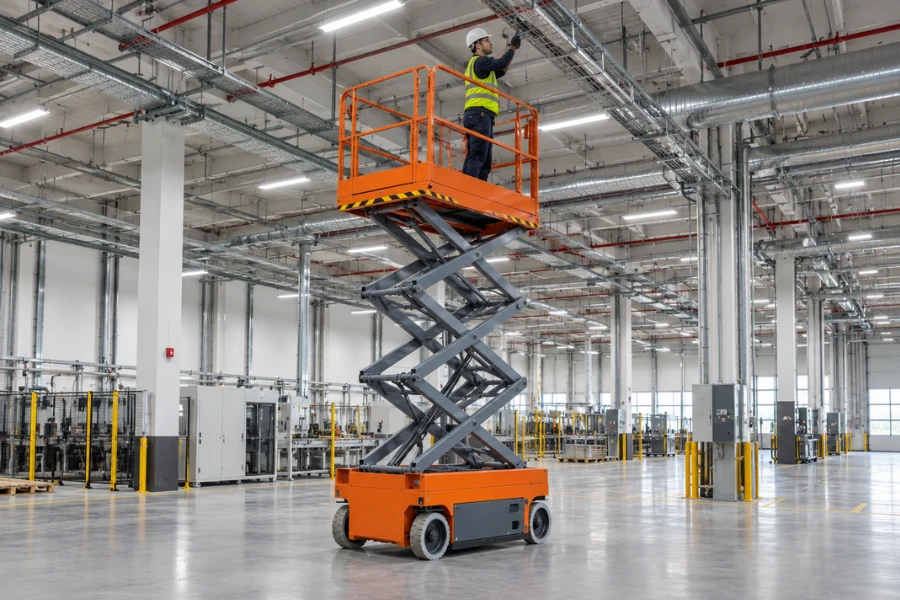
A mobile scissor lift is a movable lifting platform that raises workers, tools, and permitted materials vertically to an elevated work position. Crossed scissor arms expand and contract to raise or lower the platform, while the mobile chassis allows the machine to be repositioned between work areas.
For project buyers, mobility alone doesn’t determine suitability. Working height, rated capacity, platform dimensions, access, surface conditions, movement frequency, and operating environment determine which configuration fits the task.
What Is a Mobile Scissor Lift?
A mobile scissor lift combines a vertically elevating work platform with a chassis designed for repositioning. Depending on the design, the machine may be manually moved or self-propelled.
Its defining mechanism is a set of crossed structural arms. As the arms expand, the platform rises primarily vertically; as they contract, the platform lowers.
This geometry creates two important characteristics:
-
A relatively large working platform for personnel, tools, and permitted materials
-
Primarily vertical access rather than significant horizontal outreach
Many personnel-lifting scissor lifts fall within the broader mobile elevating work platform (MEWP) category, although classification and applicable requirements depend on the machine design and relevant standards.
“Mobile” doesn’t necessarily mean the machine can travel while elevated. It means the equipment can be repositioned. Whether travel is permitted with the platform raised depends on the specific machine and manufacturer-defined operating limits.
A mobile scissor lift should also be distinguished from a stationary scissor lift table. Both may use a similar lifting mechanism, but they solve different operating problems.
How Does a Mobile Scissor Lift Work?
A scissor lift converts power into controlled vertical movement through its crossed lifting structure.
The basic sequence is:
-
A power system supplies energy to the lifting mechanism.
-
An actuator applies force to the scissor structure.
-
The crossed arms expand and raise the platform.
-
Controls regulate elevation and platform position.
-
During lowering, the arms contract in a controlled manner.
Hydraulic designs commonly use one or more hydraulic cylinders to actuate the scissor structure, although the exact lifting and power system depends on the machine configuration.
Because the platform travels primarily upward and downward, a scissor lift works best when the machine can be positioned directly below or close to the work point.
This makes it suitable for tasks such as ceiling installation, overhead maintenance, building services, and industrial equipment servicing. If workers need to reach horizontally over machinery, structures, or other obstacles, a boom-type platform may provide a more suitable working envelope.
Main Parts of a Mobile Scissor Lift
A mobile scissor lift combines four functional systems: the platform, lifting structure, mobile chassis, and power/control system.
Platform and Guardrail System
The platform supports operators, tools, and permitted materials.
Platform dimensions determine usable working space, while guardrails and access gates form part of the platform protection system. A larger platform provides more workspace but can also increase the machine footprint and affect access.
Scissor Structure
The crossed arms transfer the platform load through the lifting mechanism.
Pivot points, pins, structural connections, and arm condition are important because these components experience repeated movement and loading throughout the machine’s service life.
Chassis and Mobility System
The chassis supports the lifting structure, power system, wheels, and drive components.
Mobility can range from manually repositioned wheels to powered drive and steering. Machine width, wheel configuration, ground clearance, turning characteristics, and stowed dimensions determine whether the lift can travel through the required access route.
Power, Controls, and Safety-Related Systems
Depending on the configuration, the machine may use batteries, electric motors, engines, hydraulic systems, or combinations of these systems for lifting and travel.
Controls manage platform elevation and, on self-propelled models, travel and steering.
Depending on the design, safety-related functions may include:
-
Emergency stop
-
Emergency lowering
-
Tilt monitoring
-
Overload-related protection
-
Travel or elevation limit functions
-
Warning devices
The exact functions and operating logic should be verified for the individual machine.
What Types of Mobile Scissor Lifts Are Available?
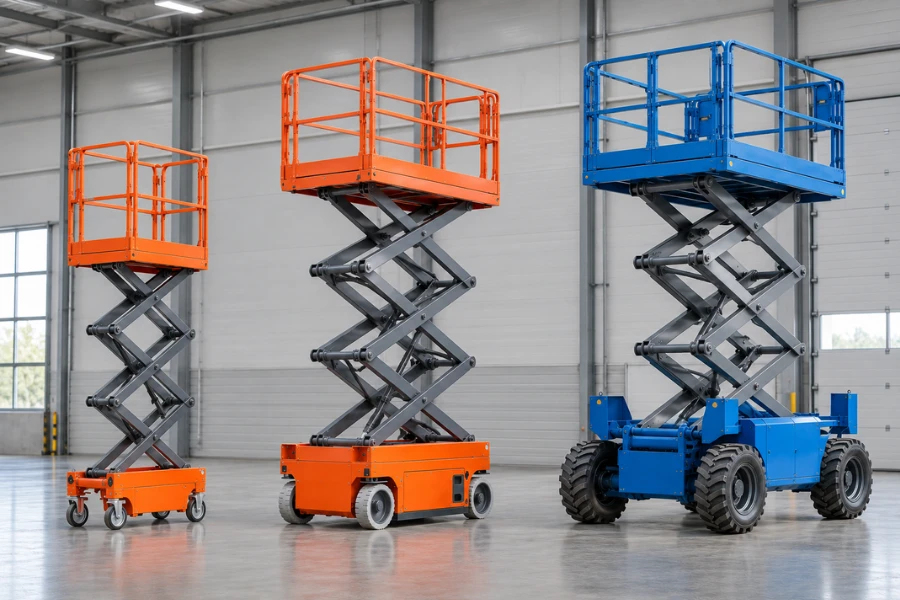
The main differences between mobile configurations are how they move and what surfaces they are designed to operate on.
Push-Around Mobile Scissor Lifts
Push-around models are manually repositioned when prepared for travel.
They can suit work involving short travel distances and occasional relocation. For repetitive tasks across large facilities, manual repositioning may reduce productivity compared with a self-propelled machine.
Self-Propelled Electric Scissor Lifts
Self-propelled electric models combine powered travel with vertical access and are commonly used in warehouses, factories, commercial buildings, exhibition facilities, and indoor maintenance.
They are particularly useful where the operator needs to move repeatedly between work points.
Selection still depends on machine dimensions, turning space, tire configuration, supporting surface, battery capacity, charging access, and expected duty cycle.
Rough-Terrain Scissor Lifts
Rough-terrain models are designed for more demanding travel surfaces.
Depending on the machine, they may provide:
-
Greater ground clearance
-
Tires designed for unfinished surfaces
-
Enhanced traction
-
Four-wheel drive
-
Stabilizing or leveling features
A rough-terrain designation doesn’t mean the machine can elevate on any slope, soft ground, or irregular surface.
Terrain mobility and permitted elevated operating conditions are separate specifications. Always verify the machine’s surface, slope, chassis-level, and elevation limits before operation.
Mobile Scissor Lift vs. Stationary Scissor Lift
Although both use scissor-type lifting geometry, mobile and stationary lifts serve different workflows.
| Factor | Mobile Scissor Lift | Stationary Scissor Lift |
|---|---|---|
| Primary purpose | Elevated access at changing locations | Repeated lifting at a fixed location |
| Mobility | Designed for repositioning | Fixed installation |
| Typical use | Maintenance, installation, construction | Production, loading, material transfer |
| Site requirements | Travel and operating clearance | Permanent installation compatibility |
| Selection focus | Height, capacity, mobility, access, surface | Load, vertical travel, cycle frequency, installation |
The distinction is primarily changing work locations versus a fixed lifting point.
A boom lift addresses a different access requirement. Scissor lifts primarily provide vertical elevation with a relatively spacious platform, while boom-type equipment provides horizontal outreach for reaching over or around obstacles.
Equipment selection should therefore follow the required movement geometry rather than maximum height alone.
Where Are Mobile Scissor Lifts Used?
Mobile scissor lifts are useful where workers need repeated access to elevated work points without permanent access equipment.
Warehouses and Logistics Facilities
Typical tasks include lighting maintenance, overhead services, signs, storage infrastructure, and conveyor maintenance.
Compact dimensions and maneuverability become important where the lift must travel through aisles and move frequently between work points.
Factories and Industrial Facilities
Factories use mobile lifts for machinery servicing, pipework, electrical systems, ventilation equipment, and overhead infrastructure.
Selection needs to account for both platform requirements and the space available around production equipment.
Commercial Buildings
Shopping centers, exhibition facilities, offices, and other commercial buildings may use mobile scissor lifts for lighting, signage, ceiling work, and mechanical or electrical maintenance.
Restricted access, finished flooring, noise, ventilation, and indoor maneuverability can influence equipment selection.
Construction Sites
Construction sites may introduce unfinished surfaces, changing access routes, weather exposure, and variable ground conditions.
These conditions can require a rough-terrain or outdoor-rated configuration.
A machine being mobile doesn’t automatically make it suitable for construction terrain. Its tires, traction, ground clearance, environmental rating, and manufacturer-defined operating limits must match the actual site.
What Are the Advantages and Limitations of a Mobile Scissor Lift?
The main advantage is the combination of vertical access, usable platform space, and repositioning capability.
Typical benefits include:
-
Relatively spacious working platforms
-
Direct access to overhead work areas
-
Capacity for personnel and permitted tools or materials
-
Manual or powered mobility options
-
Indoor and outdoor configurations
-
Efficient repositioning between elevated tasks
The primary geometric limitation is horizontal reach.
A scissor lift works best when the chassis can be positioned below or close to the work point. If machinery, structures, trenches, or other obstacles prevent that positioning, a boom-type platform or another access method may be more suitable.
Other practical limitations include access width, supporting surface, platform capacity, machine weight, environmental restrictions, and operating clearance.
How to Choose a Mobile Scissor Lift
Selection should start with the task and worksite rather than a product model or maximum specification.
1. Determine the Required Working Height
Identify the actual elevation at which the work will occur.
Distinguish working height from platform height when comparing models because manufacturers may present these as different measurements.
More height isn’t automatically better. Moving into a higher machine class can increase dimensions, weight, transport requirements, and cost without improving the actual task.
2. Calculate Platform Load
Calculate the complete permitted working load:
Operators + tools + materials + other permitted equipment
Platform dimensions should also match the task. A larger deck creates more workspace but doesn’t increase rated capacity unless the machine is designed for the additional load.
3. Verify the Access Route
The machine must physically reach the work position before its maximum lifting height becomes useful.
Check:
-
Overall width
-
Stowed height
-
Doorways
-
Aisles and corridors
-
Turning space
-
Ramps and transitions
-
Final positioning clearance
For constrained indoor sites, machine dimensions can eliminate otherwise suitable models before height or capacity becomes the deciding factor.
4. Evaluate the Operating Surface
Assess both the travel route and the surface where the platform will be elevated.
Relevant factors include:
-
Surface strength
-
Levelness
-
Ground firmness
-
Slopes
-
Holes and irregularities
-
Tire suitability
-
Ground clearance
-
Manufacturer-defined surface limits
Select rough-terrain capability when the actual site requires it rather than simply because the work occurs outdoors.
5. Determine Mobility Frequency
Mobility should match the work pattern.
Occasional short-distance repositioning may suit a manually moved unit. Frequent movement between work points can justify a self-propelled configuration.
This is the practical difference between mobility as a product feature and mobility as a productivity requirement.
6. Match Power to the Operating Environment
Indoor applications may prioritize low noise and no engine exhaust at the point of use. Outdoor projects may place greater emphasis on runtime, terrain performance, and access to charging or fuel.
Evaluate battery capacity, charging opportunities, operating duration, travel requirements, ventilation, and maintenance needs against the expected duty cycle.
Power source should follow the operating requirement rather than be used as the only basis for defining the machine as indoor or outdoor.
7. Evaluate Lifecycle Support
Initial specifications determine whether the machine can perform the task. Lifecycle support influences whether it remains serviceable.
Relevant considerations include:
-
Technical documentation
-
Inspection and maintenance requirements
-
Replacement-part availability
-
Battery and power-system support
-
Hydraulic and control components
-
Wheel and tire availability
-
Component compatibility
-
Supplier continuity
For contractors, distributors, and project buyers, these factors can affect downtime and equipment availability long after purchase.
Mobile Scissor Lift Safety and Operating Considerations
Safe operation requires the machine to remain within its designed load, surface, environmental, and movement limits.
A pre-use inspection should address relevant structural, hydraulic, electrical, travel, control, and safety-related components. The work area should also be assessed for supporting-surface condition, overhead clearance, electrical hazards, traffic, and other site-specific risks.
Operators should be trained for the equipment and follow the manufacturer’s operating instructions.
Fall protection, inspection, training, travel, and other requirements can vary by equipment type, application, and jurisdiction. Determine them from the specific machine, manufacturer documentation, site requirements, and applicable regulations rather than applying one rule to every mobile scissor lift.
When Is a Mobile Scissor Lift the Right Choice?
A mobile scissor lift is generally a good fit when the task requires:
-
Primarily vertical access
-
A platform for personnel, tools, or permitted materials
-
Repositioning between multiple work points
-
A supporting surface compatible with the selected machine
-
Sufficient clearance to position the chassis near the work
Consider another solution when the task requires substantial horizontal outreach, when the machine cannot be positioned close enough to the work, or when repetitive lifting occurs at one permanent material-transfer point.
For fixed production or loading applications, a stationary scissor lift may integrate more effectively. For work over or around obstacles, boom-type equipment may provide the required reach.
Mobile Scissor Lift Selection Checklist
Before comparing individual models, confirm:
-
What working height is actually required?
-
What total platform load must the machine carry?
-
How much platform space does the task require?
-
Can the machine pass through the complete access route?
-
What surface will it travel and elevate on?
-
How frequently must it be repositioned?
-
Is manual or self-propelled mobility more appropriate?
-
What power system fits the environment and duty cycle?
-
Are horizontal outreach or obstacle-clearance requirements present?
-
What inspection, maintenance, parts, and technical support will be required over the equipment lifecycle?
EKCNE can help project buyers evaluate these requirements and identify a mobile scissor lift configuration suited to the intended application.












