
Mobile yard ramp capacity selection should start with the maximum combined weight that will travel across the ramp, not cargo weight alone.
The calculation should include the forklift’s operating weight, operator, attachments, and heaviest actual cargo. Buyers must then consider wheel and axle loading, braking forces, duty cycle, platform dimensions, site conditions, and the manufacturer’s rated capacity.
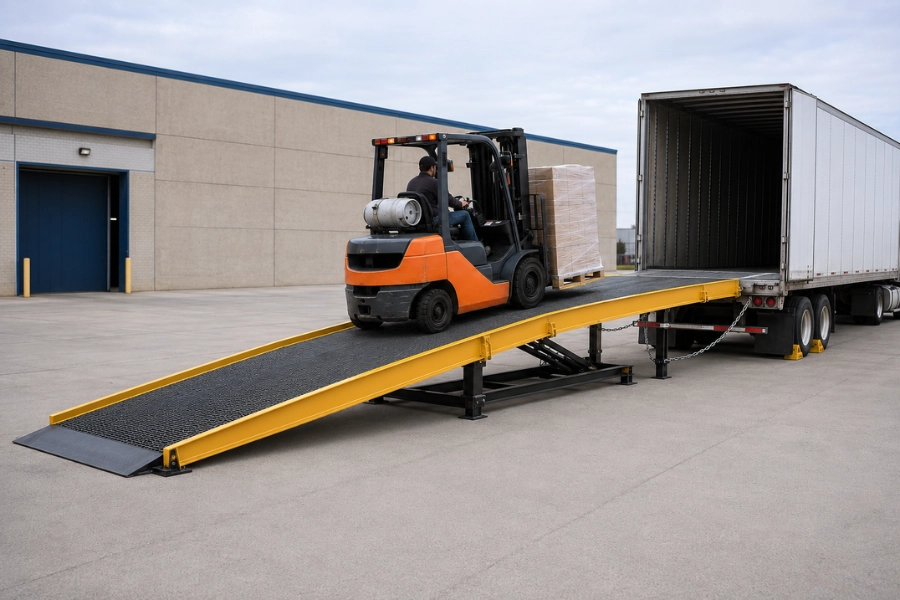
What Mobile Yard Ramp Capacity Means
A mobile yard ramp’s rated capacity is the maximum load the complete structure can support under the manufacturer’s specified operating conditions.
The applied load can include:
-
Forklift operating weight
-
Operator
-
Cargo
-
Attachments
-
Dynamic forces generated during operation
For operations subject to U.S. workplace regulations, OSHA requires dockboards to support their maximum intended load, including workers, equipment, vehicles, materials, and forces reasonably expected on the surface.
Several weight terms need to be distinguished before calculating capacity:
| Term | Meaning |
|---|---|
| Forklift operating weight | Weight of the forklift in its normal working configuration |
| Forklift rated capacity | Maximum load the forklift can lift under specified conditions |
| Cargo weight | Actual load carried during a loading cycle |
| Ramp rated capacity | Maximum permitted load applied to the ramp |
A forklift rated to lift 3.5 tons does not necessarily weigh 3.5 tons. Its actual operating weight can be substantially higher.
How to Calculate Mobile Yard Ramp Capacity
Start with the heaviest forklift-and-cargo combination that could reasonably enter the ramp.
Maximum operating load = forklift operating weight + operator + attachments + maximum actual cargo
Check what is already included in the forklift manufacturer’s published operating weight. Battery weight, standard forks, operating fluids, and other equipment may already be included. Adding them again can overstate the required capacity.
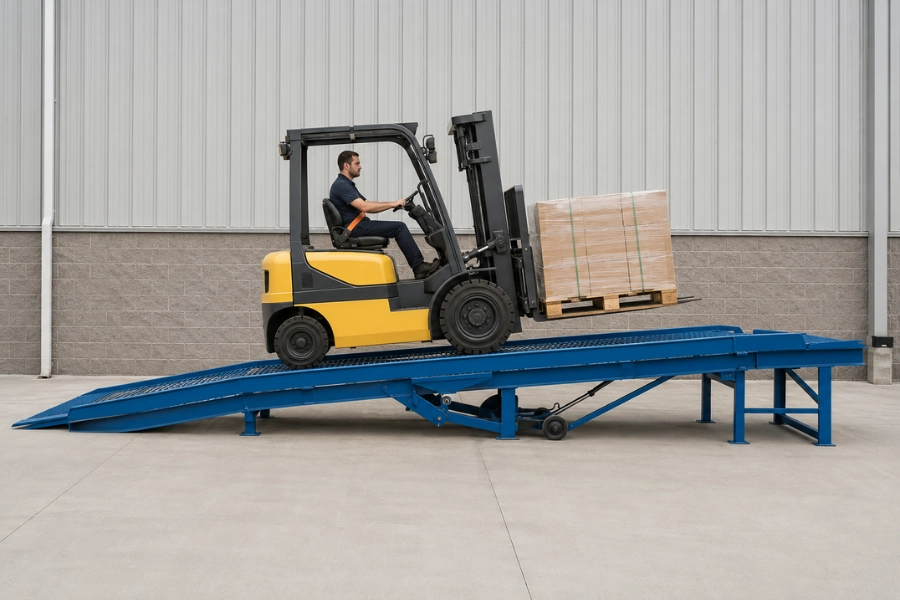
Find the Forklift Operating Weight
Use the forklift data plate, operator’s manual, or manufacturer’s technical documentation to obtain the operating or service weight.
Do not use the forklift’s rated lifting capacity as a substitute for its operating weight.
When an attachment affects the forklift’s capacity or safe operation, the applicable forklift marking and manufacturer documentation should also be reviewed. OSHA requirements for forklift markings include information about certain front-end attachments and their combined weight under specified conditions.
If multiple forklifts will use the same ramp, evaluate each realistic forklift-and-cargo combination. The heaviest forklift does not necessarily create the highest total demand if another forklift carries heavier cargo or uses a heavier attachment.
Use the Maximum Actual Cargo Weight
Use the heaviest cargo expected during an individual loading cycle rather than the average pallet weight.
Potentially heavier loads can include:
-
Machinery
-
Steel products
-
Paper rolls
-
Bulk containers
-
Dense materials
-
Unusually heavy pallets
Foreseeable changes should also be included in the planning process. A ramp selected around current average loads may become unsuitable if the facility later introduces a heavier forklift, attachment, or product line.
Include the Operator and Attachments
The operator contributes to the total applied load and should not be omitted from the calculation.
Attachments can have a larger effect. Clamps, side shifters, fork extensions, rotators, and similar equipment add weight and can change how the load is distributed across the ramp.
When the available specifications are unclear, provide the exact forklift and attachment models to the ramp manufacturer rather than relying on a general weight estimate.
Add an Appropriate Operating Margin
The maximum combined operating load is the starting point for capacity selection. Operating conditions can introduce additional structural demand through acceleration, braking, vibration, transitions, and variations in actual load.
A preliminary calculation can be expressed as:
Preliminary design load = maximum operating load × application factor
Some buyers may use a 20% or 25% allowance for preliminary planning, but these percentages are not universal regulatory requirements. The appropriate margin depends on the manufacturer’s design method and the actual operating conditions.
| Operating condition | Capacity planning approach |
|---|---|
| Occasional controlled loading | Consider a reasonable margin above the full operating load |
| Regular warehouse operation | Consider the next standard capacity above calculated demand |
| Frequent internal-combustion forklift use | Review vibration, braking, and duty cycle |
| Continuous or severe heavy-duty operation | Request a manufacturer-led structural evaluation |
The manufacturer’s published rated capacity remains the controlling limit. An internal planning margin does not permit the ramp to be operated above its marked rating.
Mobile Yard Ramp Capacity Calculation Example
Consider an internal-combustion forklift with an operating weight of 4.5 tons carrying a maximum cargo load of 2 tons.
| Calculation item | Value |
|---|---|
| Forklift operating weight | 4.5 tons |
| Maximum cargo weight | 2 tons |
| Combined operating load | 6.5 tons |
| Assumed preliminary application factor | 1.5 |
| Preliminary design load | 9.75 tons |
| Selected standard capacity | 10 tons |
Under this assumed calculation method, a 10-ton mobile yard ramp would provide a preliminary rated-capacity target because its rating exceeds the calculated 9.75-ton demand.
The 1.5 application factor in this example is an assumption, not a universal requirement. The final factor should be confirmed against the manufacturer’s design method and the actual duty conditions.
The calculation must also be revisited if the forklift uses a heavy attachment that was not included in its operating weight. Frequent travel, hard braking, concentrated wheel loads, or severe transitions may require a higher-capacity or specially configured ramp.
Common Mobile Yard Ramp Capacity Classes
Mobile yard ramps are commonly offered with nominal ratings such as 6, 8, 10, and 12 tons, while higher-capacity designs may be available for industrial or project-specific applications.
| Rated capacity | General application | Main consideration |
|---|---|---|
| 6 tons | Light warehousing and occasional loading | Limited reserve for heavier forklift combinations |
| 8 tons | General warehousing and logistics | Forklift operating weight must be verified |
| 10 tons | Heavy warehouse cargo and industrial loading | Duty cycle and wheel loads still require review |
| 12 tons and above | Machinery, manufacturing, ports, and heavy materials | Site and structural conditions become more critical |
These are product categories, not automatic matches for forklift lifting capacity.
For example, an 8-ton ramp is not automatically suitable for every forklift described as a 3.5-ton model. Forklifts with the same nominal lifting capacity can have different operating weights, wheelbases, axle loads, attachments, and tire configurations.
Why Total Weight Is Not the Only Capacity Check
Two forklifts can impose the same total weight while producing different structural demands. Capacity selection therefore needs to consider where the load is applied and how frequently the ramp is used, not only the total tonnage.
Wheel Load and Axle Load
A loaded counterbalanced forklift can transfer a large proportion of its weight toward the front axle. The ramp deck therefore experiences concentrated wheel loads rather than an evenly distributed load.
Tire configuration also affects local loading. Small, hard tires can create higher local pressure than larger pneumatic tires under similar total weight.
For demanding applications, the ramp manufacturer may need:
-
Front and rear axle loads
-
Wheel arrangement
-
Tire dimensions and type
-
Wheelbase
-
Load-center information
-
Forklift operating weight
-
Attachment information
Braking and Transition Forces
Additional forces occur when a forklift accelerates, stops, or crosses the transition between the ramp lip and truck floor.
Excessive speed, sudden braking, turning, and rough transitions can increase stress on the deck and supporting structure. The ramp should provide a stable transition, while operators should follow the manufacturer’s operating requirements and avoid unnecessary braking or turning on the incline.
Operating Frequency and Duty Cycle
A ramp used for several loading cycles per day has different fatigue and maintenance demands from one carrying continuous traffic across multiple shifts.
The maximum operating weight may be identical in both cases, but repeated loading changes the long-term structural and maintenance requirements.
For intensive applications, buyers should confirm that the ramp is designed for the expected number of loading cycles. Heavy continuous use may require a structural review rather than simply selecting the next higher nominal capacity.
Match Capacity With Ramp and Site Conditions
Capacity alone does not determine whether a mobile yard ramp is suitable. The ramp’s dimensions, geometry, height range, and site conditions must also match the forklift and vehicle.
Check the following parameters:
-
Usable width must provide adequate clearance for the widest forklift.
-
Ramp length and grade must be compatible with the forklift’s permitted climbing ability under load.
-
Height adjustment must cover the lowest and highest vehicle-floor heights.
-
Level-off length must suit the forklift wheelbase and transition geometry.
-
Lip engagement must provide secure contact with the vehicle floor.
-
Ground conditions must provide a level and stable supporting surface.
-
Side curbs and traction surfaces must suit the operating environment.
-
Vehicle restraint should be appropriate for the loading arrangement.
Selecting a ramp only for the highest truck-floor height is insufficient. The ramp must also lower far enough for shorter vehicles while maintaining stable lip contact and an acceptable operating slope.
Underselection and Overselection Both Have Costs
A ramp with insufficient capacity can create overload risk, structural damage, accelerated fatigue, downtime, and serious safety consequences.
Oversizing also has practical costs. A substantially larger ramp can increase purchase price, equipment weight, and the effort required to relocate or position it.
| Selection result | Likely operational effect |
|---|---|
| Capacity too low | Overload risk, structural damage, premature fatigue |
| Capacity greatly oversized | Higher cost, greater weight, reduced mobility |
| Capacity correctly matched | Balanced capacity, durability, cost, and handling requirements |
Moving one standard capacity class above the calculated requirement can be reasonable when foreseeable load variation or future equipment changes justify additional capacity. Excessive oversizing without a defined project need does not automatically improve the loading operation.
Mobile Yard Ramp Capacity Selection Checklist
Before requesting a quotation, collect:
-
Forklift model and operating weight
-
Maximum cargo weight
-
Attachment type and weight
-
Axle or wheel loads, when available
-
Daily loading cycles and operating shifts
-
Minimum and maximum truck-floor heights
-
Required platform length
-
Required usable width
-
Ground and environmental conditions
-
Foreseeable equipment or cargo changes
For international projects, buyers should also confirm applicable local requirements and the manufacturer’s declared design criteria. Any standard or compliance statement included in procurement specifications should be checked for its current status and actual scope.
Providing complete operating information allows the manufacturer to assess the application rather than selecting a ramp from nominal forklift lifting capacity alone.
How EKCNE Supports Ramp Selection
EKCNE treats mobile yard ramp selection as a project compatibility decision. The evaluation can consider forklift operating weight, cargo demand, wheel loading, vehicle height, platform dimensions, site conditions, traffic frequency, and foreseeable changes in operating requirements.
This information can support decisions on rated capacity, structural configuration, height adjustment, platform size, hydraulic operation, and safety features. The objective is to match the loading equipment to the actual application rather than rely on a generic tonnage recommendation.
Final Capacity Selection Advice
Reliable mobile yard ramp capacity selection begins with the forklift’s actual operating weight and the heaviest cargo it will carry.
After establishing the maximum operating load, buyers should account for attachments, wheel and axle loading, operating frequency, dynamic forces, site conditions, and the manufacturer’s capacity-rating method before selecting the final standard capacity.
The result should be a ramp that is adequately rated for the actual application without relying on forklift lifting capacity alone or adding unnecessary capacity without a defined operating requirement.












