
Choosing between a mobile yard ramp and a fixed dock leveler starts with the site’s loading configuration. If forklifts need to move directly between the yard and a trailer, a mobile yard ramp can provide access without a permanent dock. If the facility already has a raised dock, a fixed dock leveler can bridge the gap between the dock floor and trailer bed.
The choice also depends on trailer volume, forklift traffic, available space, installation requirements, operating duration, maintenance, and lifecycle cost.
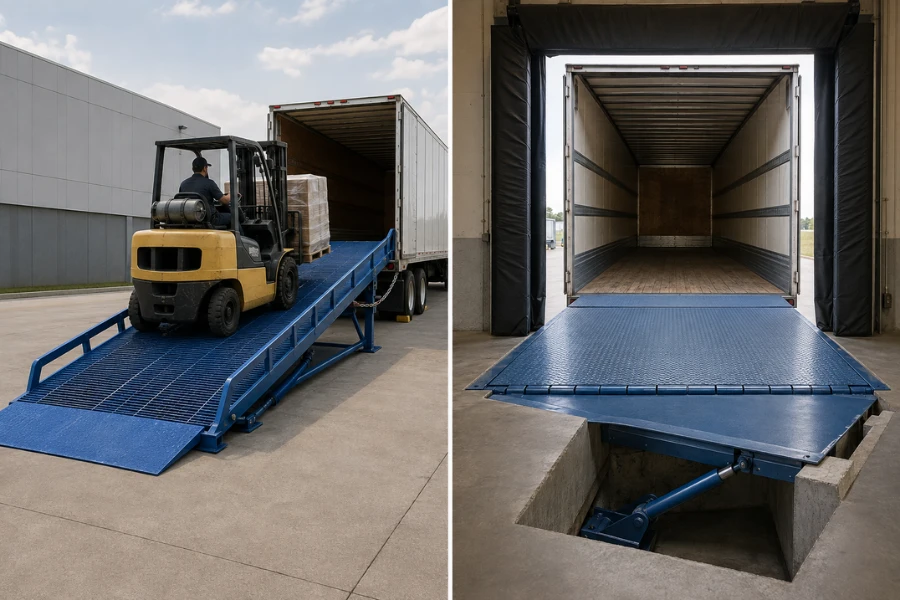
The Two Systems Solve Different Loading Problems
A mobile yard ramp creates a ground-to-trailer loading route. A fixed dock leveler connects an existing raised dock to the trailer.
| Comparison factor | Mobile yard ramp | Fixed dock leveler |
|---|---|---|
| Main function | Creates ground-to-trailer access | Bridges a dock-to-trailer gap |
| Existing dock | Not required | Required |
| Installation | Limited permanent work | Prepared pit and installation required |
| Mobility | Can serve different loading areas | Fixed at one dock door |
| Deployment | Relatively fast | Depends on construction and installation |
| Loading pattern | Variable or distributed | Stable and concentrated |
| Repeated-cycle efficiency | Lower when repositioning is required | Higher at a permanent dock |
| Space requirement | Ramp length and yard maneuvering area | Compatible dock infrastructure |
| Main maintenance | Hydraulics, wheels, supports, deck, connections | Platform, lip, hinges, hydraulics, controls, pit |
| Typical application | Dockless, temporary, outdoor or distributed loading | Permanent, high-throughput dock operations |
How a Mobile Yard Ramp Works
A mobile yard ramp is an adjustable steel structure that creates a forklift route from the ground to a trailer or shipping container. Its inclined deck connects the yard surface to the vehicle bed, allowing forklifts to load or unload without a raised dock.
Typical components include:
-
Inclined deck
-
Level-off section
-
Hydraulic lifting mechanism
-
Support legs
-
Wheels
-
Trailer connection system
The ramp can be moved between loading areas with suitable towing equipment. This makes it useful for dockless warehouses, container yards, leased properties, temporary projects, seasonal operations, and sites where loading points change.
The main operational requirement is sufficient yard space. The site must accommodate the ramp, trailer, forklift approach, towing equipment, vehicle turning, and storage when the ramp is not in use.
How a Fixed Dock Leveler Works
A fixed dock leveler is installed in a prepared pit at a raised loading dock. Its platform and lip bridge the horizontal gap and limited height difference between the dock floor and trailer bed.
Unlike a mobile yard ramp, a dock leveler does not create a complete ground-to-trailer route. It depends on a permanent dock structure positioned close to the normal trailer height.
This configuration is suited to warehouses, distribution centers, and manufacturing facilities where trailers repeatedly use designated dock doors. Because the loading position remains fixed, the equipment can be integrated into established forklift lanes, staging areas, pedestrian routes, and vehicle positions.
How Each System Affects Loading Workflow
Equipment selection affects more than the loading interface. Setup time, forklift travel distance, yard congestion, staging requirements, and loading consistency can influence operating cost and vehicle turnaround.
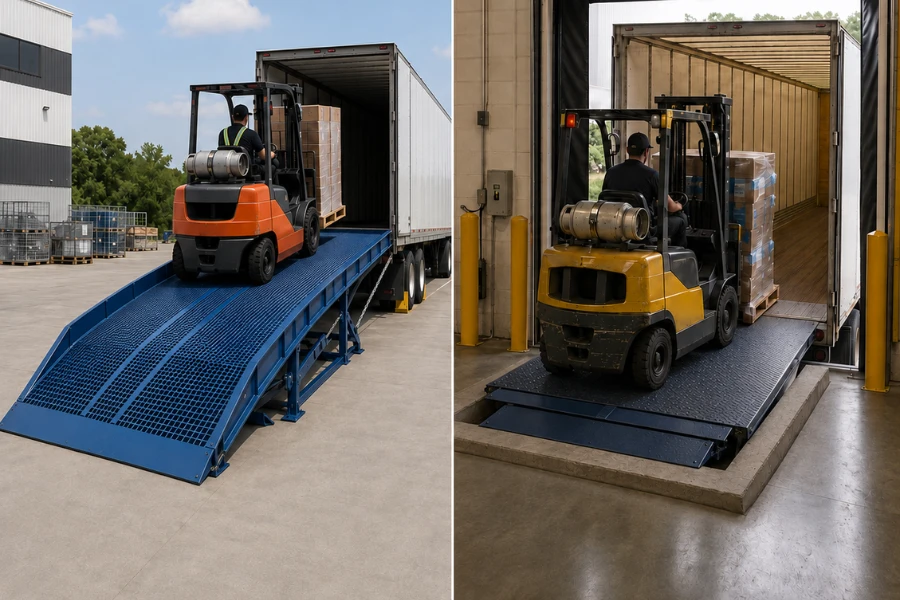
Setup and Vehicle Turnaround
A mobile ramp must be moved into position, adjusted to the trailer height, aligned with the vehicle, lowered onto the trailer bed, and secured before loading begins. The actual setup time depends on the towing method, ramp design, site layout, and operator experience.
A fixed dock leveler normally remains in position after installation. Once a trailer is correctly positioned and secured, the leveler can be deployed from the same working location for each loading cycle.
The difference becomes more important as trailer frequency increases. Occasional loading may tolerate additional setup, while frequent trailer movements can make repeated positioning and securing a significant operating burden.
Forklift Travel and Traffic Flow
A mobile ramp adds vertical travel between the yard and trailer and may lengthen the forklift route. Its entrance can also compete with trailer maneuvering, cargo staging, outdoor storage, or other yard traffic.
A fixed dock leveler generally provides a shorter route between the warehouse floor and trailer. The loading position can be incorporated into defined forklift lanes and staging zones.
The evaluation should therefore consider the complete traffic path rather than the footprint of the loading equipment alone. A correctly rated ramp can still create operational problems if its position interferes with vehicle maneuvering or material flow.
Vehicle Compatibility
Mobile ramps can accommodate trailers and shipping containers positioned in open yards when their adjustable working height covers the required vehicle bed range.
Fixed dock levelers can also accommodate trailer height variation, but the lip must maintain adequate contact with the trailer as its suspension changes during loading.
For either system, buyers should verify:
-
Lowest and highest trailer bed height
-
Trailer and container types
-
Forklift width
-
Tire configuration
-
Turning clearance
-
Ramp or platform width
-
Required lip overlap
-
Rated operating range
Installation and Site Requirements
A mobile yard ramp reduces the need for permanent dock construction, but it does not eliminate site requirements. A fixed dock leveler requires more infrastructure but provides a controlled loading position for long-term use.
Site Conditions for Mobile Equipment
The ramp should operate on a firm, stable surface capable of supporting the equipment, forklift, and transferred load. Damaged pavement, soft ground, cross slopes, poor drainage, or standing water can affect stability and alignment.
The site also needs sufficient space for the ramp, trailer, forklift approach, towing equipment, turning movements, and equipment storage.
For this reason, “no permanent installation” should not be treated as “no site planning.” Pavement condition, drainage, traffic control, and maneuvering space still need to be evaluated before deployment.
Infrastructure for a Fixed Leveler
A fixed dock leveler requires a raised dock, a correctly dimensioned pit, and adequate structural support. Depending on the project, installation may also require concrete work, electrical service, drainage, dock bumpers, vehicle restraints, controls, and building modifications.
The leveler must match the dock height, trailer fleet, door position, pit dimensions, and expected loads. Differences between building dimensions and equipment specifications can reduce the usable working range or require modification.
Maintenance access should also be considered during the design stage. Technicians need a controlled method for supporting the platform, isolating stored energy, and accessing the pit when maintenance is required.
Capacity and Safety Considerations
Loading equipment should not be selected from cargo weight alone. The working load can include the forklift, cargo, operator, and attachments, while the deck or platform is also exposed to dynamic effects as the forklift crosses it.
The maximum combined moving load provides a starting point, but final capacity selection should also consider:
-
Axle loading
-
Tire configuration
-
Load distribution
-
Forklift dimensions
-
Operating frequency
-
Travel speed
-
Manufacturer rating conditions
Safety Priorities for a Mobile Ramp
A mobile ramp depends on correct positioning and securing during every use. Before a forklift enters, the ramp should be stable, aligned with the trailer, within its specified working height range, and properly connected.
Relevant safety features and controls can include:
-
Slip-resistant deck
-
Stable support legs
-
Secure trailer connection devices
-
Side curbs
-
Vehicle restraints
-
Controlled forklift speed
Routine inspection should cover the hydraulic system, wheels, welds, deck, structural components, supports, and connection hardware according to the manufacturer’s instructions.
Safety Priorities for a Fixed Leveler
A fixed installation reduces repositioning requirements but introduces different risks. These can include premature trailer departure, trailer movement, inadequate lip engagement, exposed dock edges, and unexpected platform movement during maintenance.
Common controls include trailer restraints, adequate lip contact, dock communication procedures, edge protection, maintenance supports, and energy isolation.
Neither system is inherently safe simply because of its configuration. Safety depends on equipment selection, installation, operating procedures, inspection, and maintenance.
Upfront Cost and Lifecycle Cost
A mobile yard ramp generally requires less infrastructure investment than a new fixed dock installation. It can therefore be practical when a facility cannot justify permanent dock construction or needs additional loading access on a short schedule.
Its operating cost can increase when workers repeatedly move, position, secure, and store the equipment. Hydraulic components, wheels, supports, connection hardware, and exposed steel surfaces also require ongoing inspection and maintenance.
A fixed dock leveler normally requires a larger initial investment because the project may include the equipment, pit construction, electrical work, installation, dock protection, vehicle restraints, and building modifications.
Once installed, however, a permanent dock can reduce setup work and provide a consistent loading position. At high trailer volumes over a long operating period, the resulting reduction in setup labor and improved traffic flow can affect the cost per loading cycle.
A useful planning metric is:
Lifecycle cost per trailer movement = Total ownership cost ÷ Expected trailer movements
Total ownership cost should include equipment, construction, labor, maintenance, inspection, downtime, energy use, and expected service life. Purchase price alone does not show the cost of operating either system over its useful life.
Loading Equipment Decision Matrix
| Project condition | More suitable starting point |
|---|---|
| No raised loading dock | Mobile yard ramp |
| Existing permanent dock | Fixed dock leveler |
| Multiple outdoor loading points | Mobile yard ramp |
| Repeated traffic at one door | Fixed dock leveler |
| Temporary or leased property | Mobile yard ramp |
| Seasonal overflow | Mobile ramp or hybrid system |
| Stable long-term high throughput | Fixed dock leveler |
| Core dock traffic plus remote loading | Hybrid system |
These are starting points rather than universal rules. Capacity, vehicle geometry, available space, safety controls, utilization, and expected service life still need to be evaluated for the specific project.
When a Hybrid Loading Strategy Makes Sense
A hybrid arrangement can combine fixed dock levelers for routine inbound and outbound traffic with a mobile yard ramp for overflow or remote loading.
The mobile unit can support:
-
Peak-season loading
-
Outdoor containers
-
Remote storage areas
-
Unusual vehicle configurations
-
Loading during dock maintenance
-
Additional capacity when permanent doors are occupied
The additional flexibility only provides economic value when it addresses a recurring operational requirement. Storage, inspection, maintenance, towing, and operator training should therefore be included in the cost evaluation.
Procurement Checklist
Before requesting quotations, confirm the following project information:
-
Existing raised dock availability and condition
-
Maximum forklift operating weight
-
Maximum cargo and attachment weight
-
Forklift axle loading and tire configuration
-
Lowest and highest trailer bed height
-
Trailer and container types
-
Daily and peak trailer volume
-
Number and location of loading points
-
Available ramp length and turning space
-
Pavement condition and drainage
-
Indoor or outdoor exposure
-
Expected operating life
-
Maintenance and spare parts capability
-
Applicable building and workplace requirements
Providing these details allows the supplier to evaluate the complete operating condition rather than selecting equipment from nominal capacity alone.
How EKCNE Supports Loading Access Projects
EKCNE evaluates industrial loading equipment within the broader material-handling process. Configuration decisions can account for combined moving load, trailer height, yard conditions, loading frequency, available space, and long-term maintenance requirements.
With project-oriented manufacturing, customization coordination, export delivery support, and component supply capability, EKCNE can support mobile yard ramp and related industrial lifting projects. The configuration can be matched to the actual operating conditions rather than relying only on a standard model.
Making the Final Decision
The mobile yard ramp vs. fixed dock leveler decision comes down to the site’s loading architecture and operating pattern.
A mobile yard ramp is generally suited to ground-level access, multiple loading points, temporary operations, or situations where permanent dock construction is impractical. A fixed dock leveler is generally suited to an existing raised dock with stable, repeated trailer traffic at designated doors.
The final specification should account for trailer height, combined moving load, forklift configuration, site space, traffic flow, safety controls, maintenance requirements, utilization, and expected service life.












