
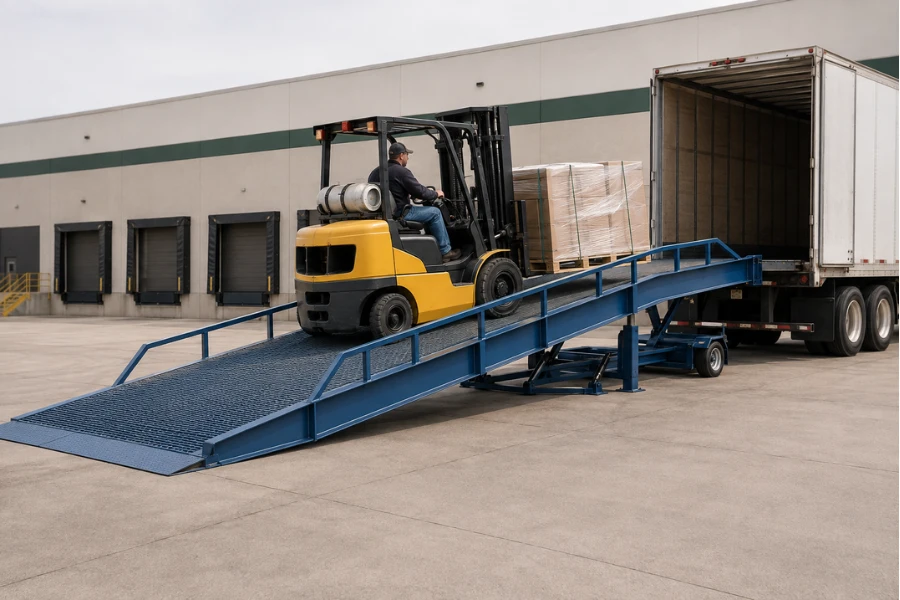
A warehouse loading ramp connects surfaces at different working heights so forklifts and other material handling equipment can move goods between the ground, loading dock, and truck bed. The right system can shorten loading cycles and help facilities without permanent docks handle trailers efficiently.
Choosing a ramp involves more than checking its stated capacity. Buyers must evaluate the loading environment, total operating weight, truck-bed height, ramp grade, usable width, surface traction, safety restraints, and available yard space.
What Is a Warehouse Loading Ramp?
A warehouse loading ramp provides an inclined route between two elevations. Depending on its configuration, it may connect the yard directly to a trailer, provide access to a raised platform, or bridge the gap between a loading dock and a truck bed.
Terms such as loading ramp, yard ramp, dock ramp, and dock leveler are sometimes used interchangeably. However, they describe systems with different structures and applications.
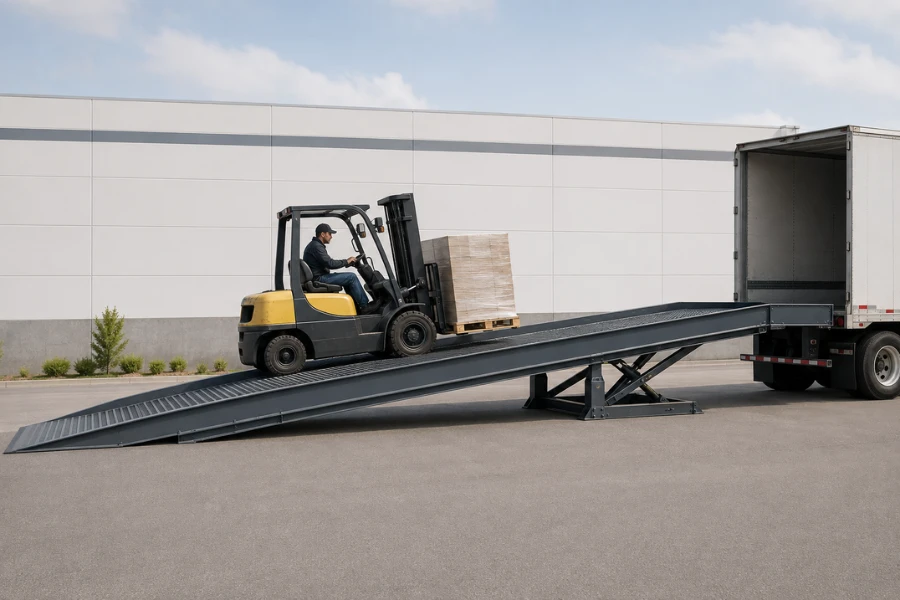
A mobile yard ramp usually creates a complete ground-to-truck route. A dock leveler only bridges the smaller height difference and gap between an existing dock and a vehicle.
Main Types of Warehouse Loading Ramps
Each ramp type offers a different balance of mobility, loading efficiency, site requirements, and initial investment.
| Ramp type | Installation | Mobility | Suitable application | Main limitation |
|---|---|---|---|---|
| Mobile yard ramp | Positioned on a hard yard surface | High | Ground-to-truck forklift access | Requires maneuvering and storage space |
| Fixed loading ramp | Permanently installed | None | Repeated loading at one location | Requires civil work and cannot be relocated |
| Dock leveler | Installed at an existing dock | None | High-frequency dock-to-truck loading | Depends on a raised loading dock |
| Modular loading platform | Assembled from structural modules | Limited | Temporary or expandable dock systems | Occupies more yard space |
| Portable loading ramp | Manually positioned | High | Light equipment and occasional loading | Limited capacity and application range |
Mobile Yard Ramps
A mobile yard ramp usually includes wheels, support legs, a steel deck, and a manual or powered height-adjustment system. It works well for warehouses without permanent docks, seasonal operations, and sites with several loading areas.
Its mobility allows one ramp to serve different positions, but operators must allow time and space for towing, positioning, securing, and storage.
Fixed Ramps and Dock Levelers
A fixed ramp creates a permanent route between the yard and a raised working area. It supports predictable traffic but requires foundations, drainage, installation space, and long-term site planning.
A dock leveler supports fast, repeated loading at a raised dock. It cannot provide complete ground-to-truck access on its own.
Modular and Portable Systems
A modular platform can create a semi-permanent loading station without a conventional concrete dock. Portable ramps are easier to deploy and store but generally suit lighter equipment and occasional handling.
Choosing the Right System for Your Facility
Ramp selection should begin with the actual loading process. Choosing capacity or length before defining site conditions can result in an expensive but incompatible system.
Define the Loading Environment
Start by determining how and where the equipment will operate.
Key questions include:
- Does the warehouse already have a raised dock?
- Will loading occur at one point or several locations?
- Is the ramp needed permanently, seasonally, or occasionally?
- Will it operate indoors or outdoors?
- How many loading cycles occur during each shift?
- Is the ground paved, level, drained, and structurally suitable?
- Is there enough room for ramp positioning and forklift travel?
A mobile yard ramp generally suits changing loading points or warehouses without fixed docks. A dock leveler or permanent ramp usually supports higher efficiency at a dedicated loading bay.
Calculate the Actual Operating Load
Ramp capacity must cover the complete loaded vehicle, not only the goods being transported.
A preliminary calculation can use:
Total operating load = Forklift service weight + Cargo weight + Attachment weight + Other traveling loads
For example, a 4,500-kilogram forklift carrying a 2,500-kilogram load creates a basic combined operating weight of 7,000 kilograms. Selecting a 2,500-kilogram ramp because the cargo weighs 2,500 kilograms would create a severe overload.
The supplier should confirm the final rating after reviewing wheel loads, axle spacing, weight distribution, travel frequency, speed, and dynamic forces.
Match the Truck-Bed Height Range
Truck-bed height varies among trailers and can change as cargo enters or leaves the vehicle. Suspension movement may raise or lower the bed during loading.
Record the lowest and highest vehicle-bed heights expected at the site. The ramp’s adjustment range must cover both limits while maintaining sufficient lip contact with the trailer floor.
Selecting a model around one average height may produce an excessive transition angle, inadequate overlap, or unstable support when other vehicles arrive.
Determine Ramp Length and Grade
Ramp length directly affects slope, traction, under-clearance, and driver control. A shorter ramp saves space but creates a steeper approach.
The basic relationship is:
Ramp grade (%) = Vertical rise ÷ Horizontal run × 100
A ramp rising 1.2 meters over a 12-meter horizontal run has a nominal grade of 10%. Before approving the design, check the forklift manufacturer’s loaded and unloaded gradeability limits, drive-wheel position, braking, traction, under-clearance, weather exposure, and transition angles.
Published gradeability may describe short-duration climbing capability under controlled conditions. It should not automatically be used as the preferred grade for repeated warehouse loading.
Confirm Width and Approach Space
The usable deck width must accommodate the forklift, its tires, the load, and normal tracking correction. Side curbs and guardrails also reduce the clear travel area.
A universal allowance of 15 or 20 centimeters is not suitable for every application. The supplier should review overall forklift width, wheel position, load overhang, steering behavior, and required side protection.
The yard should allow the forklift to align with the ramp before entry. Operators should not need to make tight turns immediately before reaching the incline.
Select the Deck Surface
Surface design affects traction, drainage, cleaning, and compatibility with different wheels.
Common options include:
- Serrated steel grating for drainage and outdoor traction
- Diamond plate for general industrial use
- Open-grid surfaces for wet environments
- Applied anti-slip coatings for specific conditions
An open deck can improve drainage but may not suit equipment with small wheels. A solid deck supports more wheel types but requires effective drainage and regular removal of water, oil, mud, and packaging debris.
Selection by Warehouse Scenario
This matrix provides an initial direction. Final selection still depends on loads, dimensions, traffic frequency, and site conditions.
| Warehouse scenario | More suitable solution | Main reason |
|---|---|---|
| No existing loading dock | Mobile yard ramp | Creates direct ground-to-truck access |
| Several loading locations | Mobile yard ramp | Can be repositioned |
| Permanent high-volume dock | Dock leveler | Supports fast repeated loading |
| Temporary warehouse | Modular platform or mobile ramp | Reduces permanent civil work |
| Outdoor wet environment | Open-grid steel ramp | Improves drainage and traction |
| Light occasional handling | Portable ramp | Easier to deploy and store |
No system is universally ideal. Mobile equipment provides flexibility but requires setup time, while a fixed system improves repeated workflow but limits future relocation.
Safety Controls During Loading Operations
A correctly selected ramp can still become unsafe when the vehicle, ramp, and forklift are not controlled as one operating system.
Secure the Vehicle and Ramp
The truck or trailer must remain stationary throughout loading. The parking brake should be applied, and wheel chocks or an appropriate vehicle restraint should be used according to the facility procedure.
Secure the ramp with the safety chains, locking pins, or other devices specified by the manufacturer. Confirm that the support legs are properly deployed and that the lip maintains sufficient contact with the truck bed.
Control Forklift Travel
Operators should enter the ramp in a straight line and maintain a controlled speed. Turning, hard braking, sudden acceleration, and passing should be avoided on the incline.
Load orientation and travel direction must follow the forklift manufacturer’s instructions and applicable powered industrial truck rules. Pedestrians should remain outside the ramp operating zone while equipment is moving.
Complete a Pre-Use Inspection
Before operation, check the main structure, deck, hydraulic system, restraints, support legs, lip plates, guardrails, and anti-slip surface. Remove mud, oil, ice, and loose debris.
Stop using the ramp if the inspection identifies cracks, deformation, serious corrosion, failed restraints, unstable supports, hydraulic leakage, or other conditions that could affect safe operation.
Common Equipment Selection Mistakes
One of the most serious mistakes is calculating capacity from cargo weight alone. In many applications, the forklift accounts for most of the load placed on the ramp.
Other common errors include:
- Selecting equipment based only on nominal capacity
- Ignoring wheel loads and axle spacing
- Using average truck-bed height instead of the full range
- Choosing a short ramp that creates an excessive grade
- Overlooking drainage and outdoor corrosion
- Failing to reserve straight approach and storage space
- Assuming every deck surface suits every wheel type
These errors often appear after installation, when changing the equipment or warehouse layout becomes more expensive.
Maintenance and Inspection Planning
Maintenance frequency should reflect operating cycles, environmental exposure, ramp design, and manufacturer instructions. Outdoor ramps used every shift normally require closer attention than equipment used occasionally indoors.
Routine work may include cleaning the deck, inspecting structural members, checking hydraulic components, lubricating approved moving parts, tightening hardware, and restoring damaged anti-corrosion coatings.
Facilities should document inspections and repairs. A written history helps identify recurring problems and prevents damaged equipment from returning to operation without approval.
Procurement Information to Prepare
A complete request for quotation allows the supplier to evaluate structural capacity, dimensions, adjustment range, and site compatibility together.
Provide the following information:
- Forklift make and model
- Forklift service weight
- Maximum cargo and attachment weight
- Axle spacing and wheel configuration
- Overall forklift width
- Minimum and maximum truck-bed height
- Daily loading frequency
- Indoor or outdoor conditions
- Available yard and storage space
- Ground condition and drainage
- Preferred deck surface
- Required restraints and guarding
- Applicable local requirements
- Installation and service expectations
Buyers should also request structural drawings, rated-capacity documentation, operating and maintenance manuals, warranty terms, spare-parts availability, and after-sales support. A supplier engineering review is especially important when the facility handles several forklift models or trailer heights.
Final Selection Advice
The correct warehouse loading ramp should match the entire loading process. Begin with the operating environment, calculate the complete loaded equipment weight, confirm the truck-bed height range, and then evaluate grade, length, width, traction, restraints, and maintenance conditions.
A larger or higher-capacity ramp is not automatically the better choice. The most suitable system is the one that fits the warehouse layout, vehicle fleet, handling equipment, loading frequency, and applicable safety requirements without creating new operational risks.












