
Mobile yard ramps allow forklifts to travel between ground level and truck trailers where no permanent loading dock is available. Safe operation depends on matching the ramp to the forklift and load, setting it on suitable ground, restraining both ramp and trailer, maintaining adequate lip contact, and controlling forklift travel.
Stop loading if the ramp shifts, loses hydraulic stability, develops insufficient trailer contact, or shows structural damage.
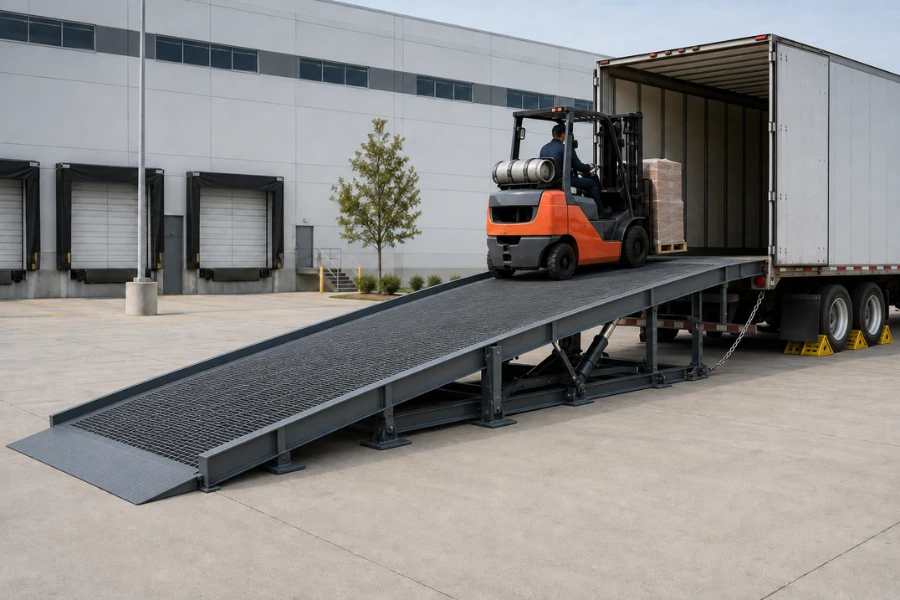
Why Mobile Yard Ramp Accidents Happen
Yard ramp accidents often result from several conditions interacting rather than one isolated failure.
For example, trailer movement can reduce lip contact while a forklift is crossing. Sudden braking or steering on the incline can then increase dynamic forces and further destabilize the ramp-to-trailer connection.
The main hazards and controls are:
| Main Risk | Possible Result | Primary Control |
|---|---|---|
| Ramp or trailer movement | Lip separation or forklift fall | Trailer restraint and ramp anchoring |
| Excessive load | Deck deformation or structural failure | Capacity verification |
| Weak or uneven ground | Support settlement and ramp tilt | Firm, level supporting surface |
| Turning or braking on incline | Forklift instability | Slow, straight travel |
| Water, ice, oil, or debris | Loss of traction | Surface inspection and cleaning |
| Structural or hydraulic damage | Loss of support | Inspection and removal from service |
The important principle is that capacity, ground support, trailer restraint, ramp connection, and forklift operation form one loading system. A wheel chock, safety chain, or careful operator can’t independently compensate for failures elsewhere.
Match the Ramp to the Forklift and Load
Safe operation begins with equipment compatibility.
Ramp capacity, deck width, incline, adjustment range, and trailer interface must match the actual forklift and loading operation.
Calculate the Maximum Operating Load
The ramp must support the maximum intended operating load, not just the cargo.
Verify:
-
Forklift operating weight
-
Maximum cargo weight
-
Fork attachments or accessories
-
Other permitted equipment traveling on the ramp
A forklift’s lifting capacity isn’t its operating weight.
For example, a forklift rated to lift 6,000 pounds may itself weigh substantially more than 6,000 pounds. Side shifters, clamps, and other attachments add further weight.
Calculate ramp loading from the actual equipment and cargo data rather than the forklift’s nominal lifting capacity.
Don’t exceed the ramp’s rated capacity or apply one arbitrary safety margin to every application. If the expected load approaches the rated limit, confirm the application with the ramp manufacturer and select a configuration suited to the operating conditions.
Verify Width, Incline, and Height Range
The deck must provide enough clearance for the forklift while keeping its wheels safely inside the side curbs.
Ramp width should be evaluated against:
-
Forklift overall width
-
Tire track
-
Required side clearance
-
Operator visibility
-
Expected alignment during crossing
More width isn’t automatically better if it makes centered travel difficult to judge.
The ramp incline must also remain compatible with the forklift manufacturer’s approved gradeability. Check forklift ground clearance, trailer floor height, ramp adjustment range, lip geometry, and the upper level-off section together.
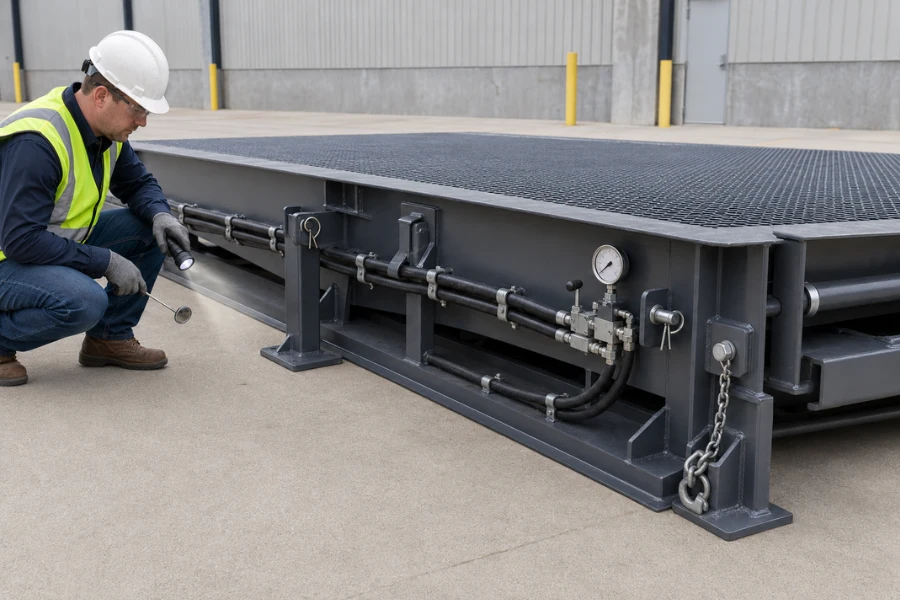
Complete a Pre-Use Inspection
Inspect the ramp before each shift or use according to the manufacturer’s procedure and workplace requirements.
The inspection should answer three questions:
-
Is the structure intact?
-
Can the ramp raise, lower, and hold its position normally?
-
Are the restraint and connection systems functional?
Check the Structure and Travel Surface
Inspect:
-
Main beams and cross members
-
Welds and structural connections
-
Deck grating
-
Side curbs
-
Lip plate
-
Support legs
-
Wheels and axles
-
Chains and hooks
-
Towing components
Look for cracks, bending, permanent deformation, loose connections, severe corrosion, abnormal wear, or impact damage.
Remove water, oil, mud, ice, packaging material, and other debris from the travel surface. Capacity information and required safety labels should remain visible and readable.
Check Hydraulic and Restraint Systems
Inspect hydraulic cylinders, hoses, couplings, valves, seals, and the reservoir for leaks or damage.
Before allowing a forklift onto the ramp, operate the hydraulic system and verify that the platform raises, lowers, and holds its position normally.
Also check:
-
Wheel brakes
-
Chocks
-
Support mechanisms
-
Safety chains and hooks
-
Towing restraints
-
Emergency or manual controls provided by the manufacturer
Use hydraulic fluid and service procedures specified for the equipment and operating environment.
Set Up and Secure the Ramp Correctly
Safe setup requires three separate conditions:
The ground supports the ramp → the ramp remains connected to the trailer → the trailer remains stationary.
All three must be controlled before forklift travel begins.
1. Use Firm and Level Ground
The supporting surface must carry the combined operating load transmitted through the ramp and its supports.
Sound concrete or asphalt generally provides more predictable support than grass, soft soil, loose gravel, or uncompacted fill.
Don’t operate on soft ground, ice, significant cross slopes, or visibly damaged surfaces unless the equipment manufacturer specifically permits the condition.
Inspect the approach route as well as the ramp position. Potholes, drainage channels, curbs, restricted turning space, mud, snow, and standing water can affect alignment or traction before the forklift reaches the incline.
Weather and lighting are part of the same assessment. Suspend loading when adequate traction, visibility, or support conditions can’t be maintained.
2. Align the Ramp and Establish Lip Contact
Position the ramp as close as practical to the trailer centerline so the forklift can approach and cross without steering corrections on the incline.
Adjust the ramp until the lip rests securely on the trailer floor.
Don’t apply one universal overlap dimension to every ramp. Required lip contact depends on:
-
Ramp manufacturer specifications
-
Lip geometry
-
Trailer construction
-
Height relationship
-
Expected movement during loading
Inspect the trailer floor before entry. Sufficient ramp capacity doesn’t make a damaged or structurally inadequate trailer floor safe for forklift loading.
3. Restrain the Trailer and Ramp
Prevent the transport vehicle or trailer from moving during loading.
Depending on the operation and applicable requirements, this may involve truck brakes, correctly positioned wheel chocks, positive vehicle restraints, or another approved method.
Then secure the ramp itself. Lower or engage its support system, apply wheel restraints or brakes as designed, and attach safety chains to suitable vehicle-frame points according to the manufacturer’s instructions.
Remove excessive chain slack where required.
Support legs, wheel restraints, trailer restraints, and safety chains perform different functions. One shouldn’t automatically be treated as a substitute for another.
For U.S. workplaces, OSHA 1910.26 requires applicable portable dockboards to support their maximum intended load, be secured against movement, and include measures to prevent the transport vehicle from moving.
A complete mobile yard ramp isn’t necessarily identical to a portable dockboard covered by every provision of that rule, so applicable requirements should be determined for the actual equipment and workplace.
Operate the Forklift Safely on the Ramp
Only trained and authorized personnel should operate forklifts on the ramp.
Training and operating procedures should account for the specific forklift, load, ramp, trailer, incline, and workplace conditions.
Travel Slowly and Straight
Align the forklift before entering the incline.
Cross at a controlled speed without:
-
Sudden acceleration
-
Sudden braking
-
Unnecessary gear changes
-
Steering corrections
-
Turning around
-
Overtaking another vehicle
Don’t treat a value such as 3 mph as a universal safe speed. Appropriate travel speed depends on the ramp instructions, forklift requirements, incline, visibility, surface condition, and load stability.
Keep the forklift near the deck centerline while maintaining adequate clearance from the side curbs.
Keep the Loaded End Toward the Higher Side
Forklift stability on a grade depends partly on load orientation.
As a general operating principle, the loaded end should remain toward the higher side of the incline. This commonly means traveling forward uphill and reversing downhill while carrying a load.
Unloaded travel can require a different fork orientation.
Operators should follow the forklift manufacturer’s grade-travel instructions and workplace training for the actual equipment because travel direction can depend on forklift type, load, visibility, and operating conditions.
Control Load Position
Keep cargo stable, centered on the forks where appropriate, and close to the mast.
Off-center loads and one-sided wheel travel can introduce concentrated forces into the ramp deck, support system, and structural members even when the total operating weight remains below rated capacity.
If the load blocks the operator’s view, use the travel method required for the forklift and workplace or use a trained spotter where appropriate.
Don’t use the ramp side curbs as normal wheel guides.
Separate Forklifts and Pedestrians
Treat the ramp and its approach area as a controlled equipment zone.
Use appropriate:
-
Barriers
-
Floor or yard markings
-
Warning signs
-
Access restrictions
-
Traffic procedures
-
Spotters where required
Keep pedestrians outside the forklift travel path and away from dock or ramp edges.
No person should stand between the ramp and a reversing or repositioning vehicle.
When Should You Stop Using a Mobile Yard Ramp?
Stop loading and remove the ramp from service when a condition could affect structural support, hydraulic stability, restraint, traction, or safe forklift travel.
Examples include:
-
Bent deck sections, beams, lip plates, or support legs
-
Cracked welds or separating structural connections
-
Hydraulic leakage
-
Inability to maintain the required ramp height
-
Missing or damaged chains, hooks, brakes, or restraints
-
Insufficient lip contact
-
Unexpected ramp or trailer movement
-
Severe corrosion
-
Damaged anti-slip surfaces
-
Missing or unreadable capacity information
-
Damage following overload, collision, or abnormal movement
Working more slowly doesn’t make structural damage, inadequate support, or an unstable connection acceptable.
Tag or otherwise control defective equipment to prevent unauthorized reuse. Qualified personnel should evaluate relevant damage, complete required repairs, and approve the ramp before it returns to service.
Build a Maintenance and Inspection Schedule
Inspection frequency should reflect actual equipment use rather than calendar intervals alone.
Relevant factors include:
-
Operating hours
-
Forklift crossings and load cycles
-
Typical load severity
-
Outdoor exposure
-
Climate and corrosion environment
-
Previous damage
-
Manufacturer recommendations
A ramp operating continuously in a wet or corrosive outdoor environment may require more frequent attention than one used occasionally under controlled conditions.
| Inspection Level | Main Responsibility |
|---|---|
| Before each use | Check deck, chains, restraints, leaks, lip, and visible damage |
| Routine maintenance | Service lubrication points, fasteners, hoses, wheels, and hydraulic system |
| Periodic structural review | Inspect welds, beams, corrosion, and permanent deformation |
| Post-incident inspection | Evaluate overload, impact, repair, or unusual movement |
Maintain records of inspections, defects, repairs, and replacement parts.
After operation, lower the ramp to its designated storage or transport position, engage required restraints, and protect it from avoidable standing water or environmental exposure where practical.
Mobile Yard Ramp Safety Checklist
Before loading begins, confirm:
-
Rated capacity covers the complete operating load
-
Ramp width suits the forklift
-
Ramp incline is compatible with forklift requirements
-
Ground is firm and suitably level
-
Trailer restraint measures are applied
-
Ramp supports and wheels are secured
-
Safety chains are correctly attached
-
Lip contact meets manufacturer requirements
-
Trailer floor is suitable for forklift entry
-
Deck is clean and provides adequate traction
-
Hydraulic system operates and holds normally
-
Structural members show no critical visible damage
-
Travel and maneuvering areas are clear
-
Lighting and weather conditions are acceptable
-
Operator is trained and authorized
-
Pedestrians are outside the controlled operating zone
If a critical condition can’t be verified, don’t begin loading.
Safety Features to Review Before Purchasing
Operating procedures can’t compensate for a ramp that is incorrectly specified for the application.
Procurement teams should evaluate:
-
Rated capacity
-
Capacity identification and documentation
-
Deck width
-
Side curbs
-
Slip-resistant deck surface
-
Support-leg design
-
Wheel restraint or braking system
-
Safety chains and usable attachment points
-
Hydraulic adjustment range
-
Trailer-height compatibility
-
Lip geometry
-
Towing and repositioning system
-
Inspection and maintenance access
-
Replacement-part availability
-
Technical documentation
-
Safety configuration required for the destination market
The procurement review should use the actual forklift operating weight, maximum cargo, attachments, trailer heights, supporting surface, operating frequency, and site conditions rather than selecting from nominal ramp capacity alone.
For industrial loading projects, EKCNE evaluates these application requirements together with equipment configuration, site conditions, usage frequency, and export requirements to reduce capacity, dimensional, and support-system mismatches before deployment.
Final Mobile Yard Ramp Safety Decision
Before the first forklift crosses the ramp, verify four conditions:
-
The ramp is correctly specified for the forklift and load.
-
The ground, ramp, trailer, and connection points are stable and secured.
-
The operator can cross the ramp without turning, sudden braking, or exceeding equipment limits.
-
No structural, hydraulic, restraint, traction, or environmental condition requires work to stop.
Mobile yard ramp safety depends on these conditions working together. A stronger chain, larger wheel chock, higher ramp capacity, or more experienced operator can’t independently compensate for a failure elsewhere in the loading system.












