
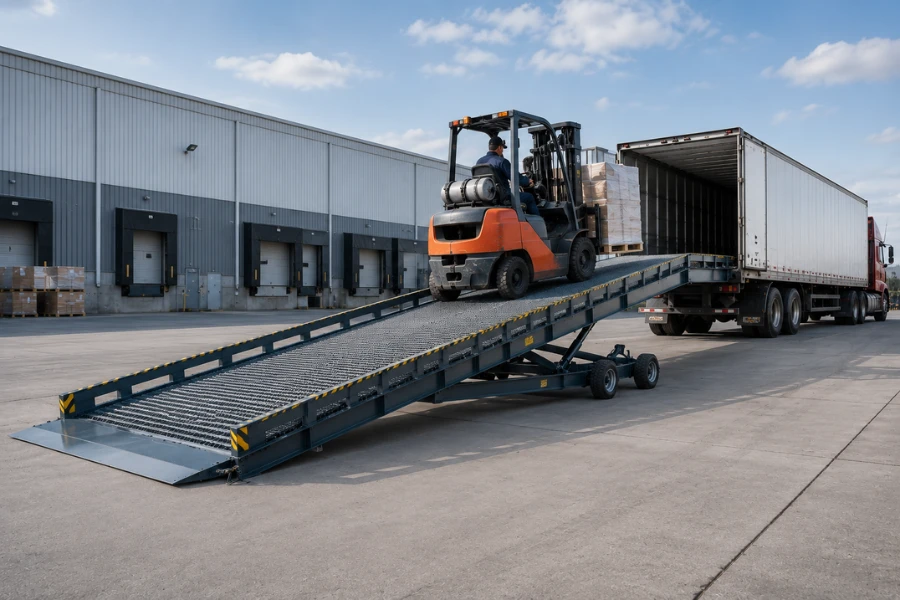
A mobile yard ramp is a movable steel loading structure that creates forklift access between ground level and an elevated truck, trailer, container, or loading area. It is commonly used when a permanent loading dock is unavailable, overloaded, or impractical.
Instead of building fixed infrastructure at every loading point, operators can move the ramp into position, adjust its working height, secure it to the vehicle, and create a temporary ground-to-truck loading path.
The main selection variables are ramp capacity, working height, length and grade, usable width, level-off configuration, site conditions, and loading frequency.
Why Yard Ramps Are Used in Loading Operations
A truck or semi-trailer floor is higher than the surrounding yard. Without a loading dock or another suitable transition, a ground-level forklift cannot drive directly into the trailer.
A yard ramp creates a continuous loading route:
Ground Level → Inclined Ramp → Transition Area → Trailer Floor
This allows dockless loading without permanent civil construction. Because the ramp can be repositioned, the same equipment can also serve different loading points when freight demand or vehicle locations change.
The mobility becomes particularly useful when loading demand varies by location, vehicle type, season, or project.
How Does a Mobile Yard Ramp Work?
A typical operating sequence consists of positioning, height adjustment, securing, and forklift loading.
1. Position the Ramp
A forklift or suitable towing arrangement moves the ramp toward the truck or loading position. Depending on the design, this may involve a tow bar, ramp clamp, or similar connection.
Wheels allow the structure to be relocated around the yard.
2. Adjust the Working Height
The upper end is raised or lowered until it corresponds with the trailer floor. Many designs use hydraulic height adjustment, including manual hydraulic systems that do not require an external electrical supply.
The required specification is not simply the maximum ramp height. The adjustment range must cover the actual deck heights of the vehicles using the ramp.
3. Secure the Loading Interface
After positioning, the ramp must remain stable during forklift traffic. Safety chains or other securing arrangements help maintain the connection between the ramp and vehicle.
The supporting yard surface and trailer stability also need to be verified before loading begins.
4. Move the Forklift Into the Trailer
The forklift travels from the yard, climbs the incline, crosses the transition area, and enters the trailer.
A suitable ramp therefore needs more than sufficient height. Its length, grade, width, transition geometry, and load capacity must also suit the forklift and operating conditions.
Main Parts and Their Functions
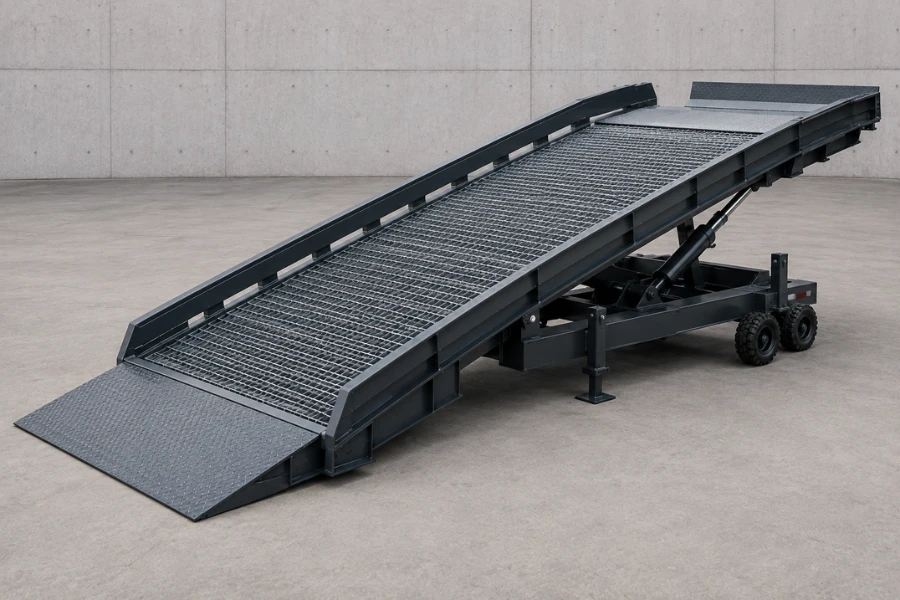
Most mobile yard ramps use welded steel construction designed for repeated forklift traffic, concentrated wheel loads, and outdoor exposure.
| Component | Engineering function |
|---|---|
| Steel structure | Supports forklift and cargo loads |
| Open or serrated deck | Provides traction and allows water and debris to drain |
| Height adjustment system | Matches the ramp to different vehicle heights |
| Level-off section | Provides a flatter transition into the trailer |
| Wheels | Allow relocation around the yard |
| Tow bar or ramp clamp | Connects the ramp to towing equipment |
| Safety chains | Help secure the ramp during operation |
| Side curbs or rails | Help reduce forklift wheel run-off |
Steel provides the structural strength required for these applications. Aluminum can reduce equipment weight but involves different structural and cost considerations.
Four Variables That Determine Whether a Ramp Will Work
Dimensions alone do not determine suitability. The ramp must match the forklift, vehicle fleet, site, and operating pattern.
Load Capacity Is More Than Cargo Weight
A common procurement mistake is sizing the ramp around cargo weight alone.
The ramp supports the loaded forklift, so the relevant load includes the forklift itself:
Required ramp capacity = forklift weight + cargo + relevant operating load
The reference material for this article indicates that common configurations may range approximately from 4 to 15 tons. These are product ranges rather than automatic capacity recommendations. The final rating must be based on the actual forklift, cargo, attachments or operating conditions, and manufacturer rating.
A forklift’s lifting capacity should not be treated as its operating weight.
Working Height Must Match the Vehicle Fleet
The ramp’s adjustment range needs to cover the loading surfaces that will actually use it.
When multiple truck or trailer types share the ramp, identify both the lowest and highest normal deck heights. Depending on design, some configurations may provide approximately 0.8 to 1.7 meters of height adjustment.
The complete vehicle range should be evaluated rather than selecting a ramp from the highest trailer height alone.
Height and Length Determine Ramp Grade
Working height and ramp length need to be evaluated together.
For a given horizontal run, a greater rise produces a steeper incline. A shorter ramp may occupy less yard space, but reaching the same trailer height over a shorter distance increases the grade.
A longer ramp requires more space but can provide a more gradual approach.
The appropriate geometry therefore depends on available yard space and the forklift’s operating limitations under load.
Usable Width Must Match the Forklift
Nominal forklift width is only the starting point.
The usable ramp width needs to provide clearance for the widest forklift expected to cross it, while also accounting for side protection and normal operating movement.
Facilities using multiple forklift models should size the usable width around the largest equipment in the operating fleet.
Why the Level-Off Section Matters
The upper transition determines how the forklift moves from the inclined ramp into the trailer.
While climbing the ramp, the forklift is operating at an angle. Without a suitable transition, the forklift and forks can remain angled as they approach the trailer floor and cargo area.
A level-off section provides a flatter area near the top:
Climb → Transition → Align → Enter Trailer
This allows the forklift to transition toward the trailer floor before entering the cargo area. It can be useful in regular ground-to-trailer operations where forklift alignment affects cargo handling.
A level-off section also increases overall ramp length, so its value needs to be considered against loading requirements and available yard space.
Mobile Yard Ramp vs. Fixed Loading Solution
Mobile and fixed loading systems address similar height differences but support different operating patterns.
| Factor | Mobile yard ramp | Fixed loading solution |
|---|---|---|
| Infrastructure | Limited permanent construction | Usually requires dedicated infrastructure |
| Location | Relocatable | Fixed |
| Loading points | Can serve multiple positions | Serves designated positions |
| Setup | Requires positioning and securing | Normally ready at installed position |
| Maintenance | Includes wheels and adjustment mechanisms | No mobility system to maintain |
| Best fit | Flexible or dockless operations | Frequent loading at permanent locations |
A mobile ramp reduces dependence on fixed dock infrastructure, but the mobility system introduces additional components such as wheels, lifting mechanisms, positioning equipment, and securing hardware.
For high-volume loading at the same location every day, permanent infrastructure may reduce repeated setup work. When loading locations change, a mobile system can provide access without duplicating fixed loading infrastructure.
Where a Portable Loading Ramp Makes Sense
Dockless Warehouses
A yard ramp can provide forklift access between the ground and trailer without immediately modifying the building to create a permanent dock.
Distribution Centers
Distribution facilities can use mobile ramps when permanent dock positions become constrained during peak freight periods. A ramp can provide an additional loading point when the yard layout permits safe positioning.
Temporary and Seasonal Operations
Construction, seasonal, and project-based operations may have loading locations or freight volumes that change over time. In these cases, permanent infrastructure may not match the operating duration or distribution of loading demand.
Container Operations
Portable ramps can also support certain container-loading applications. Container position, floor height, door configuration, approach space, and forklift requirements should be confirmed before selecting a standard configuration.
Safety Starts With a Stable Loading Interface
Structural capacity alone does not make a loading operation safe.
A typical risk chain is:
Unstable Surface → Ramp Movement → Poor Vehicle Connection → Forklift Instability → Loading Incident
The ramp should operate on a sufficiently stable surface and remain properly connected to the truck or trailer. Open or serrated decking can provide traction while allowing water and smaller debris to pass through.
Side curbs or rails can reduce wheel run-off risk. When an uncoupled semi-trailer is being loaded, trailer stabilization may also be required because forklift movement changes the forces acting on the trailer.
Routine inspection should cover:
-
Structural members
-
Securing components
-
Deck condition
-
Wheels
-
Height adjustment system
-
Connection points
How to Choose the Right Ramp
A practical selection process can be organized into five decisions.
1. Vehicle and Height
Identify the trucks, trailers, containers, or other loading surfaces and determine the required working-height range.
2. Forklift and Load
Confirm forklift operating weight, maximum cargo weight, dimensions, and relevant operating limitations.
3. Ramp Geometry
Evaluate usable width, ramp length, grade, transition geometry, and whether a level-off section is required.
4. Site Conditions
Review available yard space, ground condition, outdoor exposure, vehicle maneuvering requirements, and how frequently the ramp will be relocated.
5. Operating Pattern
Determine whether loading is occasional, seasonal, distributed across multiple locations, or consistently high-volume.
This process helps determine whether a standard configuration is suitable or whether the project requires different dimensions, capacity, or operating features.
Mobile Yard Ramp Procurement Checklist
Before requesting a configuration or quotation, confirm:
-
Maximum forklift operating weight
-
Maximum cargo weight
-
Forklift overall width
-
Required usable ramp width
-
Minimum and maximum loading height
-
Truck, trailer, or container types
-
Available ramp length and approach space
-
Forklift grade limitations
-
Level-off requirement
-
Yard surface condition
-
Loading and relocation frequency
-
Height adjustment method
-
Ramp positioning and securing method
-
Side protection requirements
-
Outdoor operating conditions
-
Trailer stabilization requirements
Providing these parameters allows a supplier to evaluate the complete loading operation instead of selecting equipment from nominal capacity alone.
When a Mobile Ramp May Not Be the Best Choice
A movable ramp is not suitable for every loading strategy.
When a facility handles high freight volumes at the same loading position every day and already has suitable permanent infrastructure, a fixed loading dock may provide a more consistent operating arrangement. A mobile system requires repositioning and includes mobility and adjustment components that require inspection and maintenance.
Available yard space can also limit feasibility. The site must accommodate the ramp incline, transition, forklift approach, vehicle positioning, and relocation movements.
Uneven ground, insufficient maneuvering space, unsuitable forklift characteristics, or operating loads above the selected capacity can also make a proposed configuration impractical.
The key procurement question is therefore not simply whether a facility needs a ramp. It is whether the selected loading interface matches its vehicles, forklifts, site conditions, freight volume, and infrastructure strategy.
Mobile Yard Ramp Solutions for Project-Based Loading
For project buyers, ramp selection extends beyond rated capacity. Working height, forklift dimensions, loading frequency, site conditions, mobility requirements, and vehicle type all influence the final configuration.
EKCNE approaches industrial loading equipment as a project-specific material-handling application. Configurations can be evaluated around actual operating requirements, with consideration for customization, manufacturing coordination, export delivery, and compatibility with the broader material-handling environment.
Defining these conditions before equipment selection reduces the risk of purchasing a ramp that reaches the required height but does not fit the actual loading workflow.












