
Absolute and incremental encoders both provide motion feedback, but they establish position differently. An incremental encoder measures movement relative to a reference, while an absolute encoder provides a distinct position value.
In elevator systems, this difference can affect motor feedback, speed regulation, position referencing, startup behavior, and leveling control. Selection should therefore follow the feedback function required by the traction and control system.
Absolute Encoder vs Incremental Encoder at a Glance
| Factor | Incremental Encoder | Absolute Encoder |
|---|---|---|
| Position information | Relative position change | Direct position value |
| Typical output | A/B pulses with optional Z index | Digital position data |
| Position calculation | Requires pulse counting | Read directly by controller |
| Reference requirement | Usually needs a known reference | Position available without homing |
| Power interruption | Stored position reference may be lost | Position can be read after power restoration |
| Multi-turn measurement | Requires external tracking | Available with multi-turn designs |
| System complexity | Relatively simple | More complex |
| Cost | Generally lower | Generally higher |
| Typical strength | Speed and relative motion feedback | Position-oriented feedback |
Incremental feedback primarily tells the controller how much movement has occurred, while absolute feedback identifies where the measured shaft is positioned.
How Does an Incremental Encoder Work?
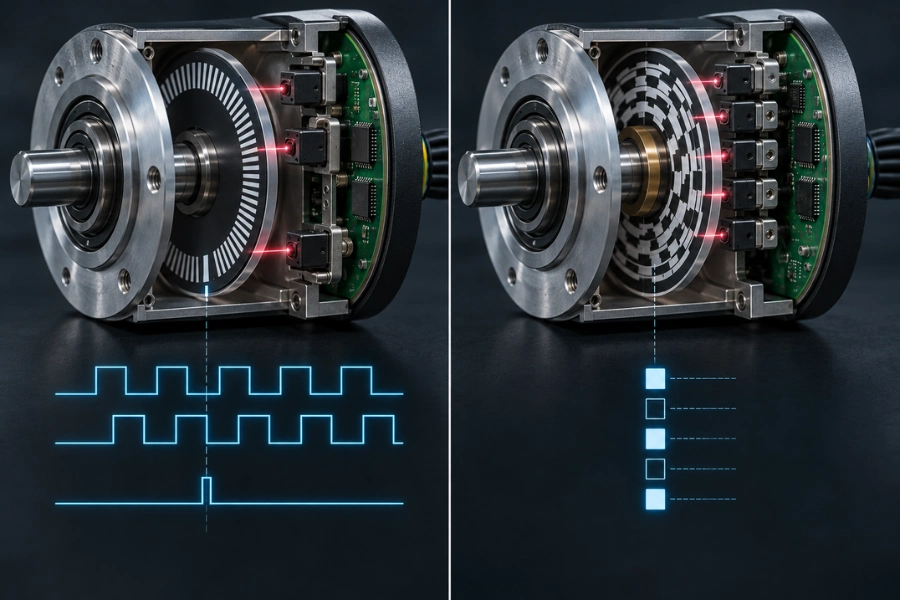
An incremental encoder generates electrical pulses as its shaft rotates. The controller counts these pulses to calculate relative displacement.
Most incremental rotary encoders use A and B output channels offset electrically by 90 degrees. Their phase relationship indicates rotation direction, while pulse frequency provides speed information.
An optional Z or index channel normally produces a reference signal once per revolution. It provides a repeatable reference but doesn’t make the encoder an absolute position sensor.
Resolution is commonly related to the number of pulses or counts available during one revolution. Higher resolution lets the controller distinguish smaller rotational increments, provided its input circuitry can reliably process the signal frequency.
Calculated position depends on a valid reference and accumulated pulse count. If either is lost, the system must re-establish its position reference before reliable positioning can continue.
How Does an Absolute Encoder Work?
An absolute encoder assigns a distinct value to each measurable shaft position. The controller reads this position directly instead of reconstructing it solely from accumulated movement.
Optical designs may use coded tracks on a rotating disk, while other encoders use magnetic sensing. Binary or Gray code can represent the measured position depending on the design.
Absolute encoders generally fall into two categories.
- Single-turn absolute encoders identify angular position within one revolution.
- Multi-turn absolute encoders additionally track position across multiple revolutions.
After a power interruption, the encoded position can be read again when power and communication are restored. This is useful where re-establishing a reference through mechanical movement is undesirable.
Key Differences Between Absolute and Incremental Encoders
Position Reference
Incremental position is calculated from a known reference plus subsequent movement. The controller must continue tracking valid pulses to maintain that calculated position.
An absolute encoder provides a value associated with the measured shaft position, reducing dependence on previous motion history.
Behavior After Power Loss
If an incremental system loses its stored count or reference, it normally needs to establish a known position again. Depending on the elevator design, this may involve an index signal, reference switch, floor-position correction, or another initialization method.
Absolute feedback doesn’t depend on the previous pulse count in the same way. Once the system restarts, the encoder’s current position value can be read.
Encoder position alone doesn’t restore the complete operating state of an elevator. The controller still relies on other system inputs and operating conditions.
Signal and Control Architecture
Incremental encoders typically provide pulse-based outputs suited to compatible drives and controllers for measuring rotational speed, direction, and relative displacement.
Absolute encoders provide explicit position data and require a compatible electrical or communication interface. This provides direct positional information but may add integration requirements.
Error Behavior
Incremental positioning depends on correctly detecting and counting successive pulses. Missed pulses, signal problems, counting errors, or loss of reference can cause the calculated position to diverge from the actual mechanical position.
Absolute encoders don’t have the same cumulative counting dependency because position is read as a value rather than derived solely from previous increments.
This doesn’t mean every absolute encoder is more accurate than every incremental encoder. Resolution, sensing technology, installation, mechanical alignment, electrical conditions, and controller processing all influence practical accuracy.
Cost and System Complexity
Incremental encoders are generally simpler and less expensive, making them practical where speed or relative movement is the primary feedback requirement.
Absolute encoders usually involve more sophisticated sensing and data processing. Multi-turn capability and communication requirements can further increase initial cost.
Lifecycle evaluation should also account for commissioning, reference recovery, downtime, maintenance, and replacement requirements rather than component price alone.
Why Encoder Type Matters in Elevator Systems
In a modern traction elevator, encoder feedback operates within a larger motion-control chain.
Traction machine → Encoder feedback → Drive/VVVF → Elevator controller → Controlled motion
The drive and controller use feedback to coordinate acceleration, constant-speed travel, deceleration, and stopping. Modern VVVF systems can use closed-loop feedback to regulate motor behavior more precisely than open-loop control.
Encoder information may also support position calculations relative to a stopping point. Floor signals, leveling sensors, door-zone signals, and other shaft devices can provide additional references.
A key engineering distinction is that motor shaft position, rotor position, and elevator car position aren’t automatically the same variable. They are related through the mechanical and control system but shouldn’t be treated as interchangeable measurements.
Incremental Encoders in Elevator Control
Incremental encoders are particularly useful for continuous rotational feedback. Pulse frequency provides motor speed information, while A/B phase relationships indicate direction.
This makes incremental feedback suitable for closed-loop motor control when the drive is designed around pulse-based signals. Where position-dependent functions are involved, floor sensors, leveling signals, or correction points can supplement the maintained pulse count.
Absolute Encoders in Elevator Control
Absolute encoders are useful when direct position information is required. Applications can include rotor position feedback, immediate position availability after startup, or measurement extending across multiple rotations.
Permanent magnet synchronous traction machines are an important example because their control may require accurate rotor position information to coordinate motor torque and movement. Multi-turn absolute encoders can additionally maintain position information across repeated shaft rotations.
Absolute feedback doesn’t automatically improve elevator leveling. Final stopping performance also depends on drive tuning, controller logic, braking behavior, mechanical conditions, leveling signals, and commissioning.
Absolute vs Incremental Encoder for Elevator Applications
Encoder selection should follow the required feedback function.
| Elevator Requirement | Engineering Consideration |
|---|---|
| Motor speed feedback | Incremental feedback may be sufficient |
| Rotation direction | A/B incremental signals can provide direction |
| Rotor position feedback | Depends strongly on motor and drive architecture |
| Position needed immediately after startup | Absolute feedback has an advantage |
| Measurement across multiple rotations | Multi-turn absolute feedback may simplify tracking |
| Existing elevator modernization | Existing control compatibility is critical |
| Encoder replacement | Electrical and mechanical requirements must match |
| Leveling improvement | Encoder type alone isn’t the solution |
The engineering question is therefore not which encoder is universally better, but what feedback variable the elevator must measure and how the control system uses it.
How to Choose an Encoder for an Elevator Project
Start by identifying whether the system needs speed feedback, relative movement, rotor angle, persistent position information, or a combination of these functions.
Then verify the technical requirements that can determine whether the encoder will operate correctly.
- Required resolution
- Single-turn or multi-turn measurement
- Output or communication interface
- Supply voltage
- Maximum operating speed
- Shaft and mounting arrangement
- Drive and controller requirements
- Installation environment
- Startup behavior
- Replacement availability
For modernization projects, a higher-specification encoder isn’t necessarily a better replacement. Its signals and operating requirements must remain usable by the existing elevator system.
Common Encoder Selection Mistakes
Choosing by Encoder Type Alone
Absolute and incremental describe how feedback information is generated. They don’t establish whether a specific encoder meets the feedback requirements of an elevator.
Confusing Motor Position With Elevator Car Position
An encoder mounted on a traction machine measures information associated with machine rotation. The controller can use that feedback to support car-motion calculations, but motor shaft position isn’t the same as independently measured car position in the hoistway.
This distinction matters when diagnosing positioning or leveling problems because an apparent car-position error can originate elsewhere in the mechanical or control chain.
Ignoring Interface Compatibility
Physical size and resolution aren’t enough to determine replacement compatibility.
Signal format, electrical requirements, connector configuration, communication method, mounting arrangement, and controller parameters can determine whether a replacement encoder operates correctly.
Assuming Higher Resolution Automatically Improves Leveling
Higher resolution provides finer measurement capability, but elevator performance depends on the complete motion-control system.
Drive tuning, brake behavior, mechanical condition, leveling sensors, controller logic, and commissioning can limit the practical benefit of additional encoder resolution.
Can Absolute and Incremental Feedback Be Used Together?
Absolute and incremental feedback aren’t necessarily competing technologies. Different feedback signals can support different functions, such as continuous speed control and position measurement.
Whether both are required depends on the specific elevator control design.
Selecting the Right Feedback for an Elevator System
Encoder selection should follow the required feedback function and the elevator’s existing traction and control configuration.
For new elevators, modernization, or component replacement, EKCNE can evaluate encoder requirements within the broader traction and control system to help match feedback components to actual project conditions.












