
Elevator encoder maintenance involves more than cleaning the device or checking its cable. Inaccurate leveling, low-speed vibration, irregular acceleration, or repeated feedback faults can originate from the encoder, but similar symptoms can also come from the coupling, wiring, power supply, controller configuration, motor tuning, or other parts of the motion-control system.
Effective elevator encoder troubleshooting therefore starts with the feedback path rather than the encoder alone. The objective is to determine whether the encoder is producing incorrect feedback, whether the signal is being corrupted between the encoder and controller, or whether another system condition is causing a correct feedback signal to produce abnormal elevator behavior.
What Does an Elevator Encoder Do in the Control System?
An elevator encoder converts motor or traction-machine rotation into electrical feedback that the control system can use to determine movement. Depending on the system architecture, this feedback supports speed detection, rotation direction, travel calculation, position control, deceleration, and floor leveling.
In a closed-loop VVVF traction system, the controller compares commanded motor behavior with actual feedback and adjusts the drive accordingly. If the feedback becomes unstable or inaccurate, the control system can make repeated or incorrect corrections, which may become most noticeable during acceleration, deceleration, and low-speed leveling.
Permanent magnet synchronous motor systems can place additional demands on encoder feedback because rotor-position information may also be required for motor control. A maintenance fault can therefore affect more than position indication when the encoder is part of the motor-control loop.
Common Signs of Elevator Encoder Problems
Encoder-related faults often appear as motion or positioning problems rather than complete encoder failure.
| Symptom | Possible Encoder-Related Cause | Other Conditions to Rule Out |
|---|---|---|
| Inaccurate floor leveling | Unstable or incorrect position feedback | Leveling sensor, brake timing, control settings |
| Low-speed vibration | Irregular feedback or mounting instability | Motor tuning, mechanical vibration |
| Jerky acceleration or deceleration | Unstable speed feedback | Drive parameters, brake behavior |
| Repeated feedback faults | Signal loss or intermittent wiring | PG card, connector, controller |
| Unexpected stopping | Missing or abnormal feedback | Other control or safety faults |
| Position inconsistency | Coupling slip or feedback error | Mechanical slip or position-reference issues |
An encoder-related symptom does not confirm encoder failure. For example, a loose coupling can allow the encoder to generate a signal while its rotation no longer accurately represents motor movement, while a damaged or poorly connected cable can interrupt the signal from an otherwise functional encoder.
Fault codes should therefore be used as diagnostic starting points rather than replacement instructions. Their meaning depends on the controller and drive platform, so the code should be evaluated together with wiring, signal behavior, mechanical condition, and system configuration.
How to Inspect and Maintain an Elevator Encoder
A practical elevator encoder maintenance process should move from mechanical inspection to electrical checks, signal verification, and controller configuration. This sequence helps isolate simple physical causes before technicians move to measurements or component replacement.
Inspect the Encoder Mounting and Mechanical Connection
Start with the physical installation. The encoder should remain securely mounted, and its connection to the motor or traction-machine shaft should not show looseness, abnormal movement, or obvious damage.
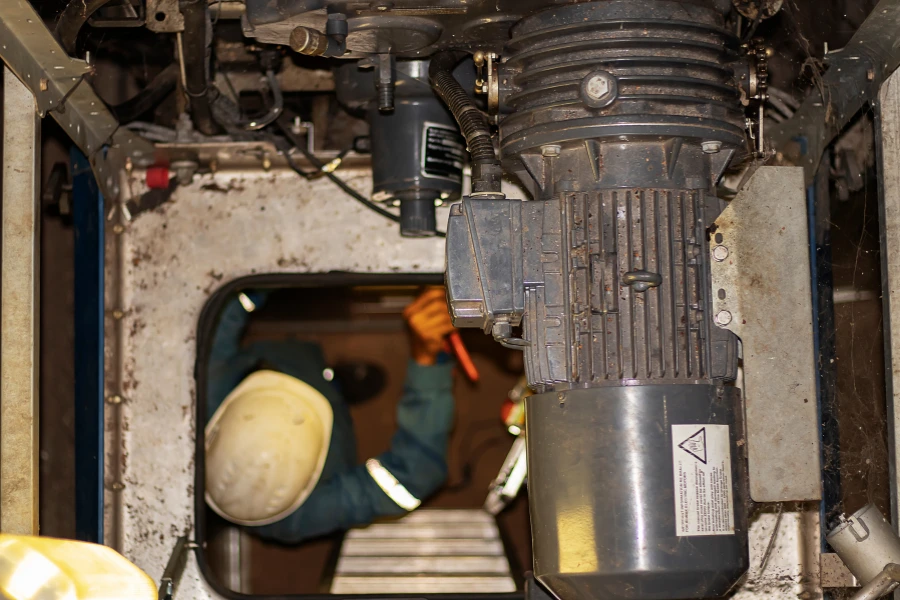
Inspect for:
- Loose encoder mounting
- Loose or damaged coupling
- Shaft connection problems
- Abnormal vibration
- External dust, oil, or other contamination
- Physical damage to the encoder housing or cable entry
- Abnormal mechanical noise where applicable
The coupling deserves particular attention because encoder feedback can remain electrically normal even when mechanical slip has developed. In that condition, the controller may receive a plausible rotational signal that no longer corresponds accurately to actual motor movement.
Alignment and mounting tolerances should be evaluated against the applicable encoder and traction-machine specifications. A universal tolerance value should not be applied across different encoder and motor assemblies.
Check Encoder Wiring, Grounding, and Shielding
Encoder signals can be affected by damaged cables, poor connections, grounding problems, and electromagnetic interference.
Inspect the cable route from the encoder toward the controller or drive for:
- Damaged or strained cables
- Loose connectors
- Poor terminal contact
- Corrosion or oxidation
- Damaged shielding
- Improper cable routing
- Signal cables installed too close to high-power wiring
Shielding and cable routing matter because electrical noise can distort the feedback signal before it reaches the controller. If the controller interprets that distorted signal as a change in motor speed or position, the resulting correction may appear as an encoder fault even though the sensing element itself has not failed.
Grounding arrangements vary by encoder, drive, controller, and system architecture. Maintenance personnel should therefore follow the applicable wiring design rather than applying a universal single-end or dual-end grounding rule.
Verify the Power Supply and Encoder Signal
If the mechanical installation and wiring appear normal, verify that the encoder is receiving the required supply and producing stable feedback.
Depending on the encoder and control architecture, technicians may need to check:
- Encoder supply voltage
- Pulse or digital feedback
- Missing or intermittent signals
- Signal phase relationship
- Feedback direction
- Controller diagnostic values
- Historical fault logs
A multimeter can support basic electrical checks, while detailed waveform or signal analysis may require an oscilloscope or system-specific diagnostic equipment.
Measured voltage and signal characteristics should be compared with the specifications for the installed encoder and controller. A voltage threshold or waveform that applies to one encoder should not be assumed to apply to another.
Check Controller and Encoder Configuration
A mechanically sound encoder can still produce an apparent feedback fault if the controller is configured incorrectly.
Depending on the elevator system, verify:
- Encoder type
- Resolution or pulses per revolution
- PG card compatibility
- Signal wiring sequence
- Feedback direction
- Motor parameters
- Controller feedback settings
- PMSM rotor-position or zero-position data
- Motor tuning status
These checks become particularly important after encoder replacement, controller work, motor wiring changes, or modernization.
A replacement encoder can have the correct physical dimensions and still be incompatible with the system if its signal interface, resolution, communication method, or controller requirements differ from the original configuration.
Before Replacing the Encoder, Rule Out Other Causes
Before replacement, technicians should determine whether another component or condition can produce the same symptom.
| Suspected Encoder Problem | Also Check |
|---|---|
| Floor leveling error | Leveling sensors, brake timing, controller settings |
| Speed deviation | Drive parameters, motor conditions, brake behavior, load |
| Feedback loss | Cable, connectors, power supply, PG card |
| Low-speed vibration | Coupling, mechanical vibration, motor tuning |
| Position inconsistency | Mechanical slip, position reference, control settings |
| Motor tuning failure | Motor parameters, wiring, feedback direction |
This distinction is important because the encoder is one part of a larger motion-control loop. A cable fault can interrupt a valid encoder signal, while mechanical slip can make a correct encoder signal inconsistent with actual elevator movement.
If the external causes have not been eliminated, replacing the encoder may not change the symptom.
How to Clean an Elevator Encoder Safely
External contamination should be addressed during routine maintenance, particularly where dust, oil, or moisture can accumulate around traction equipment.
Before maintenance begins, place the elevator in the required service condition and follow the applicable isolation and safety procedures. Clean accessible external surfaces without forcing contaminants into connectors, cable entries, or the encoder housing.
Sealed encoder assemblies should not be opened simply to clean internal optical components. Internal servicing can change alignment, compromise sealing, or damage sensitive components, so it should only be performed when the encoder service procedure permits it and by qualified personnel.
When Should an Elevator Encoder Be Replaced?
Not every encoder-related problem requires replacement.
Corrective maintenance may be sufficient when the cause is:
- A loose external connection
- Correctable cable routing or shielding
- External contamination
- Loose mounting
- Incorrect controller configuration
Replacement becomes more appropriate when there is confirmed physical damage, persistent internal signal failure, a damaged mechanical interface, or feedback that remains outside specified limits after external causes have been eliminated.
Compatibility must also be verified before installation. The replacement encoder needs to match the relevant traction motor, drive, controller, mounting arrangement, signal interface, and feedback requirements. Matching only the physical dimensions or connector appearance is insufficient.
What Should Be Checked After Replacing an Elevator Encoder?
Encoder replacement is not necessarily a plug-and-play maintenance action. Depending on the traction and control architecture, the replacement may require parameter verification, motor tuning, position learning, or other commissioning steps before normal operation resumes.
A practical post-replacement sequence is:
- Verify mechanical installation. Confirm mounting security, coupling condition, orientation, and applicable alignment requirements.
- Verify wiring. Check connectors, shielding, grounding, signal wiring, and feedback direction.
- Confirm compatibility. Verify the encoder type, interface, resolution, PG card, and controller requirements.
- Check controller parameters. Confirm that encoder and motor parameters match the installed equipment.
- Perform required tuning or position learning. PMSM and other control architectures may require motor auto-tuning, rotor-position learning, or another defined commissioning procedure.
- Test at inspection or controlled speed. Confirm stable feedback before progressing to normal operation.
- Evaluate low-speed behavior. Check startup, deceleration, and final approach to the floor.
- Verify floor leveling. Confirm repeatable stopping performance at multiple floors and operating conditions required by the commissioning procedure.
If abnormal motor current, unexpected movement, or unstable feedback appears during commissioning, stop the process and verify the wiring, feedback direction, parameters, and applicable troubleshooting procedure rather than repeatedly attempting normal operation.
Elevator Encoder Preventive Maintenance Checklist
Preventive maintenance should focus on conditions that can degrade feedback quality or mechanical synchronization before they produce repeated motion-control faults.
| Inspection Area | What to Check | Warning Signs | Response |
|---|---|---|---|
| Mounting | Encoder and coupling security | Movement or vibration | Verify installation |
| Cable | Damage, strain, routing | Cuts or loose connections | Repair or replace as required |
| Connectors | Contact condition | Corrosion or intermittent contact | Inspect and correct |
| Shielding | Cable shielding and grounding | Interference-related faults | Verify installation |
| Power | Supply stability | Intermittent feedback | Compare with specification |
| Signal | Feedback consistency | Missing or unstable feedback | Diagnose signal path |
| Environment | Dust, oil, moisture | Contamination | Clean and protect |
| Controller | Fault logs and configuration | Repeated feedback faults | Diagnose settings and interface |
| Replacement work | Compatibility and setup | Tuning or feedback problems | Recommission the system |
There is no single inspection interval that applies to every elevator encoder. The schedule should reflect the elevator maintenance program, encoder documentation, applicable local requirements, operating intensity, and environmental conditions.
Closer inspection may be appropriate where dust, humidity, vibration, heavy service, or recurring feedback faults place additional stress on the relevant components.
When Encoder Troubleshooting Requires a Qualified Technician
Building operators and facility teams can document recurring leveling errors, vibration, shutdown history, and controller alarms. Recording when the symptom occurs, such as during startup, high-speed travel, deceleration, or leveling, can also help technicians narrow the diagnostic path.
Electrical measurements, controller diagnosis, encoder replacement, wiring changes, motor tuning, feedback-direction changes, and recommissioning should be performed by qualified elevator personnel using the applicable equipment procedures.
This boundary matters because an incorrect feedback configuration can affect actual traction behavior, not merely the accuracy of a diagnostic reading.
Maintain the Complete Feedback System
Effective elevator encoder maintenance means maintaining the complete feedback path rather than treating the encoder as an isolated spare part.
A systematic diagnosis can prevent unnecessary replacement and distinguish encoder faults from problems in mounting, wiring, signal transmission, or control configuration.
For elevator modernization, component replacement, or system integration projects, EKCNE supports project teams in evaluating traction-system compatibility, elevator components, installation conditions, and long-term vertical transportation requirements.












