
Escalator energy efficiency is not determined by a single motor, control system, or energy-saving feature. It depends on how passenger traffic, escalator duty classification, drive efficiency, operating strategy, mechanical condition, and building requirements interact throughout the equipment lifecycle.
Two escalators with similar rated motor power can produce very different annual electricity consumption. One may operate continuously in a busy metro station, while another serves a shopping mall with long periods of low passenger traffic. Operating hours, passenger load, travel direction, mechanical resistance, standby periods, and control strategies all change actual energy demand.
For project owners, contractors, distributors, and procurement teams, the practical objective is to configure an energy-efficient escalator system that meets transportation requirements while controlling electricity consumption, maintenance costs, and long-term operating expenses.
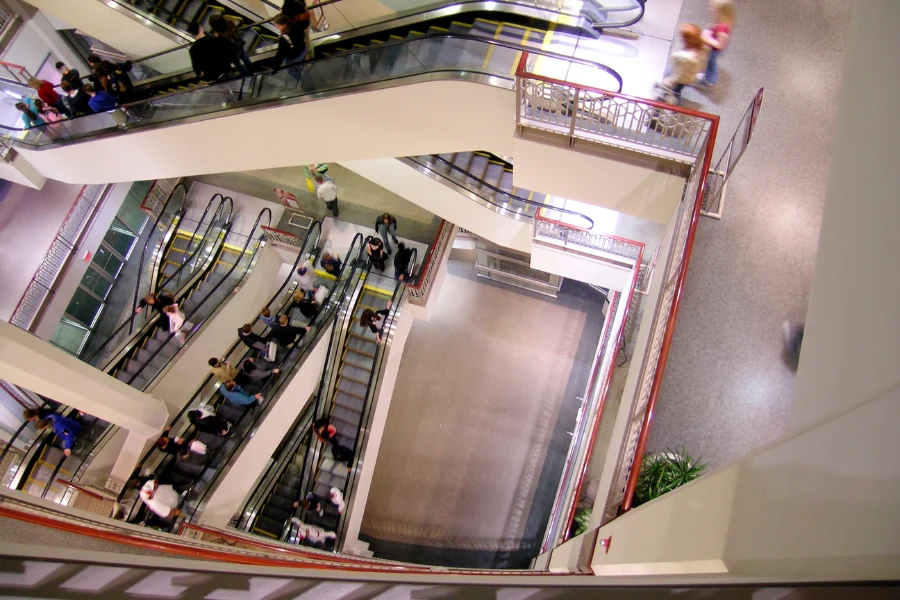
What Determines Escalator Energy Efficiency?
An escalator consumes electricity to move its mechanical system, transport passengers, operate the handrail system, power control equipment, and support auxiliary functions such as lighting or environmental protection equipment.
Major factors include motor and gearbox efficiency, passenger load, travel direction, mechanical resistance, operating speed, daily operating hours, control strategy, auxiliary loads, and equipment condition.
Comparing motor efficiency alone therefore provides an incomplete picture.
A three-phase asynchronous motor may operate at approximately 92% efficiency, while a gear transmission system may reach around 94%. A worm gearbox used in some commercial escalators may operate closer to 80% to 85%.
These individual values matter, but project teams should evaluate total drive efficiency and the complete path of energy through the escalator system.
Understanding the Escalator Energy Flow Model
Electrical energy passes through several conversion and transmission stages before useful passenger transportation occurs.
Electrical Input → Motor Losses → Gearbox Losses → Main Drive Transmission Losses → Step Chain Resistance → Guide Rail and Roller Resistance → Handrail Drive Resistance → Useful Passenger Transportation Work
The motor first converts electrical energy into mechanical output. Electrical resistance, magnetic losses, heat, and other internal losses reduce the amount of energy available at the motor shaft.
The gearbox introduces another efficiency stage. Its losses depend on gear type, lubrication condition, operating load, alignment, and mechanical condition.
Power then passes through the main drive chain, drive shaft, sprockets, and step chain system. Chain tension, lubrication, component wear, and alignment influence how much mechanical energy is lost before the steps move along the guide rails.
Step rollers and guide rails create rolling and contact resistance. Worn rollers, damaged bearings, contaminated tracks, or poor alignment increase the force required to circulate the step system.
The handrail drive creates additional resistance through friction, tension, drive wheel condition, and alignment.
Only the remaining mechanical energy contributes to moving the escalator system and transporting passengers.
This energy flow model explains why Escalator Energy Efficiency should be evaluated as a system-level performance outcome. Installing a high-efficiency motor cannot fully compensate for an inefficient gearbox, excessive chain resistance, poor alignment, or deteriorated mechanical components.
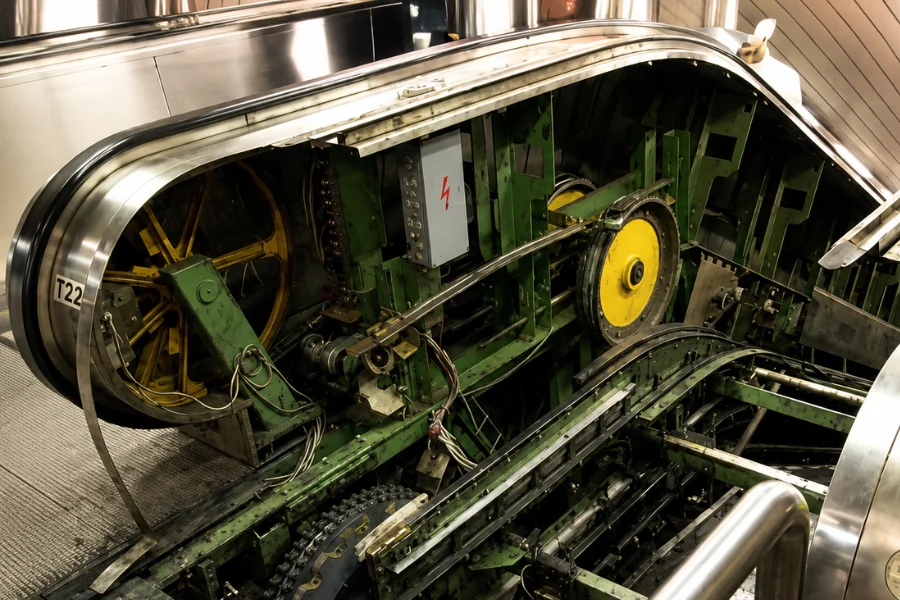
Why Rated Motor Power Does Not Equal Actual Energy Consumption
Rated motor power is often one of the first specifications compared during escalator procurement. However, an 8 kW, 11 kW, or 15 kW motor rating does not directly indicate annual electricity consumption.
Rated power represents the motor’s designed operating capability under specified conditions. Actual input power changes with passenger load, travel direction, mechanical efficiency, operating mode, and equipment condition.
Annual consumption can be estimated through a basic relationship.
Annual Energy Consumption = Average Input Power × Daily Operating Hours × Operating Days
The challenge is determining average input power.
An escalator serving intermittent passenger traffic may operate empty for much of the day. Another unit with the same rated motor power may carry continuous passenger traffic for extended periods.
Direction also matters. An upward-running escalator carrying passengers requires the drive system to overcome gravity and mechanical resistance. A heavily loaded downward escalator creates a different energy flow and may provide opportunities for regenerative operation.
Mechanical deterioration further changes actual demand. Poor lubrication, excessive chain tension, worn rollers, contaminated guide rails, and increased handrail resistance can gradually increase motor load.
Rated motor power should therefore be treated as one design parameter rather than a direct measure of escalator energy consumption.
Passenger Traffic Comes Before Energy-Saving Technology
The primary function of an escalator is to transport passengers safely and continuously according to building traffic requirements. Energy-saving decisions should begin with passenger demand.
A 1000 mm step-width escalator operating at 0.5 m/s may provide a theoretical transportation capacity of approximately 6,000 passengers per hour. Higher speed or different step width can change theoretical capacity, but equipment selection should reflect realistic traffic demand.
Project teams should understand peak passenger volume, average traffic, peak duration, off-peak demand, zero-passenger periods, arrival frequency, transportation continuity, and directional traffic changes.
If actual traffic remains far below available transportation capacity for much of the day, the main energy problem may not be motor efficiency. It may be a mismatch between the building’s traffic profile and the selected operating strategy.
The opposite situation occurs in transport infrastructure. Frequent stopping or aggressive speed reduction may save electricity during short idle intervals but interfere with passenger circulation and increase starting cycles.
An energy-efficient escalator must balance passenger throughput with reasonable lifecycle energy demand.
Escalator Duty Classification Changes the Energy Strategy
Escalators operate under different traffic intensity, operating hours, and load conditions. These differences influence structural design, drive configuration, maintenance requirements, service life expectations, and suitable energy-saving strategies.
Commercial Escalators
Commercial escalators commonly serve shopping malls, hotels, office buildings, and retail facilities where passenger demand changes throughout the day.
Standby stop, low-speed operation, passenger detection, variable-frequency control, and efficient lighting can reduce unnecessary electricity consumption.
The main challenge is controlling empty running without reducing equipment availability or creating excessive start cycles.
Public Transport Escalators
Airports, railway stations, and metro systems require long operating hours and reliable passenger transportation.
Energy performance remains important, but transportation continuity, mechanical durability, maintenance accessibility, and operational reliability carry greater project weight.
Efficient drive systems, appropriate low-speed operation, preventive maintenance, and controlled mechanical resistance can provide better lifecycle results than aggressive stop-and-start strategies.
Heavy-Duty Escalators
Heavy-duty escalators may operate under sustained passenger loads for extended periods, particularly at metro entrances and infrastructure projects.
Total drive efficiency, transmission durability, lubrication performance, component alignment, mechanical resistance, and long-term maintenance condition become central considerations.
Frequent stopping offers limited value when passenger demand remains consistently high.
Where Escalator Energy Is Actually Lost
Improving Escalator Energy Efficiency requires identifying losses that occur throughout the drive system and mechanical structure rather than focusing on one component.
Motor losses result from electrical resistance, heat, electromagnetic effects, and inefficient operating conditions. Appropriate motor sizing matters because long-term operation under unfavorable partial-load conditions may reduce expected energy performance.
Gearbox losses depend on transmission type, lubrication, alignment, load, and mechanical condition. Gear transmissions may provide higher efficiency than worm gear systems, but efficiency should be evaluated together with initial cost, durability, noise, maintenance requirements, and operating conditions.
Mechanical losses occur throughout the step chains, guide rails, rollers, bearings, sprockets, tensioning systems, and handrail drive.
Auxiliary systems also consume electricity. Lighting, controllers, monitoring devices, heating equipment, and environmental protection systems contribute to total energy demand.
Outdoor escalators require broader evaluation. Projects in cold climates may need heating and freeze protection, while rain-exposed installations require drainage and environmental protection measures. Dust, humidity, and corrosion can also increase maintenance requirements and gradually affect mechanical resistance.
Comparing Escalator Energy-Saving Operating Modes
Operating strategy can significantly influence Escalator Energy Efficiency, particularly in buildings with variable passenger traffic.
| Operating Mode | Energy-Saving Potential | Passenger Flow Impact | Mechanical Considerations | Suitable Projects |
|---|---|---|---|---|
| Continuous Operation | Limited | Minimal | Continuous component operation | Heavy and continuous traffic |
| Standby Stop | High during long idle periods | Restart required | Increased start cycles | Intermittent traffic with long idle periods |
| Standby Low Speed | Moderate to high | Faster passenger response | Reduced full-speed running | Commercial buildings and airports |
| Load-Based Control | Traffic dependent | Usually limited | More complex control logic | Variable medium to heavy traffic |
| Regenerative Operation | Project dependent | Minimal | Additional drive and electrical complexity | Suitable directional load profiles |
Continuous operation remains appropriate where passenger flow is frequent and equipment availability must remain uninterrupted.
Standby stop can reduce empty-running time when zero-passenger periods are long. If passengers arrive frequently, repeated stopping and restarting may reduce the practical advantage.
Low-speed standby operation provides a compromise. Some variable-frequency systems reduce speed to approximately 20% of nominal speed when no passengers are detected and smoothly return to rated speed as passengers approach.
Passenger arrival frequency, idle duration, traffic continuity, start frequency, maintenance strategy, and control complexity should determine the operating mode.
Project Scenario: Shopping Mall With Long Off-Peak Periods
Consider a shopping mall where escalators remain available for 14 hours per day, but meaningful passenger traffic is concentrated within approximately six hours.
Morning periods, weekday afternoons, and the final hours before closing may include long intervals with few passengers.
Continuous full-speed operation would keep the escalator ready for immediate use, but much of the daily electricity consumption would support empty running.
Standby stop may provide substantial savings when zero-passenger intervals are long. If passengers arrive intermittently every few minutes, however, repeated start cycles and equipment response should be evaluated.
Low-speed operation may offer a better balance where visible equipment availability and faster passenger response are important.
The appropriate strategy depends on measured passenger arrival patterns rather than building type alone.
How VFD Control Improves Escalator Energy Efficiency
Variable frequency drive control allows motor speed and operating behavior to respond more effectively to passenger demand.
During periods without passengers, an escalator can operate at reduced speed. Passenger detection systems can then trigger smooth acceleration to nominal speed.
This reduces unnecessary full-speed running and can improve Escalator Energy Efficiency in buildings with significant off-peak periods.
VFD control can also reduce mechanical shock during acceleration, potentially lowering stress on drive components and improving passenger comfort.
The benefits are smaller where passenger traffic remains continuous. A heavily used metro escalator may rarely enter low-speed operation.
Retrofit projects require further evaluation. The existing motor, controller, braking logic, safety circuits, passenger detection system, electrical installation, and remaining equipment life must support the modernization strategy.
When Regenerative Drives Actually Save Energy
Regenerative drives can recover electrical energy when operating conditions cause the escalator system to generate energy rather than consume it.
A common opportunity occurs when a heavily loaded escalator travels downward and gravitational energy drives the system.
Instead of dissipating excess energy as heat, a regenerative drive can return part of the recovered electricity to the building electrical system.
Practical savings depend on travel direction, passenger load profile, escalator rise, duration of regenerative conditions, drive efficiency, building electrical infrastructure, and the ability to use recovered electricity.
An upward-running escalator may have limited regenerative potential. A downward escalator with sustained passenger loading may provide a stronger opportunity.
Investment cost and system complexity must also be considered. Regenerative technology should be selected from the project load profile rather than added automatically to every energy-efficient escalator configuration.
Mechanical Condition Can Gradually Increase Energy Consumption
Escalator Energy Efficiency can deteriorate during operation even when the original drive and control systems remain unchanged.
The relationship is direct.
Mechanical Degradation → Increased Resistance → Higher Motor Load → Higher Energy Consumption
Step chains require appropriate tension and lubrication. Excessive tension increases resistance, while insufficient lubrication accelerates wear.
Worn rollers, damaged bearings, contaminated guide rails, poor alignment, and increased handrail resistance can all increase the force required to circulate the escalator system.
Gearbox condition, bearing performance, lubrication quality, and sprocket alignment should also be monitored.
Changes in motor current, vibration, temperature, noise, or energy consumption can indicate developing mechanical problems before major failures occur.
Preventive and condition-based maintenance therefore support both operational reliability and long-term energy performance.
Project Scenario: Metro Station With Sustained Peak Traffic
Consider a metro station where an escalator operates for 18 hours per day.
Morning and evening peaks create sustained heavy passenger flow, while off-peak periods remain relatively short. The escalator may have few opportunities to remain stopped or operate at reduced speed.
Installing sophisticated stop-and-go control would provide limited value if passenger arrivals frequently trigger full-speed operation.
Total drive efficiency, durable transmission components, correct lubrication, controlled chain tension, roller condition, guide alignment, and maintenance accessibility may have greater influence on lifecycle energy consumption.
A small reduction in mechanical losses sustained over thousands of annual operating hours can be more valuable than a control strategy that rarely enters its energy-saving mode.
This is why energy-efficient escalator design must reflect actual duty conditions rather than technology availability alone.
Should You Modernize or Replace an Existing Escalator?
Older escalators may improve energy performance through VFD upgrades, passenger detection, efficient lighting, drive modernization, control replacement, or mechanical refurbishment.
Modernization may be suitable when the truss and major mechanical structure remain serviceable, the equipment has sufficient remaining life, spare parts remain available, and energy improvements can be completed without extensive reconstruction.
Replacement may be more rational when structural or mechanical degradation is significant, reliability problems are frequent, multiple major systems require simultaneous modernization, or remaining service life is too short to recover the investment.
A useful project framework is:
Energy-Saving Potential × Modernization Cost × Remaining Service Life
A project that reduces annual electricity consumption but requires extensive reconstruction may have a weak return on investment. Upgrading an escalator with a sound mechanical structure and outdated control system may provide much stronger lifecycle value.
Escalator Energy Efficiency by Building Type
Building usage patterns change the priorities of energy-efficient escalator projects.
Shopping Malls
Variable passenger traffic creates opportunities for standby operation, low-speed running, passenger detection, and VFD control.
The selected strategy should reduce unnecessary empty running without creating poor passenger response or making the equipment appear unavailable.
Airports
Airport escalators frequently operate for extended hours while passenger traffic changes according to flight schedules and terminal activity.
Low-speed standby operation can be useful where traffic is intermittent but visible equipment availability remains important. Drive efficiency, maintenance reliability, and component durability also matter because long operating hours magnify mechanical losses.
Metro Stations
Transportation capacity and reliability remain primary requirements.
Efficient drive systems, durable mechanical components, controlled resistance, effective lubrication, and condition-based maintenance may provide greater lifecycle value than frequent stop-and-start operation.
Outdoor Escalator Projects
Outdoor installations require a broader energy evaluation.
Heating, freeze protection, drainage, environmental protection systems, and increased maintenance requirements may influence total energy consumption.
Cold climates, coastal corrosion, humidity, heavy rainfall, and dust exposure can also affect equipment condition and mechanical resistance.
How to Evaluate Escalator Energy Efficiency Before Procurement
Escalator Energy Efficiency should be designed into the project before equipment procurement rather than treated only as an operating cost problem after installation.
Procurement teams should evaluate:
- Expected and peak passenger traffic
- Passenger arrival patterns
- Daily operating hours
- Duration of zero-passenger periods
- Required transportation continuity
- Escalator rise and inclination
- Step width and nominal speed
- Duty classification
- Motor and gearbox efficiency
- Total drive efficiency
- Operating mode
- VFD configuration
- Regenerative potential
- Lighting and auxiliary loads
- Indoor or outdoor environment
- Maintenance accessibility
- Spare parts continuity
- Modernization compatibility
- Expected service life
- Local electricity costs
The lowest motor rating does not necessarily produce the lowest lifecycle energy cost.
Adding every available energy-saving technology can also increase procurement cost, maintenance requirements, and control complexity without producing a reasonable return.
Buyers should compare transportation capacity, actual traffic conditions, drive efficiency, annual energy use, operational reliability, maintenance requirements, modernization flexibility, and expected service life together.
How EKCNE Approaches Energy-Efficient Escalator Projects
EKCNE approaches Escalator Energy Efficiency through project-level evaluation rather than isolated equipment features.
The process begins with building usage, passenger traffic profile, required transportation capacity, operating hours, duty classification, installation environment, and maintenance conditions.
These requirements guide the selection of drive configurations, operating modes, control strategies, mechanical specifications, and environmental protection measures.
A commercial project with long zero-passenger periods may benefit from suitable standby or low-speed control. A public transport project may require greater emphasis on total drive efficiency, mechanical durability, maintenance accessibility, and long-term operating stability.
EKCNE supports customized escalator configuration, manufacturing coordination, export delivery, international project deployment, component supply, and long-term maintenance compatibility.
The objective is to develop an energy-efficient escalator system that balances passenger transportation requirements, building conditions, electricity consumption, maintenance realities, and lifecycle value.
Final Thoughts
Escalator Energy Efficiency is a system-level engineering outcome.
Efficient motors, VFD control, regenerative drives, intelligent operating modes, and low-power auxiliary systems can reduce electricity consumption, but their value depends on passenger traffic, building usage, duty conditions, mechanical resistance, and lifecycle requirements.
A shopping mall with long off-peak periods requires a different operating strategy from a metro station with sustained passenger loads. An outdoor escalator in a cold or humid environment introduces different auxiliary loads and maintenance conditions from an indoor commercial installation.
Effective energy-efficient escalator planning combines traffic compatibility, appropriate duty classification, total drive efficiency, suitable operating control, controlled mechanical losses, preventive maintenance, and lifecycle planning.
For project owners, contractors, distributors, and engineering teams evaluating new escalator installations or modernization projects, EKCNE can support project requirement analysis, customized escalator configuration, manufacturing coordination, international delivery, and long-term component supply.
The goal is to select an escalator system that meets building transportation requirements while maintaining practical energy performance, operational reliability, and long-term lifecycle value.












