
For many older adults, remaining in their own home is far more appealing than relocating to a retirement community or assisted living facility. However, stairs often become one of the biggest barriers to independent living as mobility changes over time.
A home elevator for elderly users can help eliminate this challenge by providing safe and convenient access between floors. More importantly, a well-planned aging in place elevator allows homeowners to maintain independence, reduce fall risks, and adapt their homes for future mobility needs.
Whether you are planning for yourself, your parents, or a multi-generational household, choosing the right home lift for elderly family members requires careful consideration of accessibility, building compatibility, safety, and long-term usability.
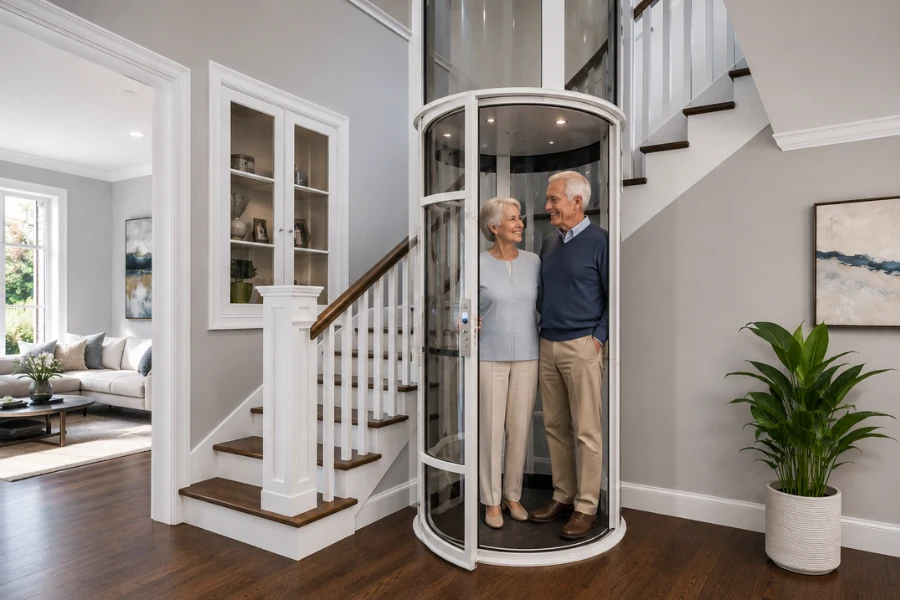
Why More Seniors Are Choosing Home Elevators
A growing number of homeowners are installing a home elevator for elderly users as part of their aging-in-place strategy.
Unlike temporary accessibility solutions, a residential elevator for seniors provides long-term access throughout the home while supporting future mobility changes. As stairs become more difficult due to arthritis, balance issues, joint replacement recovery, or reduced strength, an elevator can help preserve independence without requiring relocation.
Many homeowners also view an elevator for seniors as a proactive investment. Rather than waiting until mobility becomes severely limited, they choose to install an aging in place elevator while renovation options remain more flexible.
Common benefits include:
- Reduced stair-related fall risks
- Easier transportation of laundry and groceries
- Improved accessibility for walkers and wheelchairs
- Greater independence
- Support for caregivers and family members
- Long-term usability of multi-story homes
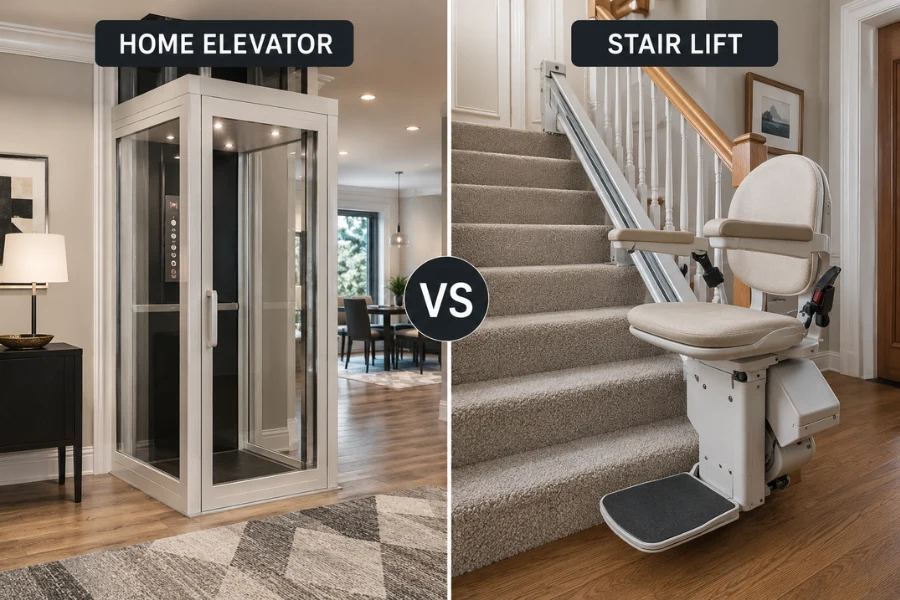
Home Elevator vs Stairlift for Elderly Users
Stairlifts and elevators both improve accessibility, but they solve different problems.
A stairlift transports a seated user along a staircase. A home elevator for elderly users provides a fully enclosed cab that moves vertically between floors.
Know more about Stairlift Solution >>
For homeowners planning long-term accessibility, a residential elevator for seniors often offers greater flexibility.
| Feature | Home Elevator | Stairlift |
|---|---|---|
| Wheelchair Compatible | Yes | No |
| Caregiver Can Accompany User | Yes | No |
| Carries Household Items | Yes | Limited |
| Multiple Floors | Yes | Limited |
| Future Mobility Changes | Excellent | Moderate |
| Daily Convenience | Excellent | Moderate |
Many families initially consider a stairlift because of lower installation costs. However, when future wheelchair use, caregiver assistance, or everyday convenience become priorities, an elderly home elevator frequently becomes the more practical long-term solution.
Which Type of Home Elevator Is Best for Seniors?
There is no universal answer. The best home lift for elderly users depends on the home’s structure, available space, travel requirements, and future accessibility goals.
Hydraulic Home Elevators
Hydraulic systems remain a popular option for residential applications.
Advantages include:
- Smooth ride quality
- Lower structural requirements
- Shallow pit possibilities
- Suitable for retrofit projects
Potential limitations include:
- Hydraulic fluid maintenance
- Higher energy consumption
- Temperature sensitivity
Hydraulic elevators can be particularly effective for existing homes where construction constraints limit available installation options.
Traction Home Elevators
Traction systems use ropes or belts and a counterweight system to move the cab.
Advantages include:
- Quiet operation
- Excellent leveling accuracy
- High energy efficiency
- Smooth acceleration and deceleration
- Automatic rescue functions
For homeowners seeking premium ride comfort and long-term efficiency, traction systems are often considered an excellent elevator for seniors.
Screw Drive Home Elevators
Screw drive systems are frequently selected when installation space is limited.
Advantages include:
- Compact footprint
- Minimal pit requirements
- Low overhead requirements
- Suitable for retrofit projects
Their primary limitations include slower travel speeds and greater mechanical noise compared with traction systems.
For small homes or space-constrained renovations, screw drive systems can provide an effective aging in place elevator solution.
Safety Features Every Elderly User Should Prioritize
Safety features often influence daily usability more than drive technology.
When selecting a home elevator for elderly users, homeowners should prioritize features that improve confidence and reduce operational risks.
Important safety features include:
- Automatic rescue devices during power outages
- Emergency communication systems
- Door obstruction sensors
- Emergency lighting
- Non-slip flooring
- Handrails
- Battery backup systems
Modern residential elevator for seniors projects should also include reliable door protection systems that prevent movement when obstructions are detected.
Accessible Controls and User-Friendly Design
Accessibility extends beyond simply moving between floors.
The control system must remain easy to operate for users with changing physical abilities.
Important design features include:
- Large illuminated buttons
- Braille labels
- Audible floor announcements
- Visual floor indicators
- Reachable control panel heights
These features improve usability for individuals with reduced vision, limited dexterity, or mobility challenges.
An elevator for seniors should be intuitive to use every day, not only during emergencies.
Why Door Width and Cabin Size Matter
One of the most overlooked aspects of planning a home lift for elderly users is cabin sizing.
Many homeowners design around current needs while overlooking future accessibility requirements.
Wider door openings provide:
- Easier wheelchair access
- Better walker maneuverability
- Improved caregiver assistance
- Safer entry and exit
Similarly, larger cabins improve usability and comfort while providing additional flexibility if mobility devices become necessary later.
A properly sized aging in place elevator should support not only today’s requirements but also future mobility changes.
Planning for Future Wheelchair Accessibility
One of the strongest arguments for installing a home elevator for elderly users is future-proofing the home.
Many homeowners can still use stairs when they begin researching elevators. However, mobility needs often evolve gradually over time.
Questions worth considering include:
- Will a wheelchair eventually be required?
- Will a caregiver need to ride with the user?
- Will a walker or mobility scooter be used?
- Will medical equipment need transportation between floors?
By planning for these possibilities early, homeowners can avoid expensive modifications later.
Future-oriented cabin dimensions, wider doors, and accessible controls often provide better long-term value than designing around immediate requirements alone.
Why Mirrors and Handrails Improve Safety
Mirrors and handrails are frequently viewed as optional design features, but they often play an important accessibility role.
For wheelchair users, mirrors can improve visibility when maneuvering in compact cabins. They help users identify door locations and navigate safely when reversing.
Handrails provide additional support during:
- Entry
- Exit
- Balance adjustments
- Unexpected movement
Because many falls occur while entering or exiting an elevator rather than during travel, handrails can significantly improve user confidence.
Common Building Challenges When Installing a Home Elevator
Building compatibility is one of the most important factors in any elderly home elevator project.
The ideal elevator on paper may not be the ideal elevator for a specific building.
Limited Shaft Space
Many existing homes were not designed for elevators.
Available space often determines whether a hydraulic, traction, screw drive, or compact shaft solution is most practical.
Narrow Stairwells
Retrofitting an elevator near an existing staircase may require careful structural evaluation and customized shaft planning.
Shallow Pit Conditions
Some homes cannot accommodate traditional pit depths without extensive excavation.
In these situations, low-pit or shallow-pit elevator designs may provide a more practical solution.
Low Overhead Clearance
Top-floor clearance requirements vary between systems.
Limited overhead space can influence elevator selection and overall project feasibility.
Structural Load-Bearing Limitations
Older homes may require structural assessments before installation.
Load-bearing capacity, wall construction, and foundation conditions can all influence elevator planning.
For retrofit projects, EKCNE frequently evaluates shaft conditions, available floor space, pit depth limitations, and overhead restrictions before recommending a suitable elevator configuration.
Can Existing Homes Be Retrofitted With a Home Elevator?
Yes. Many successful aging in place elevator projects occur in existing homes.
Potential installation approaches include:
- Stairwell integration
- Small shaft installations
- Exterior elevator additions
- Self-supporting shaft systems
- Customized structural solutions
The most suitable strategy depends on building conditions rather than elevator preferences alone.
This is why building assessment is often one of the first steps in successful retrofit planning.
Home Elevator Cost Considerations for Seniors
The cost of a home elevator for elderly users varies significantly depending on project requirements.
Key factors influencing costs include:
- Drive system selection
- Number of floors served
- Shaft construction requirements
- Cabin dimensions
- Door configurations
- Retrofit complexity
- Accessibility customization
In many projects, building conditions have a greater influence on overall costs than the elevator equipment itself.
Homes requiring significant structural modifications typically involve higher installation expenses than projects where suitable space already exists.
Can a Home Elevator Improve Long-Term Property Usability?
While many homeowners focus on accessibility benefits, a residential elevator for seniors can also improve long-term property usability.
Benefits may include:
- Improved accessibility for future occupants
- Greater appeal to multi-generational households
- Enhanced aging-in-place readiness
- Better accommodation of mobility devices
Rather than viewing an elevator solely as a mobility solution, many homeowners see it as a way to extend the functional lifespan of their property.
Maintenance and Long-Term Reliability Considerations
Reliability is essential for any home elevator for elderly users.
Routine maintenance helps ensure consistent operation and minimizes unexpected downtime.
Homeowners should evaluate:
- Preventive maintenance requirements
- Local service availability
- Spare parts continuity
- Emergency support options
- Lifecycle operating costs
An elevator that remains reliable over decades often delivers greater value than one selected solely on initial purchase price.
How EKCNE Supports Home Elevator Projects for Elderly Users
Every home presents unique accessibility challenges.
Some projects involve limited shaft space. Others require wheelchair accessibility, shallow pits, outdoor installations, or customized cabin layouts.
As a project-oriented vertical transportation solution provider, EKCNE helps homeowners, contractors, and developers evaluate building conditions, accessibility requirements, installation constraints, and long-term mobility goals before selecting a solution.
By focusing on building compatibility, maintenance accessibility, future mobility planning, and lifecycle reliability, EKCNE helps create practical elderly home elevator solutions that support safe and independent living for years to come.












