
When planning a home lift project, one of the most important decisions is choosing between a hydraulic home elevator and a traction home elevator. Both systems are widely used in residential buildings, but they differ significantly in operating principles, installation requirements, long-term maintenance, and building compatibility.
Many homeowners initially focus on purchase price alone. In reality, factors such as elevator shaft conditions, travel height, energy consumption, maintenance accessibility, and future modernization often have a greater impact on long-term ownership.
Understanding these differences can help homeowners, architects, builders, and developers select the most suitable residential elevator solution.
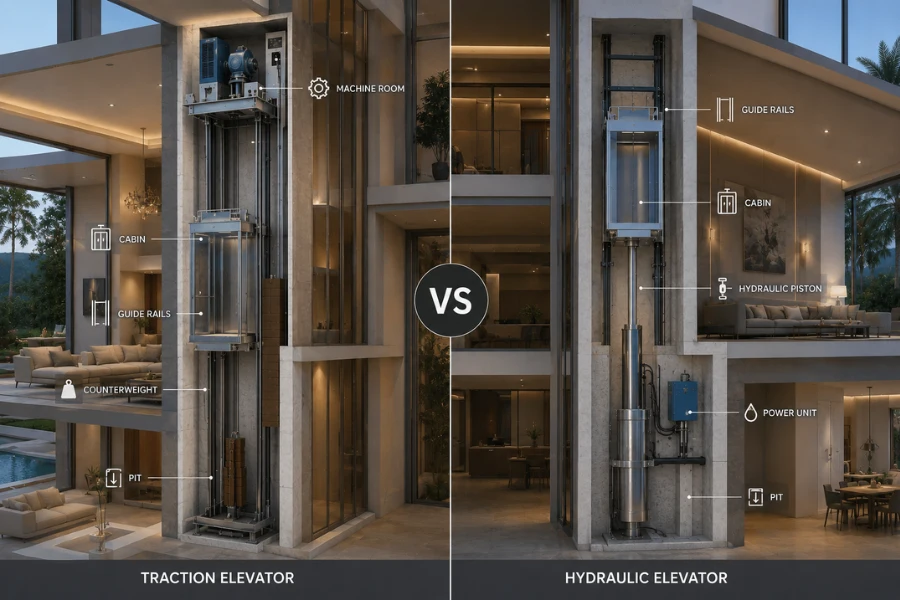
What Is a Traction Home Elevator?
A traction home elevator uses a traction machine, traction sheave, steel wire ropes, and a counterweight system to move the elevator car.
As the traction machine rotates the sheave, friction between the ropes and the sheave creates the force needed to raise or lower the elevator car. The counterweight balances a large portion of the elevator load, reducing the amount of work required from the motor.
Modern residential elevators increasingly use gearless traction machines and machine-room-less (MRL) configurations, making traction technology one of the most common choices for new home elevator installations.
Traction systems are widely used in residential elevators, house lifts, domestic elevators, and luxury villa elevator projects where energy efficiency and travel flexibility are important.
What Is a Hydraulic Home Elevator?
A hydraulic home elevator uses hydraulic pressure rather than ropes and counterweights.
The system typically consists of a hydraulic pump, oil reservoir, control valves, cylinder, and piston. When the elevator is called, hydraulic fluid is pumped into the cylinder, pushing the piston upward and lifting the elevator car.
When descending, the fluid returns to the reservoir in a controlled manner, allowing the cab to lower smoothly.
Hydraulic systems have been used in residential elevators for decades and remain popular in certain low-rise applications where building conditions favor hydraulic technology.
How Does a Traction Elevator Work?
The performance of a traction elevator depends on several interconnected mechanical systems.
Traction Machine
The traction machine serves as the primary driving component.
Common traction machine types include:
- Gearless traction machines
- Worm gear traction machines
- Helical gear traction machines
- Planetary gear traction machines
- Belt-driven traction systems
Among these options, gearless traction machines have become increasingly popular for residential elevator applications because of their compact design, high efficiency, and low noise levels.
Traction Sheave and Wrap Angle
The traction sheave contains specially designed grooves that grip the steel ropes.
The effectiveness of the system depends heavily on the wrap angle between the rope and the sheave. A larger wrap angle generally increases traction capability and helps prevent rope slippage.
Although homeowners rarely see this component, proper traction sheave design directly influences ride quality, leveling accuracy, and long-term reliability.
Steel Wire Ropes
Steel wire ropes connect the elevator car and counterweight.
Common rope constructions include:
- 8×19S+NF
- 6×19S+NF
The rope structure affects flexibility, wear resistance, fatigue life, and overall service life. Rope inspection remains an important part of long-term elevator maintenance planning.
Counterweight System
The counterweight system balances the weight of the elevator car and a portion of the rated load.
Because the motor does not need to lift the full weight of the car, traction elevators generally consume less energy than hydraulic systems in buildings with regular daily usage.
How Does a Hydraulic Elevator Work?
Hydraulic elevators rely on fluid power rather than traction.
When the user selects a floor, the motor drives a hydraulic pump that transfers fluid into a cylinder. Pressure inside the cylinder moves the piston upward, lifting the elevator car.
During descent, valves regulate the flow of hydraulic fluid back into the reservoir.
Because hydraulic systems generate lifting force directly through the piston, they can handle substantial loads while maintaining smooth operation. This characteristic makes hydraulic elevators suitable for some heavy-duty residential and low-rise commercial applications.
Traction vs Hydraulic Home Elevator Comparison
| Feature | Traction Home Elevator | Hydraulic Home Elevator |
|---|---|---|
| Drive Method | Rope and counterweight system | Hydraulic cylinder and piston |
| Travel Height | Higher | Lower |
| Speed | Faster | Slower |
| Energy Efficiency | Better for frequent use | Better in some low-use scenarios |
| Machine Room | Often not required | Usually required |
| Maintenance Focus | Ropes, sheaves, traction machine | Pump, oil, valves |
| Long-Term Cost | Often lower | Can be higher |
| Modernization Flexibility | Excellent | Moderate |
| Elevator Shaft Efficiency | High | Moderate |
| Multi-Floor Homes | Excellent | Suitable for low-rise homes |
Gearless vs Geared Traction Elevators
Not all traction elevators are the same.
Older residential elevator systems often used geared traction machines, which include a gearbox between the motor and sheave. While reliable, geared systems typically produce more mechanical losses and require additional maintenance.
Modern home lift systems increasingly use gearless traction machines. These systems connect the motor directly to the traction sheave, improving efficiency while reducing vibration and noise.
For homeowners planning a long-term residential elevator investment, gearless technology is often considered the preferred solution.
1:1 vs 2:1 Roping Systems in Home Elevators
Another factor that influences traction elevator performance is the roping arrangement.
The most common configurations include:
- 1:1 roping
- 2:1 roping
- 3:1 roping
A 1:1 roping system moves the elevator car at the same speed as the rope movement.
A 2:1 roping system uses additional pulleys, allowing the elevator to lift heavier loads while reducing motor force requirements.
For residential elevators, the selection depends on elevator shaft dimensions, travel requirements, cabin size, and overall building design.
Although most homeowners never encounter these engineering details, roping design affects energy efficiency, ride quality, and component longevity.
Pit Depth and Headroom Requirements
One of the most overlooked aspects of home elevator selection is building compatibility.
Many elevator retrofit projects face limitations such as:
- Limited shaft space
- Shallow pit conditions
- Low headroom
- Structural constraints
Modern traction elevators often require greater pit depth and overhead clearance than some hydraulic configurations.
However, advances in home elevator engineering have introduced shallow pit designs and low-headroom traction systems that can fit many existing homes.
This is why evaluating the building first is often more important than choosing a drive system first.
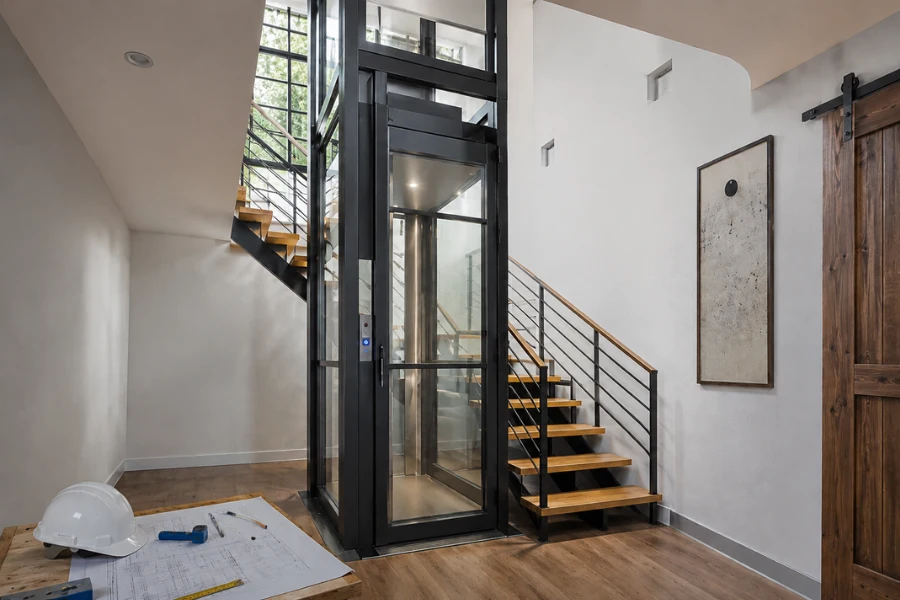
Which Elevator Is Better for Existing Home Retrofits?
Retrofitting a home elevator into an existing building is often more complex than installing one in a new construction project.
Challenges commonly include:
- Limited shaft space
- Stairwell restrictions
- Existing structural walls
- Utility conflicts
- Low overhead clearance
- Limited pit excavation capability
In these situations, the best solution is not always hydraulic or traction by default.
Instead, the elevator system should be selected based on the actual building conditions, available shaft configuration, and installation feasibility.
Many successful home elevator retrofit projects rely on customized engineering rather than standard elevator packages.
Home Elevator Safety Systems
Modern residential elevators incorporate multiple safety systems regardless of drive type.
Typical safety features include:
- Safety gear systems
- Emergency brakes
- Door interlocks
- Battery backup systems
- Overspeed protection
- Load sensors
- Overload protection devices
Many systems provide warning notifications when the elevator load approaches approximately 80% of rated capacity.
If the load exceeds allowable limits, overload protection systems can prevent operation until the excess load is removed.
These safety features help ensure reliable operation for homeowners and family members.
Which Elevator Is Better for Elderly Homeowners?
Both hydraulic and traction residential elevators can improve accessibility and independence.
For elderly users, important considerations include:
- Smooth ride quality
- Leveling accuracy
- Reliability
- Emergency operation capability
- Easy-to-use controls
- Wheelchair accessibility
The best home lift system is often the one that integrates most effectively into the building while providing dependable daily operation.
Why Modern Home Elevators Are Increasingly Using Traction Technology
The residential elevator market has changed significantly over the last decade.
Advances in:
- Gearless traction machines
- Permanent magnet motors
- Intelligent controllers
- Compact machine-room-less designs
have made traction systems more practical for residential applications than ever before.
As a result, many new residential elevator installations now favor traction technology, particularly in multi-story homes where long-term operating efficiency becomes increasingly important.
How EKCNE Supports Customized Home Elevator Projects
Every building presents unique mobility challenges.
Some projects require a custom elevator shaft because of limited installation space. Others involve existing building elevator retrofits where pit depth, headroom, or structural conditions create engineering constraints.
EKCNE supports home elevator projects through building-specific evaluation rather than one-size-fits-all product selection. By considering shaft dimensions, travel height, door configuration, traffic requirements, and future maintenance accessibility, suitable hydraulic or traction elevator solutions can be matched to the actual building environment.
This project-oriented approach is particularly valuable for limited shaft projects, outdoor home elevators, shallow pit installations, low-headroom applications, and customized residential elevator systems.












