
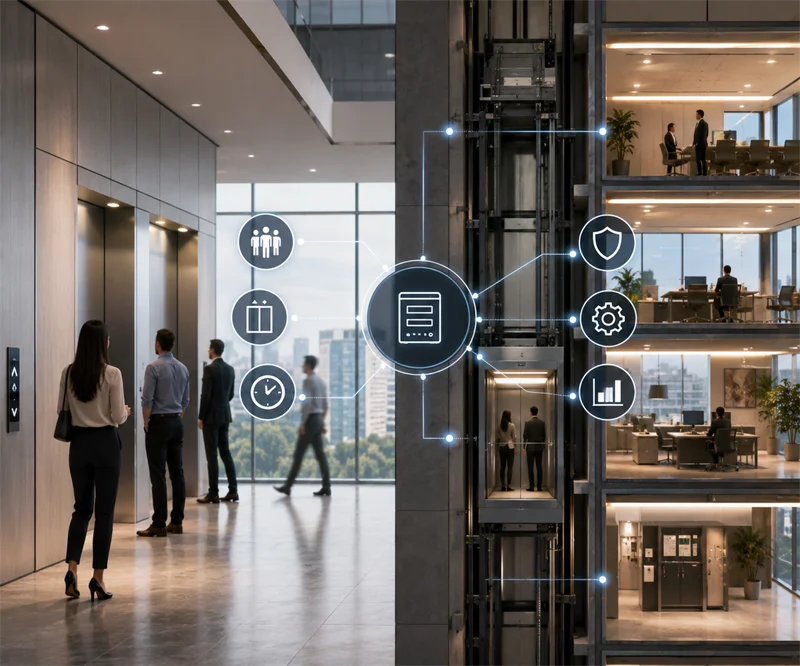
Modern elevators are expected to do far more than move passengers between floors. In today’s office towers, hospitals, hotels, shopping centers, residential complexes, and mixed-use developments, elevator control systems continuously coordinate traffic flow, dispatch logic, speed regulation, safety protection, and building operation efficiency.
A modern elevator may process thousands of hall calls and dispatch decisions every day. The quality of the control system directly affects passenger waiting time, travel efficiency, ride comfort, energy consumption, and long-term operational reliability.
As buildings become taller and traffic density increases, elevator control architecture has become one of the most important engineering components behind reliable vertical transportation.
Why Elevator Control Systems Matter More Than Elevator Quantity
Many people assume elevator efficiency mainly depends on elevator quantity or travel speed. In practice, poor dispatch coordination can still create severe congestion even in buildings with multiple elevator cars.
In some office towers, several elevators may repeatedly respond to the same lobby demand while upper-floor passengers experience unnecessary delays during peak traffic periods. In older commercial buildings, dispatch imbalance often becomes more noticeable after partial modernization projects where newer controllers operate alongside aging door systems or inconsistent floor position sensors.
This is why elevator traffic performance depends heavily on control logic rather than motor power alone.
Modern elevator controllers must continuously evaluate:
- Passenger demand
- Car position
- Travel direction
- Hall call registration
- Door status
- Speed feedback
- Load condition
- Safety signals
- Traffic density
- Dispatch efficiency
The controller then determines how elevators should respond in real time.
Get Elevator Control System Solutions Now >>
How Elevator Controllers Process Building Traffic
Every elevator control system operates through continuous signal collection and command processing.
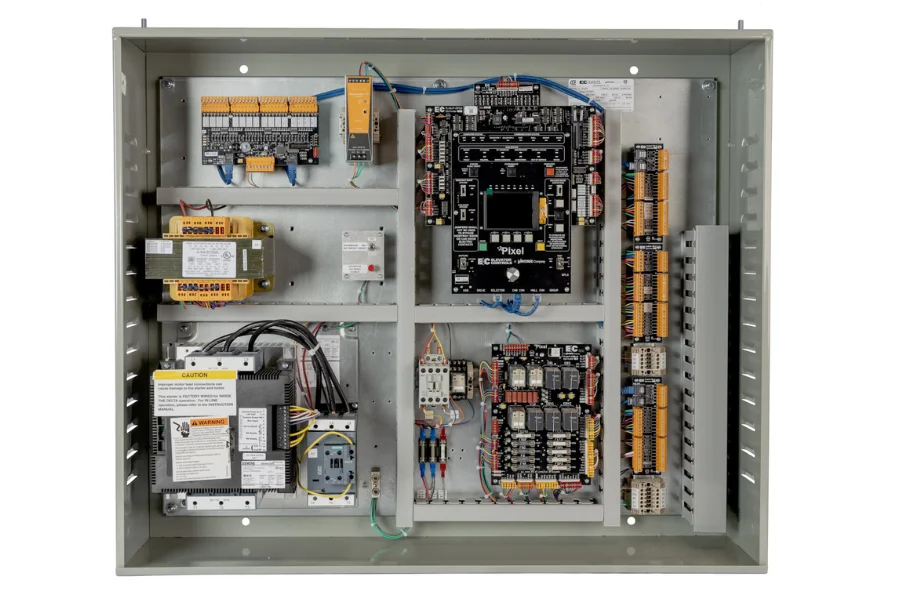
The controller receives information from multiple devices installed throughout the elevator system, including:
- Car operating panels
- Hall call buttons
- Floor position sensors
- Door interlocks
- Speed feedback devices
- Load weighing systems
- Limit switches
- Safety circuits
- Encoder feedback systems
- Inspection operation controls
After processing these signals, the controller calculates the most efficient operating response.
For example, when several passengers request elevators simultaneously, the controller must determine:
- Which elevator should answer the call
- Which travel direction should be prioritized
- Whether intermediate stops are efficient
- How to reduce unnecessary reversals
- How to balance traffic between multiple elevator cars
In busy buildings, these dispatch calculations happen continuously within fractions of a second.
During morning office traffic peaks, poor dispatch sequencing may increase lobby congestion long before elevator carrying capacity itself reaches its limit.
From Relay Logic to PLC and Microprocessor Elevator Control
Traditional elevators relied heavily on relay-based control systems. While relay systems were mechanically straightforward, they required large amounts of wiring and had limited flexibility for traffic optimization.
Modern elevator systems now primarily use PLC platforms and microprocessor-based controllers.
PLC-based elevator control systems became widely adopted because they offer several engineering advantages:
- Strong anti-interference capability
- Stable signal processing
- Modular expansion capability
- Flexible programming logic
- Easier maintenance
- Reduced wiring complexity
- Better operational reliability
Microprocessor-based elevator controllers further improve performance through:
- Digital speed regulation
- Real-time dispatch analysis
- Traffic pattern optimization
- Intelligent group coordination
- Automatic fault diagnosis
- Dynamic operation adjustment
Compared with older relay systems, modern elevator controllers significantly improve dispatch flexibility while simplifying long-term maintenance.
This transition also made advanced traffic management strategies possible in high-rise elevator systems.
Single Automatic Control and Collective Selective Control
Different buildings require different elevator operating strategies.
Smaller residential buildings may use single automatic control systems, where one elevator independently responds to floor calls according to simple sequencing rules.
Larger buildings typically use collective selective control systems.
Under collective control:
- Upward hall calls are grouped together
- Downward calls are processed separately
- The elevator responds according to its current travel direction
- Opposite-direction calls are temporarily stored until directional travel changes
This reduces unnecessary reversals and improves transportation efficiency.
Collective selective control remains common in residential buildings, hotels, mid-rise offices, and smaller commercial projects.
Group Supervisory Control in Multi-Elevator Buildings
In large commercial buildings, elevators usually operate under group supervisory control.
Under this architecture, multiple elevators communicate continuously while a supervisory controller evaluates:
- Car location
- Passenger demand
- Travel direction
- Car load condition
- Waiting time
- Traffic density
- Peak-hour movement behavior
The controller then assigns hall calls to the most suitable elevator.
This coordinated operation significantly improves transportation efficiency compared with independent elevator operation.
Modern group supervisory systems continuously analyze dispatch conditions to reduce inefficient car movement, unnecessary stops, and traffic imbalance between elevator groups.
In high-density office buildings, even small dispatch improvements may noticeably reduce average waiting time during peak arrival periods.
How Group Dispatch Systems Improve Elevator Efficiency
Modern group dispatch systems are designed to reduce both waiting time and unnecessary stopping cycles.
Instead of allowing elevators to respond independently, the controller treats all elevator cars as part of one coordinated transportation network.
Modern dispatch strategies may include:
- Traffic clustering
- Sector zoning
- Peak-hour allocation
- Load balancing
- Dynamic car reassignment
- Idle car positioning
- Energy optimization logic
For example, during morning office traffic, some elevators may automatically prioritize upward transportation from the lobby while others remain available for inter-floor movement.
This improves passenger handling efficiency while reducing congestion near high-traffic floors.
In many commercial projects, optimized dispatch logic improves actual transportation performance more effectively than simply increasing elevator quantity.
Destination Dispatch Systems and Traffic Clustering Logic
Many newer commercial buildings now use destination dispatch systems instead of traditional hall call operation.
With conventional elevators, passengers enter the car first and then select a destination floor.
Destination dispatch systems reverse this process.
Passengers register their destination floor before entering the elevator. The controller then groups passengers traveling toward similar floor zones into the same car.
This approach helps:
- Reduce unnecessary intermediate stops
- Improve handling capacity
- Reduce travel time
- Improve traffic flow efficiency
- Lower energy consumption
- Improve peak-hour transportation performance
Destination dispatch systems are especially effective in:
- High-rise office towers
- Hotels
- Hospitals
- Mixed-use developments
- Large commercial buildings
Because the controller can predict passenger flow more accurately, dispatch decisions become significantly more efficient during heavy traffic conditions.
Floor Authorization and Access-Based Elevator Control
Modern elevator control systems increasingly integrate access management functions.
In office buildings, hotels, residential towers, and restricted facilities, passengers may only access authorized floors.
Integrated authorization systems may use:
- RFID cards
- IC cards
- QR verification
- Biometric access
- Destination authorization terminals
From an operational perspective, floor authorization improves both security and traffic efficiency.
When the controller knows which floors are accessible to specific users, traffic behavior becomes more predictable and unnecessary floor calls are reduced.
This becomes especially important in high-density commercial towers where uncontrolled floor access may increase dispatch inefficiency during busy periods.
Anti-Nuisance Logic and False Call Reduction
Modern elevator controllers often include anti-nuisance functions designed to reduce unnecessary stops.
In crowded buildings, passengers sometimes accidentally or intentionally register excessive floor calls. This increases stopping frequency, extends travel time, and reduces overall transportation efficiency.
Anti-nuisance logic helps minimize these problems by analyzing:
- Passenger load data
- Call timing
- Car occupancy
- Traffic behavior
- Empty-car operation
- Abnormal floor registration patterns
Some systems automatically cancel unrealistic floor registrations when passenger load conditions do not match the number of registered calls.
Although passengers rarely notice these functions directly, anti-nuisance logic plays an important role in maintaining stable building traffic flow during peak operating periods.
Speed Feedback, Position Signals, and Leveling Accuracy
Modern elevator operation depends heavily on accurate speed and position feedback.
The control system continuously monitors:
- Car speed
- Motor rotation
- Floor position
- Door zone status
- Deceleration timing
- Leveling accuracy
Modern elevator systems commonly use encoder-based feedback devices for precise motion control.
Accurate speed feedback allows the controller to coordinate:
- Smooth acceleration
- Stable deceleration
- Precise floor stopping
- Door opening timing
- Ride comfort optimization
In high-speed elevators, even small positioning errors may noticeably affect passenger comfort and stopping precision.
For this reason, modern elevator controllers rely heavily on continuous digital motion feedback rather than purely mechanical positioning methods.
Inspection Mode and Maintenance Operation Control
Elevator controllers must also manage specialized operating modes for maintenance and inspection work.
Inspection operation allows technicians to safely control elevator movement during servicing.
Under inspection mode:
- Elevator speed is heavily restricted
- Normal passenger operation is disabled
- Continuous manual control is required
- Safety monitoring remains active
- Certain automatic functions are temporarily suspended
This allows technicians to safely inspect shaft equipment, guide rails, door systems, sensors, and safety devices.
Modern elevator standards impose strict operational limitations during inspection mode to reduce maintenance risk.
In older modernization projects, inspection operation instability may occasionally appear when newer controllers are integrated with aging relay systems or inconsistent signal feedback devices.
Fire Recall and Emergency Operating Logic
Fire recall operation is one of the most important emergency functions in elevator control systems.
When the controller receives a fire signal:
- Normal passenger operation is canceled
- Registered calls may be cleared
- Elevators return to designated recall floors
- Door operation changes to emergency logic
- Dispatch strategy switches to fire-control mode
This prevents elevators from operating unpredictably during emergencies.
Modern fire recall systems are closely integrated with building fire alarm systems and elevator safety circuits.
In larger buildings, fire-control logic may also coordinate with smoke management systems, access control systems, and emergency evacuation planning.
Safety Integration Between Controllers and Protection Devices
Modern elevator controllers continuously communicate with multiple mechanical and electrical safety systems.
These include:
- Overspeed governors
- Safety gears
- Door interlocks
- Terminal limit switches
- Rope tension monitoring devices
- Safety circuits
- Emergency stop systems
- Buffer protection devices
The controller continuously verifies safety circuit conditions before allowing elevator movement.
If abnormal conditions are detected, the system may:
- Prevent startup
- Stop operation
- Trigger braking
- Activate alarms
- Enter protection mode
Modern elevator safety depends heavily on coordination between electronic control systems and mechanical protection devices.
Elevator Modernization and Controller Upgrades
Many older buildings still operate elevators using aging relay-based controllers or outdated dispatch systems.
In these buildings, modernization projects often focus heavily on controller upgrades.
Common modernization improvements include:
- Relay-to-PLC conversion
- Microprocessor controller upgrades
- Group dispatch optimization
- Encoder feedback integration
- Destination dispatch retrofits
- Traffic analysis improvements
- Remote monitoring capability
Older buildings often experience issues such as:
- Slow dispatch response
- Frequent unnecessary stops
- Inconsistent leveling accuracy
- High maintenance complexity
- Limited spare part availability
In some modernization projects, dispatch inefficiency becomes especially noticeable during peak traffic periods when older signal wiring, delayed relay response, or inconsistent floor position feedback affects controller decision timing.
Modern control upgrades can significantly improve transportation performance without fully replacing the elevator system.
This has become increasingly important in aging commercial buildings worldwide.
How to Choose the Right Elevator Control System
The ideal elevator control architecture depends heavily on building traffic characteristics.
Smaller residential buildings may only require basic collective selective control systems.
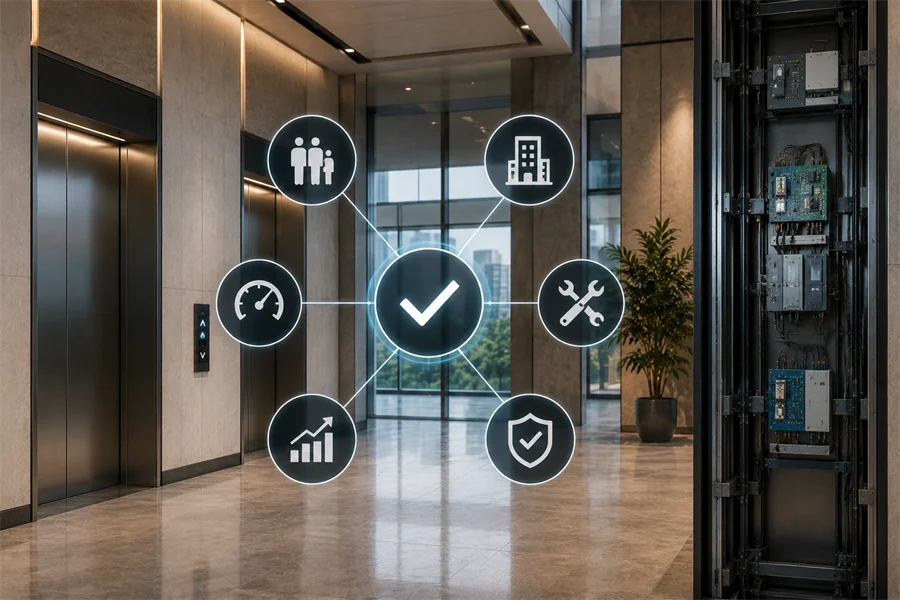
Large commercial buildings typically require more advanced features such as:
- Group supervisory control
- Intelligent dispatch algorithms
- Destination dispatch
- Access integration
- Traffic analysis
- Remote diagnostics
- Energy optimization
- Scalable control architecture
When evaluating elevator control systems, building owners and engineering teams should consider:
- Building height
- Passenger traffic density
- Peak-hour transportation demand
- Future scalability
- Maintenance compatibility
- Modernization flexibility
- Spare part support
- Long-term operational reliability
In many projects, traffic logic configuration becomes just as important as elevator speed or carrying capacity.
Supporting Complex Elevator Projects Through Integrated Control Planning
As elevator projects become more complex, control system planning has become an increasingly important part of overall vertical transportation design.
For large commercial buildings, hospitals, hotels, transportation hubs, and mixed-use developments, elevator traffic behavior must often be evaluated together with:
- Building usage patterns
- Passenger flow density
- Access management strategy
- Emergency operation requirements
- Future modernization plans
- Multi-elevator coordination logic
Project-oriented elevator suppliers and engineering teams increasingly focus not only on elevator equipment itself, but also on how control architecture matches long-term building operation requirements.
This becomes especially important in projects involving customized dispatch logic, modernization coordination, or multi-building traffic integration.
Conclusion
Modern elevator control systems do far more than operate motors and doors.
Today’s systems continuously coordinate traffic management, dispatch sequencing, motion feedback, safety monitoring, emergency operation, and building transportation efficiency in real time.
As buildings become taller and passenger traffic becomes more complex, elevator control architecture plays a central role in ride quality, waiting time, energy efficiency, and long-term operational reliability.
For building developers, contractors, elevator companies, and engineering teams, understanding how elevator control systems actually manage traffic and safety is essential when designing efficient vertical transportation solutions.












