
Escalators move passengers continuously between building levels through a coordinated mechanical, structural, electrical, and safety system. Understanding how escalators work requires more than knowing that an electric motor pulls a chain of moving steps.
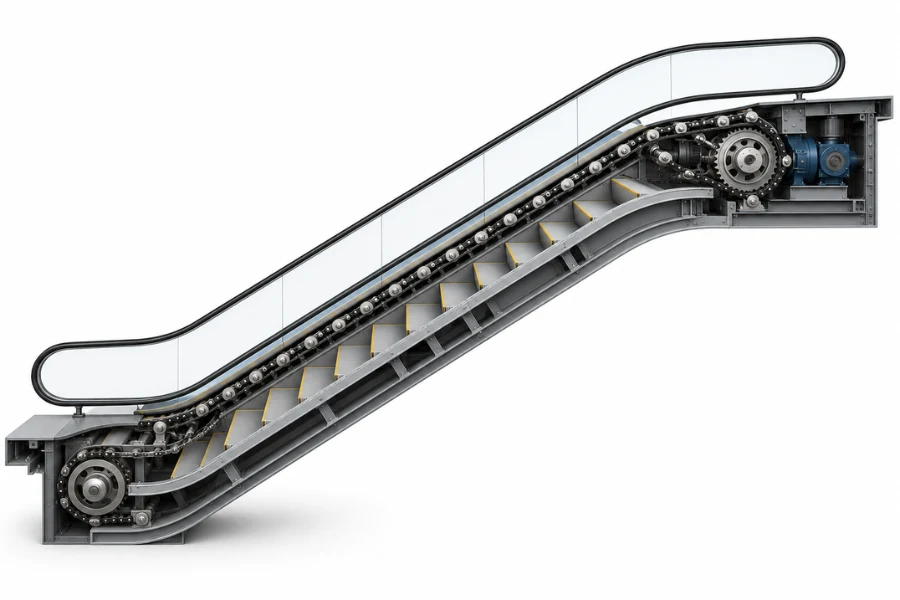
The escalator working principle begins with a drive machine that transfers mechanical power to the main drive shaft. Drive sprockets then move two continuous step chains, while step rollers follow separate track paths that control the position of each step throughout the operating cycle.
At the same time, the handrail system provides moving passenger support, protective structures separate riders from internal machinery, and the control system monitors speed, braking, chains, steps, and other operating conditions.
For project buyers and engineers, understanding how an escalator works also helps explain why rated speed, rise, step width, duty classification, maintenance access, and building traffic must be evaluated together.
How Does an Escalator Work?
An escalator works as a continuous passenger transportation system. The escalator motor generates mechanical power, the transmission system transfers that power to the main drive shaft, and step chain sprockets pull the connected steps around a continuous circuit.
Each step uses separate rollers that follow the main tracks and trailing tracks. The geometry between these tracks keeps the step tread horizontal in the inclined passenger-carrying section and allows the steps to flatten near the landing areas.
After passing beneath the floor plate, the steps travel along the return track inside the truss and begin another operating cycle.
The complete power transmission sequence can be summarized as:
Drive Machine → Main Drive Chain → Main Drive Shaft → Step Chain Sprockets → Step Chains → Moving Steps
This mechanical sequence is the foundation of how escalators work, but reliable escalator operation also depends on the supporting structure, handrail drive, passenger protection system, control system, safety circuit, and lubrication strategy.
What Are the Main Operating Systems Inside an Escalator?
A modern escalator is not simply a moving staircase. It is an integrated escalator operating system in which several subsystems perform different functions while remaining mechanically and electrically connected.
The major systems include the supporting truss, drive machine, power transmission components, step chains and tracks, handrail system, passenger protection structures, control equipment, safety devices, and lubrication system.
Truss and Supporting Structure
The truss extends between the upper and lower building levels and supports the equipment, moving components, and passenger loads.
Tracks, drive equipment, electrical components, step chains, and the return system are installed within or supported by this structure. The upper and lower ends transfer escalator loads to the building supports.
Truss requirements change with rise, span, passenger loading, and duty classification. Public transportation and heavy-duty escalators may require greater structural stiffness than escalators used under moderate commercial conditions.
In international escalator projects, structural opening confirmation and truss segmentation often need to be completed before production. Site lifting limitations, transportation routes, building access, and intermediate support conditions can affect how the escalator is manufactured and delivered.
Drive Machine and Power Transmission
The drive machine provides the mechanical power required for escalator operation.
A typical assembly includes the escalator motor, gearbox, coupling, service brake, and monitoring components. In a common upper-drive arrangement, power passes through the main drive chain to the main drive shaft.
Drive sprockets and step chain sprockets then transfer rotational movement to the step chains.
The motor therefore doesn’t directly pull every individual step. The escalator mechanism depends on a connected power transmission system that must remain aligned, lubricated, and capable of carrying repeated passenger loads.
Different transmission configurations also create engineering trade-offs.
| Drive Consideration | Gear Transmission | Worm Gear Transmission |
|---|---|---|
| Efficiency | Higher | Lower |
| Typical Duty | Public transport and heavy-duty operation | Moderate commercial operation |
| Energy Implication | Lower transmission loss | Higher transmission loss |
| Selection Logic | Long operating hours and demanding duty | Commercial applications with moderate operating requirements |
Transmission efficiency becomes more important as operating hours increase. However, drive selection should also consider maintenance conditions, equipment layout, project cost, and expected lifecycle.
Step Chains and Track System
Two continuous step chains circulate through the escalator truss and carry the connected steps.
Each step is supported and guided by rollers following different track paths. The main tracks support the passenger-carrying movement, while trailing tracks control the orientation of the step structure.
A tensioning device, usually installed in the lower section, compensates for changes in step chain length and helps maintain appropriate operating tension.
In long-hour commercial and transit applications, poor lubrication, incorrect chain tension, roller wear, or track contamination can gradually increase vibration and noise before they cause a more visible operating problem.
This is one reason maintenance teams should evaluate operating changes as system-level symptoms rather than treating noise or vibration as isolated comfort issues.
Purchase Escalator Step Chains >>
Why Do Escalator Steps Stay Level?
One of the most important parts of the escalator working principle is the relationship between step rollers and track geometry.
Each step has rollers that follow separate paths. In the inclined section, the vertical relationship between the main tracks and trailing tracks controls the angle of the step structure and keeps the passenger standing surface horizontal.
Near the upper and lower landing areas, the tracks gradually approach the same level. The steps move closer together and form a horizontal moving surface before passing beneath the comb plate and floor plate.
The horizontal transition provides passengers with time to establish balance when boarding and prepare to leave the escalator at the exit.
Track geometry also affects ride quality and component wear. Poor track alignment can increase roller loads, vibration, noise, and uneven mechanical wear even when the escalator continues to operate.
Understanding how escalators work therefore requires recognizing that the tracks don’t simply guide the steps. They continuously control step orientation throughout the complete operating cycle.
How Does the Escalator Handrail System Work?
The handrail system provides passengers with a moving support surface throughout the inclined transportation path.
It typically includes the handrail belt, handrail drive, guide rails, return devices, rollers, and tensioning components. Mechanical power from the escalator drive system moves the handrail around a continuous circuit.
The handrail and steps must maintain controlled speed coordination. The handrail shouldn’t move noticeably slower than the steps, and abnormal speed differences can trigger monitoring devices and a safety response.
In long-hour commercial and transit applications, persistent handrail speed deviation may indicate drive wheel wear, incorrect tension, contamination, handrail deterioration, or problems within the guide system.
A maintenance team that repeatedly adjusts handrail speed without identifying the underlying mechanical condition may temporarily reduce the symptom without improving long-term reliability.
This is an important lifecycle consideration because the visible handrail is only one part of the complete handrail drive system.
How Escalator Passenger Protection Systems Work
The moving steps and internal mechanical components of an escalator must remain separated from passengers during normal operation.
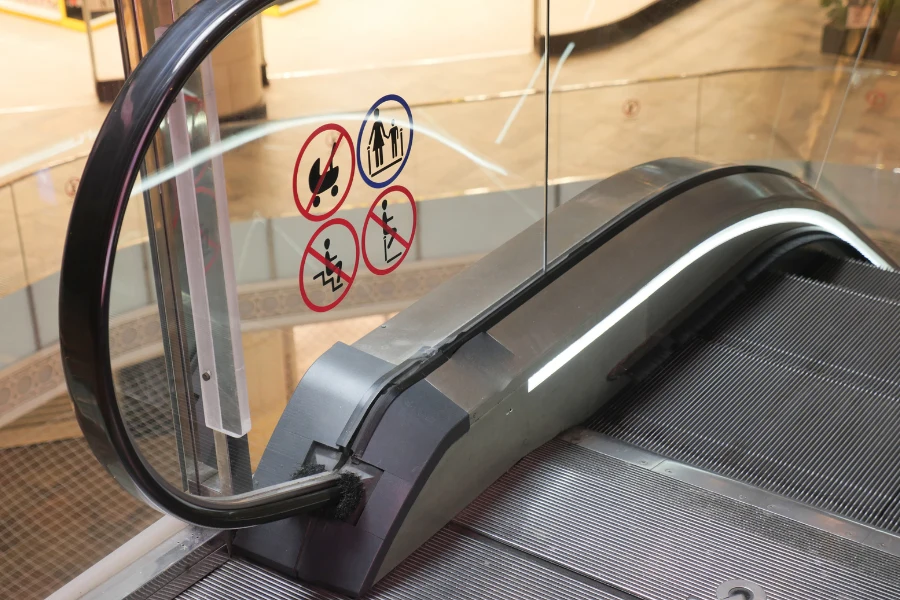
Balustrades create a physical boundary along both sides of the passenger transportation path. Inner and outer decking cover mechanical areas and reduce passenger access to moving equipment inside the truss.
Skirt panels run beside the steps and maintain controlled clearances between the moving step system and the fixed escalator structure. Skirt brushes provide an additional visual and physical reminder that passengers should keep shoes and loose objects away from the step edges.
At each landing, the grooved steps enter the comb plate before disappearing beneath the floor plate. The comb teeth engage with the step grooves to support a controlled transition between the moving steps and stationary landing surface.
If foreign material causes abnormal comb plate movement, a safety device can interrupt escalator operation.
These protective structures are not decorative covers. They form the passenger interface between continuously moving machinery and the people using the escalator.
How Does an Escalator Control Speed and Direction?
The control system coordinates motor operation, travel direction, braking, operating mode, fault detection, and safety monitoring.
Traditional systems may use direct motor control and star-delta starting. Modern escalators can use variable voltage variable frequency drives to provide smoother acceleration and different energy-saving operating modes.
An escalator may run continuously, reduce speed during periods without passengers, or stop after a defined period of low demand. Passenger detection devices can return the equipment to normal operating speed when riders approach.
The correct operating mode depends on building traffic.
Continuous operation may be appropriate where pedestrian circulation remains high throughout the day. Standby low-speed or automatic stop modes may reduce unnecessary energy consumption in buildings with intermittent passenger demand.
Frequent starting, passenger arrival patterns, control response time, operating duty, and maintenance requirements still need to be evaluated together. An energy-saving function is useful only when it remains compatible with actual building traffic.
What Happens When an Escalator Detects a Problem?
The mechanical operation of an escalator is continuously monitored by electrical and mechanical safety devices.
The control system receives signals related to operating speed, direction, brake condition, drive chains, step chains, step position, handrail movement, landing conditions, and emergency devices.
The basic safety logic can be understood as:
Normal Operation → Condition Monitoring → Fault Detection → Safety Circuit Response → Controlled Stop and Inspection
Overspeed and underspeed protection monitor abnormal escalator speed. Unintended reversal protection helps prevent an inclined escalator from moving unexpectedly in the opposite direction.
Other devices can detect main drive chain failure, step chain problems, missing steps, abnormal step displacement, handrail entry obstruction, handrail speed deviation, comb plate movement, and abnormal braking performance.
Emergency stop devices allow the equipment to be stopped when an immediate hazard is observed.
A common project mistake is to evaluate escalator safety only by counting installed safety devices. Their placement, monitoring logic, inspection accessibility, maintenance condition, and integration with the control system also affect long-term operational reliability.
This monitoring logic is another important part of how escalators work. Safe operation depends on detecting abnormal mechanical conditions before normal passenger transportation continues.
What Determines Escalator Speed and Passenger Capacity?
Escalator traffic handling capacity depends on rated speed, step width, passenger behavior, landing design, building traffic, and operating conditions.
Faster or wider equipment doesn’t automatically produce better vertical circulation.
Rated Speed
Common nominal escalator speeds include 0.5 m/s, 0.65 m/s, and 0.75 m/s.
A speed of 0.5 m/s is widely used in commercial buildings because it provides a practical balance between transportation capacity and passenger boarding stability.
Higher speed can increase theoretical capacity, but passengers have less time to enter and leave the moving steps.
In projects serving elderly passengers, families, travelers carrying luggage, or users unfamiliar with escalators, boarding behavior may limit actual throughput before mechanical capacity becomes the primary constraint.
Step Width
Common step widths are approximately 600 mm, 800 mm, and 1,000 mm.
Wider steps can support greater theoretical capacity, but actual traffic handling depends on how passengers occupy the escalator.
Riders may leave empty steps, travel in groups, carry luggage, or hesitate at the entrance. Wider equipment also requires larger structural openings and affects project cost.
Step width should therefore be coordinated with passenger characteristics, building space, peak passenger demand, and expected pedestrian circulation.
Inclination and Rise
A 30-degree inclination is common because it provides a practical balance between passenger comfort, transportation efficiency, and building footprint.
A 35-degree inclination may be used under specific limits involving rise and rated speed. A steeper escalator can reduce horizontal space requirements, but it isn’t universally suitable.
Rise affects truss length, structural loading, drive requirements, safety configuration, installation access, and maintenance planning.
Long-rise escalators may also require intermediate supports or segmented delivery. These project conditions should be confirmed before manufacturing rather than resolved after the equipment reaches the site.
Theoretical Capacity vs. Actual Passenger Throughput
Theoretical capacity can range from several thousand passengers per hour to more than 8,000 passengers per hour depending on step width and rated speed.
Actual passenger throughput is normally lower.
Passenger spacing, luggage, boarding hesitation, elderly users, group travel, traffic surges, and landing congestion all reduce usable capacity.
The escalator entrance may become the real traffic bottleneck. Increasing equipment speed or width doesn’t solve the problem if surrounding corridors and landing areas cannot accept or distribute passengers effectively.
In transportation hubs, peak passenger demand may arrive in concentrated waves after a train unloads or during flight arrival periods. Equipment capacity must be coordinated with pedestrian circulation before and after passengers use the escalator.
This distinction between theoretical capacity and actual building traffic performance is essential when evaluating how escalators work within a complete vertical transportation system.
Why Are Escalators Effective for Continuous Passenger Flow?
Elevators and escalators use different transportation logic.
An elevator transports passengers in batches and requires loading, travel, unloading, and dispatch cycles. An escalator provides continuous transportation, allowing passengers to enter the traffic stream as space becomes available.
This operating principle makes escalators effective for short-distance vertical circulation in shopping malls, airports, railway stations, metro systems, hotels, and other public buildings.
The two systems aren’t universal substitutes.
Elevators remain necessary for accessibility, selective floor service, longer travel distances, and passenger or goods movement that cannot be handled safely by escalators.
Large projects often require integrated vertical transportation planning. Escalators manage continuous pedestrian circulation between nearby levels, while elevators provide accessible and selective transportation.
How Escalator Operation Changes Across Different Buildings
The escalator mechanism may remain similar, but building traffic and operating conditions change project requirements.
Shopping malls usually require continuous passenger circulation, effective floor distribution, appropriate escalator arrangement, and practical maintenance access.
Airports and railway stations experience concentrated passenger arrivals and significant luggage movement. Public transportation duty, landing capacity, structural stiffness, long operating hours, and maintenance planning become more important.
Metro stations may require heavy-duty equipment, long-rise configurations, additional braking protection, stronger chains, demanding structural requirements, and maintenance strategies designed around limited shutdown periods.
Hotels and commercial buildings may place greater emphasis on space, noise, appearance, and energy-saving operation.
Outdoor projects introduce another group of engineering conditions. Drainage, corrosion protection, electrical enclosure protection, water monitoring, heating requirements in cold climates, and maintenance exposure should be reviewed together rather than treated as unrelated equipment options.
Understanding how escalators work in real buildings means connecting the mechanical system to actual operating conditions rather than assuming one configuration is suitable for every project.
How Maintenance Conditions Affect Escalator Reliability
Escalators operate through continuous mechanical circulation, which creates repeated loading, friction, wear, and lubrication requirements.
Step chains, main drive chains, and handrail drive components require appropriate lubrication and inspection. Roller wear, track contamination, incorrect chain tension, brake deterioration, and handrail problems can gradually affect ride quality and reliability.
Automatic lubrication systems reduce manual maintenance for selected chains, but bearings, gearboxes, drive components, and other systems still require scheduled inspection and servicing.
Maintenance accessibility matters as much as maintenance frequency.
A compact equipment arrangement may save building space but make drive equipment, control components, or major mechanical systems difficult to reach. This trade-off can increase service time and complicate future component replacement.
Spare parts continuity should also be considered during procurement. Escalators can remain in operation for decades, making long-term compatibility of rollers, chains, safety switches, drive components, and control equipment important to lifecycle planning.
What Should Project Buyers Evaluate Before Selecting an Escalator?
Understanding how escalators work allows buyers to evaluate a transportation system rather than compare equipment only by price, speed, or appearance.
A practical project review should consider:
- Building usage and passenger characteristics
- Average and peak passenger demand
- Required rise and available structural opening
- Step width, rated speed, and inclination
- Theoretical capacity and expected actual throughput
- Commercial, public transportation, or heavy-duty classification
- Indoor, semi-outdoor, outdoor, or special environmental conditions
- Daily operating hours and energy-saving strategy
- Truss support conditions and installation access
- Drive configuration and transmission efficiency
- Safety monitoring and braking requirements
- Landing space and surrounding pedestrian circulation
- Maintenance accessibility
- Delivery scheduling and truss segmentation
- Long-term component and spare parts availability
- Supplier engineering and project coordination capability
Many escalator selection problems begin outside the escalator itself.
Insufficient landing space can restrict passenger flow. Incorrect structural openings can delay installation. Limited lifting access can affect truss delivery, while poor drainage planning can create long-term problems for outdoor equipment.
Project evaluation should begin with the building, traffic behavior, installation conditions, and operating duty before the final equipment configuration is selected.
How EKCNE Supports Escalator Projects
EKCNE approaches escalator supply as part of a complete vertical transportation project.
Project coordination can involve building geometry, passenger flow, operating duty, environmental conditions, structural openings, installation access, safety configuration, delivery planning, and long-term component requirements.
In international escalator projects, early confirmation of structural conditions and transportation access can reduce later changes to truss segmentation, lifting plans, and installation scheduling. Outdoor projects also require drainage, corrosion protection, electrical protection, and climate conditions to be reviewed as one operating environment.
EKCNE supports contractors, distributors, developers, and engineering teams with escalator configuration, customized manufacturing coordination, installation-compatible supply, export delivery, component supply, and long-term spare parts continuity.
For projects combining escalators with elevators, moving walkways, accessibility lifts, or other mobility systems, coordinated procurement can also reduce supplier fragmentation and improve project-level delivery management.
The objective is not to recommend the fastest or largest escalator. It is to match the escalator operating system to building traffic, structural conditions, operating duty, maintenance strategy, and lifecycle requirements.
If you’re planning a commercial, transportation, infrastructure, or distributor escalator project, EKCNE can help review project compatibility and evaluate suitable escalator configurations.












