
Why Preventive Maintenance Is More Effective Than Reactive Repairs
A platform lift is expected to operate safely whenever it is needed, particularly in residential buildings, healthcare facilities, schools, commercial properties, and public infrastructure where barrier-free access is essential. Unlike many building systems that can tolerate temporary interruptions, an out-of-service accessibility lift immediately affects building usability, occupant mobility, and compliance with accessibility requirements. For this reason, an effective Platform Lift Maintenance Guide should focus on preventing failures before they disrupt daily operation rather than responding only after equipment has already malfunctioned.
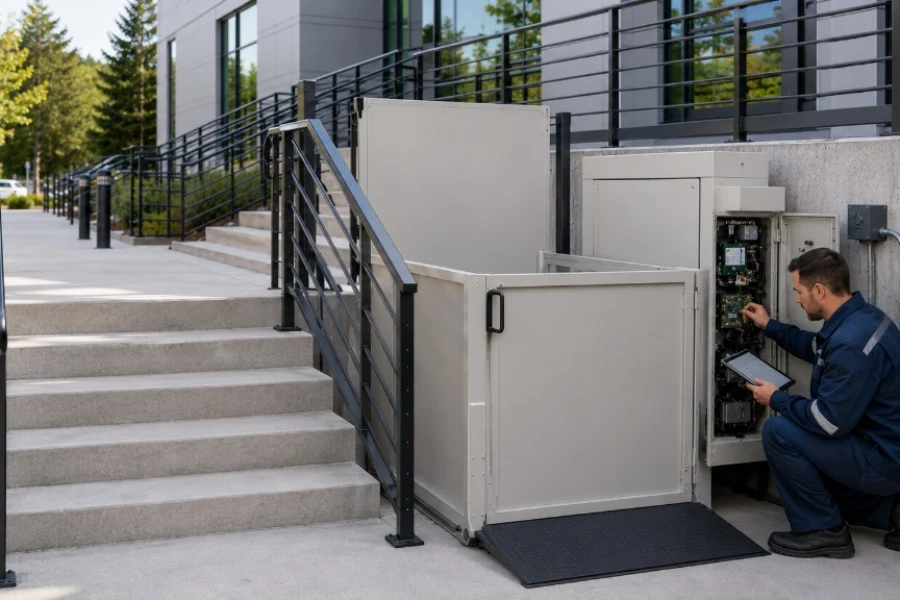
Preventive maintenance aims to identify gradual deterioration before it develops into mechanical failure or safety risks. Regular inspections, lubrication, cleaning, adjustment, and functional testing allow maintenance personnel to detect early signs of wear while the lift remains fully operational. Reactive maintenance, by comparison, often begins only after abnormal noise, hydraulic leakage, platform misalignment, electrical faults, or unexpected shutdowns have already affected service.
From an engineering perspective, the objective of maintenance is not simply to repair equipment but to preserve long-term operational reliability. A well-maintained wheelchair platform lift experiences fewer emergency callouts, lower lifecycle costs, improved component longevity, and more predictable maintenance budgets. This approach also reduces accessibility interruptions for building occupants while extending the service life of major components such as drive units, guide systems, control panels, and safety devices.
Modern maintenance programs generally combine several maintenance strategies according to equipment age, operating frequency, and building function.
| Maintenance Strategy | Typical Application | Primary Objective |
|---|---|---|
| Preventive Maintenance | Scheduled inspections and servicing | Prevent failures before they occur |
| Condition-Based Maintenance | Maintenance based on operating condition | Replace components according to actual wear |
| Predictive Maintenance | Data-driven maintenance using monitoring information | Detect deterioration before failure develops |
| Corrective Maintenance | Planned repairs after defects are identified | Restore normal operation efficiently |
| Emergency Maintenance | Unexpected breakdown response | Minimize accessibility interruption |
For accessibility equipment installed in hospitals, transportation facilities, shopping centers, and government buildings, preventive maintenance combined with predictive maintenance generally delivers the best balance between operational reliability and lifecycle cost.
Understanding the Components That Require Regular Maintenance
Every platform lift contains mechanical, electrical, and safety systems that experience continuous loading during normal operation. Although different manufacturers use hydraulic, screw-driven, chain-driven, or electric drive technologies, the engineering principle remains the same: components subjected to repeated movement gradually wear and eventually require adjustment, repair, or replacement.
A comprehensive Platform Lift Maintenance Guide should therefore focus on understanding how each component ages, why failures occur, and how early intervention prevents larger mechanical problems.
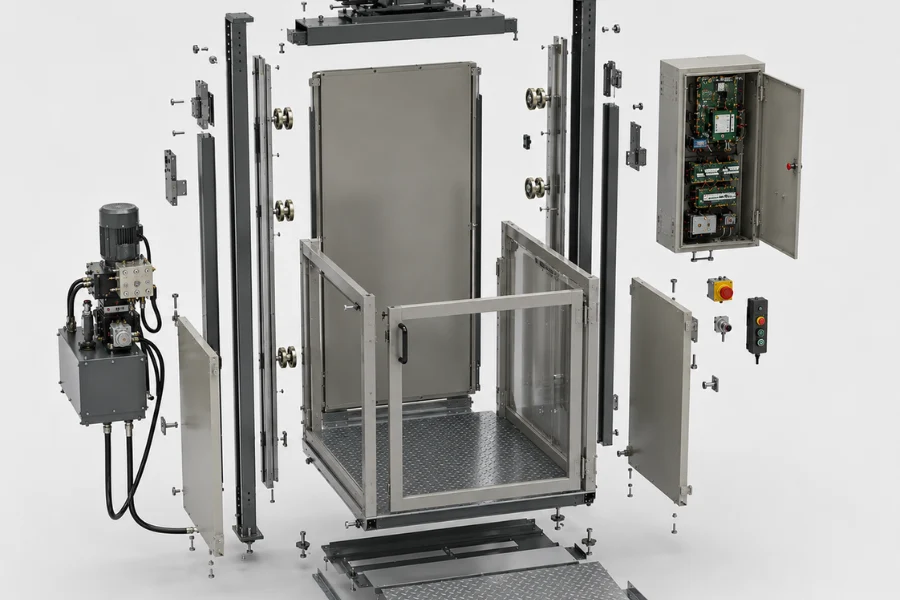
Drive System
The drive system generates the lifting force and is typically the most maintenance-intensive assembly.
Hydraulic platform lifts require routine inspection of hydraulic pumps, cylinders, hoses, fittings, reservoirs, valves, filters, and hydraulic oil quality. Screw-driven platform lifts require inspection of lead screws, drive nuts, bearings, couplings, and lubrication systems. Chain-driven lifts require attention to chain elongation, sprocket wear, lubrication quality, and tension adjustment.
Different drive technologies experience different failure mechanisms.
For example, hydraulic contamination does not immediately stop the lift. Instead, microscopic contaminants gradually wear valve surfaces, increasing internal leakage. As hydraulic pressure becomes unstable, lifting performance becomes inconsistent, platform leveling accuracy decreases, and the hydraulic pump must work harder to compensate for pressure losses. If maintenance is delayed, excessive pump loading accelerates wear throughout the hydraulic circuit and significantly increases repair costs.
Likewise, insufficient lubrication in screw-driven systems increases friction between the lead screw and drive nut. Increased friction raises motor torque demand, generates additional heat, accelerates bearing wear, and eventually affects travel smoothness and positioning accuracy.
Understanding these engineering relationships allows maintenance personnel to correct the root cause rather than repeatedly addressing symptoms.
Guide Rails and Guide Rollers
Guide rails maintain vertical alignment while guide rollers stabilize platform movement throughout the travel path.
Although guide systems appear relatively simple, they operate under continuous rolling contact and gradually experience wear from repeated loading cycles, dust accumulation, insufficient lubrication, and environmental contamination.
Guide roller deterioration usually follows a predictable progression.
Reduced lubrication increases rolling resistance. Higher rolling resistance places greater demand on the drive system, increasing motor current or hydraulic pressure. Additional loading accelerates bearing wear, produces abnormal vibration, and gradually affects platform leveling accuracy.
If guide alignment is ignored, the resulting increase in friction can shorten the service life of both guide components and the drive system itself.
Instead of viewing guide rollers as isolated wear items, maintenance should evaluate the entire motion system and identify whether guide resistance is affecting overall lift performance.
Electrical System
The electrical system controls lift operation, safety monitoring, user commands, and communication between control devices.
Routine inspections should include:
- Landing controls
- Platform controls
- Push-button stations
- Control panels
- Limit switches
- Wiring terminals
- Power supplies
- Battery backup systems
- Electrical enclosures
Electrical failures often develop gradually rather than suddenly.
Loose electrical terminals increase contact resistance. Higher resistance generates localized heat during repeated operation, accelerating oxidation and insulation degradation. Over time, intermittent voltage drops may occur, causing unpredictable controller faults, unexpected shutdowns, or unreliable lift operation.
Outdoor installations require additional attention because moisture entering electrical enclosures may accelerate connector corrosion, compromise insulation performance, and increase maintenance frequency.
Safety Devices
Safety systems should receive the same level of attention as the drive system because they protect passengers when abnormal operating conditions occur.
Routine functional testing should verify:
- Emergency stop buttons
- Platform edge sensors
- Door or gate interlocks
- Obstruction detection systems
- Emergency lowering devices
- Limit switches
- Audible or visual alarms
- Battery-supported emergency functions
Unlike mechanical wear, many safety device failures cannot be detected through visual inspection alone. A limit switch may appear undamaged while failing electrically under load, and an emergency stop button may become unreliable after years of repeated use.
Functional testing under realistic operating conditions therefore provides far greater assurance than visual examination alone.
Platform Structure
The platform structure supports repeated passenger loading throughout its service life.
Routine inspections should include:
- Structural welds
- Platform floor
- Handrails
- Guard panels
- Gate hinges
- Mounting brackets
- Anchor bolts
- Protective coatings
Repeated loading cycles introduce fatigue into structural components. Outdoor installations additionally experience ultraviolet exposure, moisture, temperature fluctuations, and corrosion, all of which may gradually reduce structural integrity if maintenance is neglected.
Rather than replacing structural components only after visible damage appears, periodic inspections help identify early corrosion, loose fasteners, or coating failures before structural deterioration accelerates.
Platform Lift Maintenance Requirements Vary by Installation Environment
Maintenance intervals should never be determined solely by calendar schedules. The building environment often has a greater influence on maintenance requirements than equipment age.
A platform lift installed in a private residence experiences completely different operating conditions from one serving a hospital entrance or a busy transportation hub. Effective maintenance programs therefore consider operating frequency, environmental exposure, building function, and accessibility requirements together.
Indoor Residential Platform Lifts
Residential platform lifts generally complete relatively few operating cycles each day, but they often remain unused for extended periods.
Long idle periods create different maintenance challenges. Batteries gradually discharge, lubricants settle, seals may begin to harden, and moving components receive less natural lubrication through operation. Preventive maintenance should therefore include periodic functional operation even when the lift appears to be in good condition.
Commercial Buildings
Commercial offices, retail buildings, hotels, and mixed-use developments usually generate significantly more daily operating cycles.
Higher operating frequency accelerates wear of guide rollers, bearings, drive assemblies, and electrical switches. Instead of performing inspections only according to monthly schedules, maintenance programs should also consider cumulative operating cycles because mechanical fatigue increases with repeated use.
For example, in a shopping mall where a wheelchair platform lift may complete hundreds of travel cycles every day, guide roller wear develops much faster than in a residential installation. Maintenance intervals should therefore be adjusted according to operating frequency rather than following identical calendar-based schedules.
Healthcare Facilities
Hospitals represent one of the most demanding operating environments for accessibility lifts.
Healthcare buildings frequently operate around the clock, leaving virtually no tolerance for unexpected downtime. A platform lift failure may delay patient movement, restrict wheelchair access, and interrupt essential building operations.
For this reason, maintenance strategies should extend beyond preventive servicing.
Predictive maintenance becomes particularly valuable because condition monitoring can identify gradually deteriorating components before operational failures occur. Hospitals should also maintain critical spare parts such as batteries, emergency switches, door interlocks, and control modules to reduce repair time if failures occur unexpectedly.
In high-dependency healthcare facilities, redundant inspections during critical operating periods may provide greater operational security than relying solely on standard maintenance intervals.
Outdoor Platform Lifts
Outdoor platform lifts experience the greatest environmental exposure and therefore require more comprehensive maintenance planning.
Rainwater alone is not the primary maintenance concern. The larger engineering issue is how water interacts with the lift system over time.
Poor drainage design allows standing water to accumulate around the base of the lift. Standing water introduces dirt and debris onto guide rails, increasing contamination and rolling resistance. As contamination builds, corrosion gradually develops on exposed components while electrical enclosures experience higher moisture exposure. These conditions increase the likelihood of electrical faults, sensor failures, and mechanical wear.
Consequently, maintenance frequency for outdoor platform lifts should consider not only climate but also drainage effectiveness, enclosure protection, and environmental contamination levels.
Routine inspections should verify that drainage channels remain unobstructed, protective seals remain intact, and water cannot accumulate around moving components or electrical equipment.
Coastal and High-Humidity Environments
Coastal environments introduce additional maintenance challenges because airborne salt accelerates corrosion of exposed metal surfaces and electrical connections.
Salt deposits gradually attack protective coatings, increase connector resistance, and accelerate oxidation of structural hardware. Maintenance programs should therefore include more frequent inspection of stainless steel components, protective finishes, electrical terminals, grounding systems, and exposed fasteners.
Rather than treating corrosion as purely cosmetic, maintenance personnel should recognize it as a progressive condition that can eventually affect structural integrity, electrical reliability, and long-term operational safety.
Recommended Platform Lift Maintenance Schedule
A maintenance schedule should be based on both time and operating conditions. While manufacturers typically recommend service intervals based on months, actual maintenance frequency should also consider travel cycles, passenger demand, environmental exposure, and building criticality. Two lifts installed on the same day may require completely different maintenance programs if one serves a private residence while the other operates continuously in a hospital or shopping center.
The following schedule provides a practical framework for most accessibility lifts and wheelchair platform lifts.
| Interval | Recommended Maintenance Tasks |
|---|---|
| Before Each Use | Check for visible damage, confirm the travel path is clear, verify gate operation, test the emergency stop, and listen for abnormal noises. |
| Monthly | Inspect guide rails, rollers, electrical controls, batteries, drive components, hydraulic hoses where applicable, and clean accumulated debris. |
| Quarterly | Lubricate moving components, inspect anchor bolts, verify platform leveling accuracy, test safety devices, inspect drainage around outdoor lifts, and examine weather protection. |
| Semi-Annual | Inspect hydraulic oil condition, drive assemblies, guide alignment, electrical connections, emergency lowering systems, and complete a detailed safety inspection. |
| Annual | Perform a comprehensive inspection, functional testing, load verification where applicable, replace worn consumable parts, review maintenance records, and evaluate long-term equipment condition. |
A fixed schedule should always be adjusted according to actual usage.
For example, a shopping mall may generate several hundred operating cycles each day, while a residential lift may operate only a few times daily. Instead of performing identical monthly inspections, maintenance frequency should reflect cumulative mechanical loading. This approach improves reliability while avoiding unnecessary servicing costs.
Routine Inspection Checklist
Routine inspections should follow a standardized process rather than relying on individual technician experience. Consistent inspection procedures improve maintenance quality and make it easier to identify gradual deterioration over time.
Structural inspections should verify platform stability, structural welds, anchor bolts, gates, handrails, hinges, and protective barriers. Small structural defects often develop slowly, making trend monitoring more valuable than isolated inspections.
Mechanical inspections should focus on guide rails, guide rollers, bearings, hinges, drive assemblies, screw mechanisms or chains where applicable, and all moving joints. Components should move smoothly throughout the entire travel distance without hesitation, vibration, or excessive resistance.
For hydraulic platform lifts, inspections should include hydraulic oil level, oil cleanliness, cylinders, hoses, fittings, pumps, valves, and evidence of leakage. Hydraulic oil should remain clean and free from discoloration. Water contamination or oxidized oil gradually reduces lubrication performance, accelerates valve wear, and increases internal leakage, eventually affecting platform leveling accuracy.
Electrical inspections should verify the condition of control panels, landing stations, push buttons, wiring terminals, limit switches, batteries, power supplies, and electrical enclosures. Electrical systems should also be checked for loose terminals, connector corrosion, moisture intrusion, and insulation deterioration.
Safety inspections should include emergency stop devices, obstruction sensors, platform edge protection, emergency lowering systems, door interlocks, audible alarms, and limit switches. Functional testing under real operating conditions provides significantly more reliable results than visual inspection alone.
Rather than following identical inspection priorities for every project, maintenance personnel should consider the operating environment. In a public transportation station where accessibility lifts operate continuously throughout the day, guide systems, control buttons, and door interlocks experience substantially more wear than identical components installed in low-use residential buildings. Inspection resources should therefore focus on the components experiencing the highest cumulative loading.
Common Platform Lift Problems and Their Root Causes
Correct maintenance addresses the source of equipment deterioration rather than repeatedly correcting symptoms. Understanding failure mechanisms allows maintenance teams to plan repairs before reliability is affected.
Platform Does Not Stop Level with the Landing
Incorrect leveling often develops gradually.
Possible causes include hydraulic pressure instability, worn guide rollers, sensor misalignment, control calibration drift, excessive guide friction, or drive system wear.
If leveling deviations continue without correction, passengers may experience uncomfortable boarding conditions while additional mechanical loading accelerates wear throughout the drive system.
Hydraulic Performance Becomes Unstable
Hydraulic systems rarely fail without warning.
A common deterioration sequence is:
Hydraulic oil contamination → valve wear → internal leakage → unstable system pressure → uneven lifting speed → platform leveling deviation → increased pump operating time → accelerated hydraulic pump wear.
Replacing hydraulic oil alone may temporarily improve performance, but identifying the contamination source is essential for preventing repeated failures.
Increased Guide Roller Resistance
Guide roller problems frequently begin with deteriorating lubrication or contamination.
The progression often follows:
Lubrication degradation → increased rolling resistance → higher drive load → increased motor current or hydraulic pressure → additional heat generation → bearing wear → vibration → guide misalignment.
Treating guide rollers as isolated wear components may overlook underlying alignment or contamination issues that continue affecting the entire lift system.
Battery Performance Declines
Battery deterioration is often associated with repeated deep discharge, prolonged inactivity, or improper charging.
As battery capacity decreases, emergency lowering functions and backup operation become less reliable during power failures. Regular battery testing is therefore as important as replacing batteries when capacity falls below acceptable levels.
Electrical Faults Become Intermittent
Electrical problems often appear randomly because connector degradation develops slowly.
A typical failure sequence may include:
Connector oxidation → increased electrical resistance → localized heating → insulation degradation → intermittent signal interruption → controller faults → unexpected equipment shutdown.
Replacing electrical components without identifying the source of moisture or corrosion frequently results in recurring failures.
Maintenance Differences Between Hydraulic and Electric Platform Lifts
Maintenance strategies should always reflect the lift’s drive technology because different systems experience different wear mechanisms.
| Drive System | Primary Maintenance Focus | Typical Maintenance Considerations |
|---|---|---|
| Hydraulic Platform Lift | Hydraulic oil, cylinders, seals, pumps, hoses | Monitor oil quality, replace seals when necessary, inspect for contamination and leakage. |
| Screw-Driven Platform Lift | Lead screw, drive nut, bearings, lubrication | Maintain lubrication quality, inspect thread wear, monitor alignment and bearing condition. |
| Chain-Driven Platform Lift | Chains, sprockets, lubrication, tension | Inspect elongation, adjust tension, lubricate regularly, replace worn sprockets. |
| Electric Motor Drive | Motors, controllers, electrical systems | Inspect motor bearings, electrical connections, cooling performance, and electronic controls. |
No drive technology eliminates maintenance requirements. Hydraulic lifts require attention to fluid condition and sealing components, while screw-driven systems depend heavily on proper lubrication and mechanical alignment. Selecting the most appropriate maintenance strategy depends on building usage, environmental conditions, operating frequency, and long-term lifecycle expectations rather than drive technology alone.
Safety Inspection and Compliance Considerations
Routine maintenance should always include systematic safety inspections. A platform lift that appears to operate normally may still contain safety devices that no longer perform correctly under emergency conditions.
Maintenance programs should generally follow the manufacturer’s recommendations together with applicable accessibility and lifting equipment standards, including the principles established by standards such as ASME A18.1 and other regional requirements. The objective is not only regulatory compliance but maintaining reliable accessibility throughout the equipment’s lifecycle.
Routine inspections should verify emergency stop buttons, obstruction detection systems, emergency lowering functions, platform edge protection, door interlocks, travel limit switches, battery backup systems, and warning devices. Functional testing under actual operating conditions is essential because many electrical or mechanical faults cannot be identified through visual inspection alone.
Structural inspections should also verify weld integrity, mounting brackets, guide rail supports, anchor bolts, platform flooring, and handrails. Early detection of corrosion, fatigue, or loose structural connections prevents progressive deterioration that may eventually affect operational safety.
Maintenance Accessibility Should Be Considered During Installation
One of the most overlooked aspects of a Platform Lift Maintenance Guide is that maintenance efficiency is largely determined during the installation phase rather than after commissioning.
Many maintenance difficulties originate from limited access rather than equipment failure.
If the drive unit is installed against a wall with insufficient clearance, replacing pumps, motors, or hydraulic components may require partial equipment disassembly. Similarly, electrical cabinets positioned in confined spaces increase inspection time, reduce maintenance efficiency, and complicate troubleshooting.
Outdoor installations should also reserve adequate space around drainage systems. Without sufficient inspection access, blocked drainage channels may go unnoticed until standing water accelerates guide contamination, corrosion, and electrical failures.
Maintenance accessibility should therefore be considered during project planning by evaluating:
- Drive unit access for servicing
- Electrical cabinet working clearance
- Inspection space around guide rails
- Pump and controller replacement access
- Drainage maintenance access
- Roof clearance for lifting equipment
- Safe technician working positions
- Future modernization and component replacement
Designing for maintenance accessibility reduces labor costs throughout the lift’s service life while improving inspection quality and shortening repair times.
Maintenance Records and Lifecycle Planning
Maintenance records are valuable engineering documents rather than administrative paperwork. Every inspection provides data that helps maintenance teams understand equipment condition and identify long-term performance trends.
Each maintenance visit should document inspection dates, components serviced, test results, abnormal observations, replaced parts, and recommended follow-up actions.
Over time, these records become the foundation for predictive maintenance. Repeated guide adjustments, gradually increasing motor current, declining battery performance, or shortening hydraulic oil replacement intervals often indicate progressive component deterioration long before failures occur.
Digital maintenance records further improve lifecycle management by allowing service history, fault trends, spare parts consumption, and maintenance costs to be analyzed across multiple projects. Combined with remote monitoring technologies that track operating cycles, motor load, battery health, fault codes, or hydraulic pressure, maintenance teams can schedule servicing before unexpected breakdowns occur.
This data-driven approach reduces downtime, improves budgeting accuracy, and supports future modernization decisions.
Choosing a Platform Lift Maintenance Service Provider
Selecting a maintenance contractor involves more than comparing annual service prices. A reliable service partner contributes directly to equipment availability, lifecycle cost control, and long-term operational reliability.
Building owners and facility managers should evaluate several factors before selecting a maintenance provider.
Important considerations include:
- Response time for emergency callouts
- Availability of OEM or approved replacement parts
- Technician qualifications and product familiarity
- Preventive maintenance procedures
- Maintenance documentation quality
- Digital reporting capabilities
- Remote diagnostic support
- Spare parts inventory
- Long-term technical support
A contractor with strong technical documentation, engineering knowledge, and reliable spare parts support often delivers lower lifecycle costs than providers offering only the lowest maintenance contract price.
Conclusion
A comprehensive Platform Lift Maintenance Guide should extend beyond cleaning schedules and routine lubrication. Effective maintenance requires understanding how drive systems, guide mechanisms, electrical components, safety devices, environmental conditions, and building operation interact throughout the equipment’s entire lifecycle.
Preventive maintenance remains the most effective strategy for reducing unexpected downtime, extending service life, protecting user safety, and controlling long-term ownership costs. However, maintenance planning should also consider installation environment, building function, maintenance accessibility, spare parts continuity, predictive maintenance opportunities, and future modernization requirements.
Whether maintaining a residential wheelchair platform lift, an outdoor accessibility lift, or a high-traffic commercial installation, engineering-based maintenance planning consistently delivers better operational reliability than reactive repair alone. For project owners, contractors, and facility managers, a well-structured Platform Lift Maintenance Guide serves not only as a maintenance reference but also as a long-term asset management strategy that improves accessibility, reduces lifecycle costs, and supports dependable building mobility.
As a project-oriented vertical transportation solutions provider, EKCNE supports customers with customized platform lift systems designed for long-term maintainability, project compatibility, and lifecycle reliability, helping building owners achieve both operational efficiency and sustainable maintenance performance.












