
An elevator door system is commonly recognized as the mechanism that opens and closes the entrance to an elevator. From an engineering perspective, however, it is one of the most important safety subsystems within the entire vertical transportation system. Every elevator journey depends on the door system successfully completing a series of mechanical and electrical verification steps before the controller permits the car to move.
Unlike standalone mechanical assemblies, the elevator door system is closely integrated with the elevator controller, traction machine, braking system, and safety circuit. Before every trip, the controller continuously verifies door position, landing door locking status, electrical interlock signals, and obstacle detection devices. If any monitored component fails to confirm a safe operating condition, the elevator remains stationary until the fault is corrected.
This operating philosophy explains why door-related issues account for a significant percentage of elevator maintenance activities worldwide. Many service interruptions are not caused by failures of the traction machine or controller, but by worn guide rollers, contaminated light curtains, misaligned interlocks, damaged door contacts, or incorrect door timing that interrupt the safety chain.
For architects, developers, elevator distributors, contractors, and procurement teams, understanding the elevator door system goes beyond identifying individual components. It helps explain how building layout, passenger traffic, maintenance strategy, and modernization planning influence door selection, operational efficiency, and long-term lifecycle costs.
Why Is the Elevator Door System Critical to Elevator Safety?
Every modern elevator incorporates multiple independent safety systems, including overspeed protection, braking systems, safety gears, buffers, and electronic monitoring devices. Among these systems, the door system is unique because it participates in every operating cycle while directly protecting passengers at the point of entry and exit.
The primary responsibility of the elevator door system is preventing unsafe movement.
Before the controller authorizes travel, it must verify that every monitored landing entrance has reached a fully locked condition, the car doors are completely closed, and the safety circuit has been successfully completed. This verification process combines mechanical locking with electrical confirmation rather than relying on software commands alone.
The operating sequence can be simplified as follows.
Passenger call registered
↓
Elevator dispatched
↓
Car enters the door zone
↓
Leveling sensors verify car position
↓
Door operator opens the entrance
↓
Passengers enter or exit
↓
Door operator closes the entrance
↓
Mechanical door lock engages
↓
Electrical interlock confirms locking
↓
Safety circuit closes
↓
Machine brake releases
↓
Traction machine begins acceleration
Every step depends on successful completion of the previous one. If the landing door lock fails to engage, if the electrical interlock does not confirm the locked condition, or if the obstacle detection system continues to detect an obstruction, the controller immediately interrupts the sequence.
This fail-safe design explains why many elevators remain safely out of service after relatively minor door faults. Although the traction machine, suspension system, and controller may all be functioning normally, the elevator cannot operate because one section of the safety chain has not been verified.
From a building operation perspective, the door system influences far more than passenger protection.
It directly affects:
- Passenger throughput during peak traffic periods
- Waiting times in commercial buildings
- Accessibility for wheelchairs, stretchers, and freight trolleys
- Noise and vibration levels
- Door cycle durability
- Maintenance frequency
- Long-term operational reliability
For high-rise office buildings, hospitals, airports, and shopping centers, improving door performance often has a greater impact on transportation efficiency than increasing elevator travel speed alone. A faster elevator cannot compensate for slow boarding caused by an unsuitable door configuration or an unreliable door operator.
Main Components of an Elevator Door System
An elevator door system consists of multiple mechanical and electrical assemblies that function as an integrated operating unit. Rather than performing isolated tasks, these components continuously interact with one another throughout every door cycle.
Understanding the engineering responsibility of each component makes it easier to diagnose faults, evaluate modernization projects, and select suitable equipment for different building types.
Door Operator
The door operator is the driving unit responsible for controlling every opening and closing movement.
Modern commercial elevators generally use automatic VVVF door operators because they provide precise speed regulation, smoother acceleration, reduced impact loading, lower operating noise, and better positioning accuracy than earlier AC or DC systems.
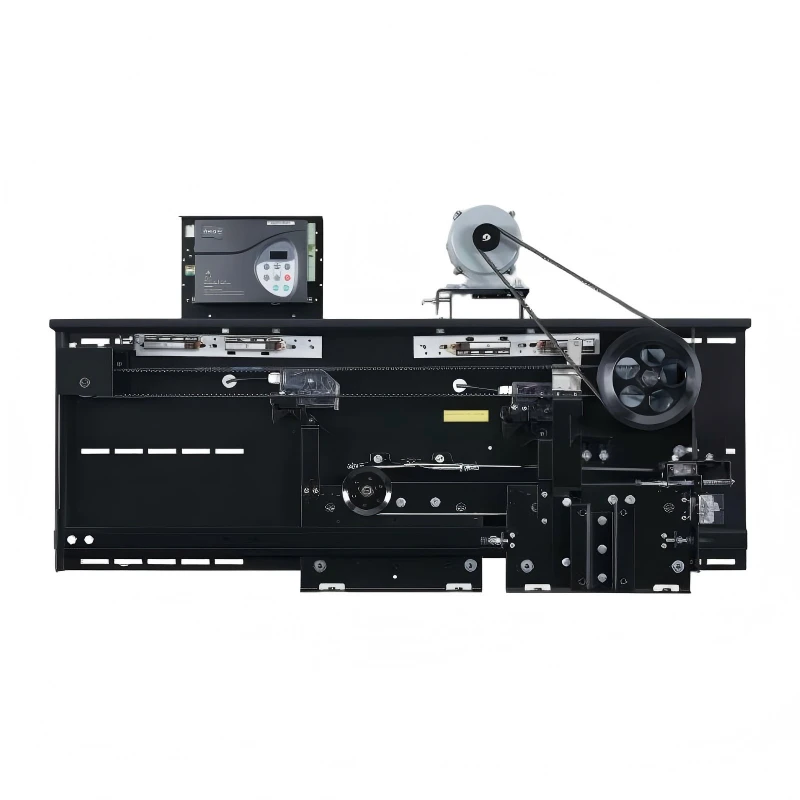
From an engineering standpoint, selecting a door operator is not simply a question of motor power.
Engineers also evaluate:
- Expected door cycle frequency
- Door panel weight
- Entrance width
- Opening and closing time
- Required closing force
- Passenger traffic volume
- Controller compatibility
- Future maintenance accessibility
For example, a busy office tower may complete several hundred door cycles every day. Under these operating conditions, smoother acceleration and deceleration significantly reduce wear on rollers, hangers, guide shoes, and coupling mechanisms, extending component life while lowering maintenance costs.
Car Doors
Car doors are mounted directly on the elevator car and travel with it throughout the shaft.
Unlike landing doors, they are actively driven by the automatic door operator. When the elevator reaches the correct landing position, the car doors engage the landing doors through the door coupling mechanism, allowing both entrances to open and close together.
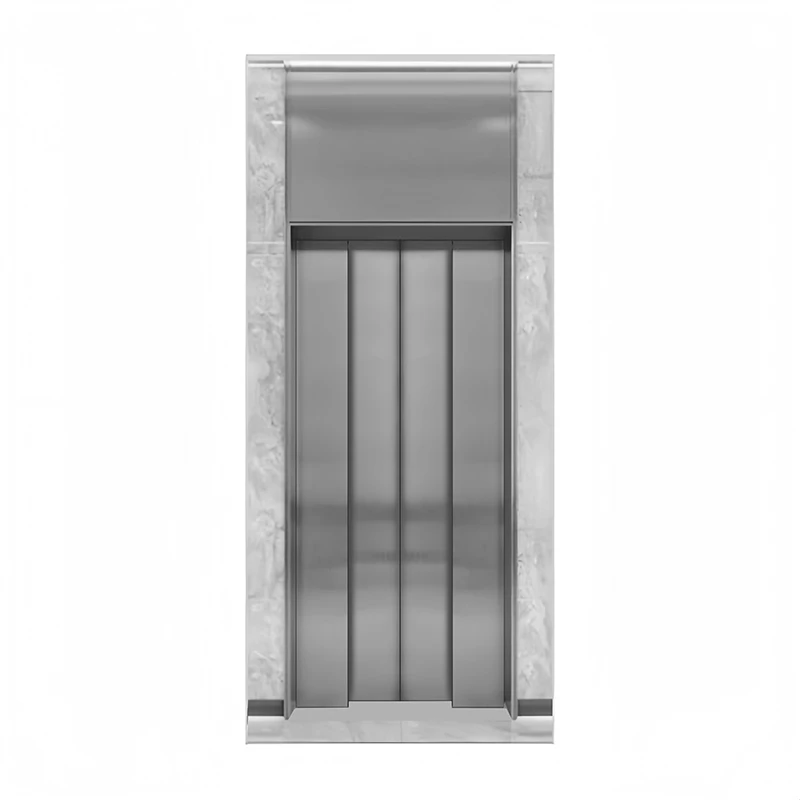
Although passengers mainly view the car doors as an entrance, they also influence several engineering characteristics, including:
- Passenger flow
- Door operating speed
- Entrance clearance
- Noise generation
- Energy consumption
- Operator loading
As door panels become larger or heavier, the operator requires greater torque to maintain smooth movement. This relationship becomes particularly important in freight elevators and hospital elevators, where reinforced doors improve durability but increase mechanical loading on the entire operating mechanism.
Landing Doors
Landing doors are permanently installed at every floor entrance.
Their primary purpose is protecting the hoistway rather than transporting passengers.
Whenever the elevator car is absent, the landing entrance remains mechanically locked, preventing accidental access to the shaft. Only after the elevator enters the designated door zone can the coupling mechanism release the mechanical lock and allow the landing doors to move together with the car doors.
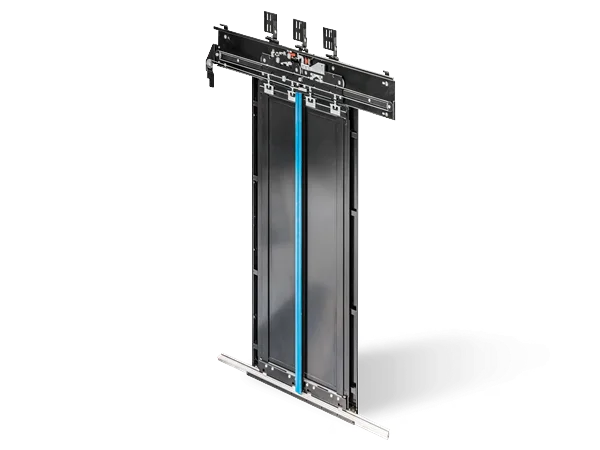
Fire-rated landing doors introduce an additional engineering consideration.
In many commercial buildings, landing doors also contribute to fire compartmentation by helping maintain separation between floors. Consequently, engineers must evaluate both elevator performance and building code requirements when selecting landing door assemblies.
Door Interlock and Mechanical Locking System
The door interlock represents one of the most important safety devices within the entire elevator door system.
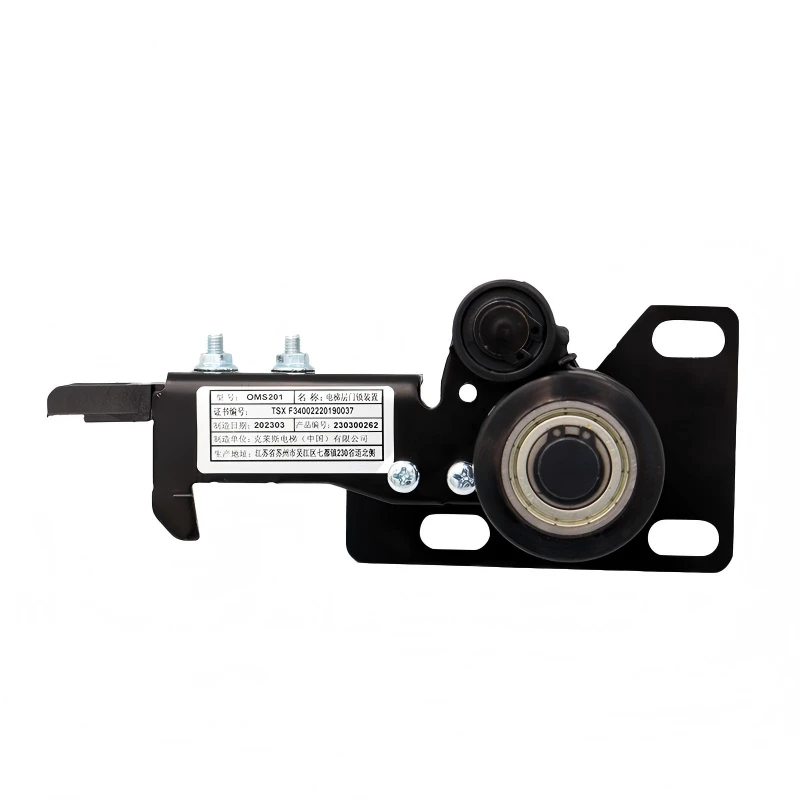
Each landing entrance incorporates both a mechanical locking mechanism and electrical interlock contacts.
The mechanical lock physically prevents the landing door from opening when the elevator car is absent.
The electrical interlock independently verifies that the lock has reached its fully engaged position before completing the elevator safety circuit.
This dual-verification philosophy ensures that apparent door closure is not sufficient.
The controller requires confirmation that the landing door is both mechanically secured and electrically verified.
Consequently, a slightly worn door hanger, increased guide clearance, incorrect interlock adjustment, or damaged door contact may interrupt elevator operation even when the doors appear fully closed from the passenger’s perspective.
This conservative engineering strategy intentionally prioritizes passenger safety over continued operation.
Door Guide System
Smooth door movement depends as much on accurate guidance as on motor performance.
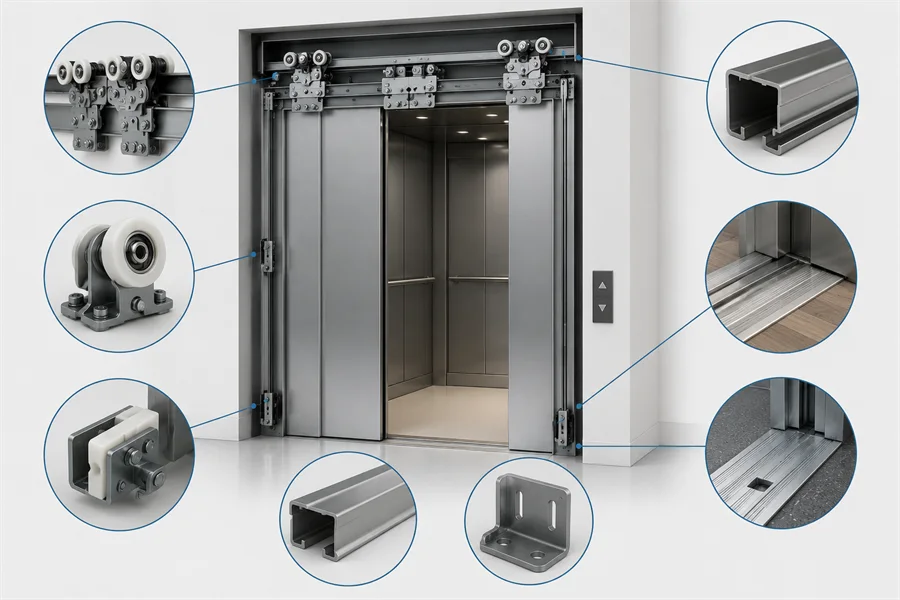
The guide system typically consists of:
- Door hangers
- Guide rollers
- Guide shoes
- Door tracks
- Landing sills
- Car sills
- Hanger brackets
Together, these components maintain panel alignment while minimizing friction throughout every operating cycle.
Wear develops gradually.
Guide rollers slowly increase clearance.
Door tracks accumulate contamination.
Guide shoes deteriorate through repeated movement.
Initially, these changes may produce only additional vibration or operating noise. As deterioration progresses, however, they begin influencing door timing, closing accuracy, and interlock alignment.
This illustrates an important engineering relationship.
Mechanical wear eventually becomes an electrical safety issue.
A worn roller may no longer simply create noise. It may prevent accurate locking, interrupt electrical confirmation, and ultimately stop the entire elevator from operating.
Door Protection and Obstacle Detection
Passenger safety extends beyond preventing shaft access.
Modern elevator entrances must also prevent contact between moving doors and passengers.
Most contemporary systems combine several protection technologies, including infrared light curtains, photoelectric sensors, electronic closing-force monitoring, and intelligent obstacle detection algorithms integrated within the door controller.
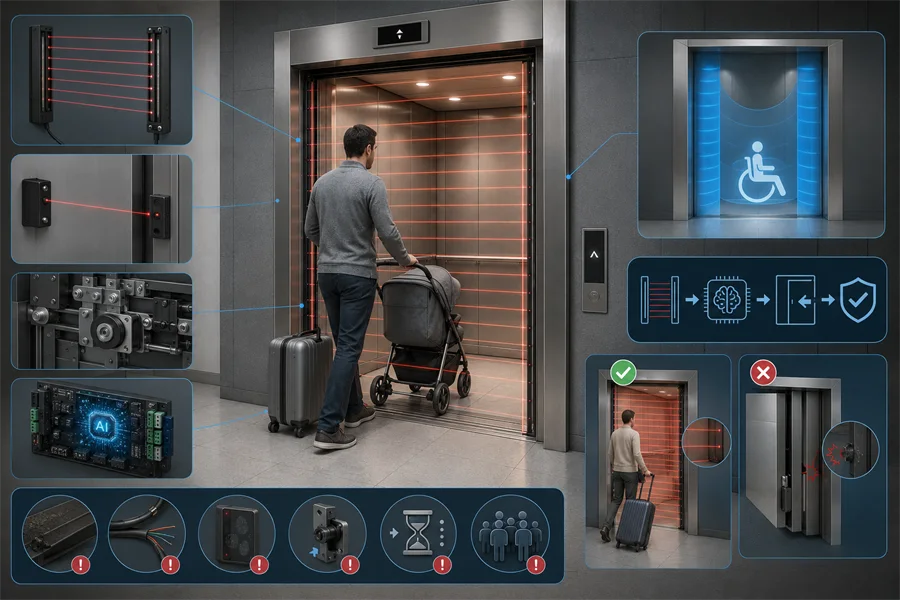
Compared with older mechanical safety edges, full-height infrared light curtains monitor almost the entire entrance opening. This improves accessibility for wheelchairs, luggage, hospital beds, and freight carts while reducing unnecessary passenger contact.
However, these systems also require regular inspection.
Dust accumulation, cable damage, sensor contamination, incorrect alignment, or deteriorating door timing may generate repeated door reversals, increase waiting times, and reduce passenger throughput during busy operating periods.
Rather than evaluating these devices individually, elevator engineers consider the entrance protection system as part of the complete door operating strategy, balancing safety, traffic efficiency, maintenance accessibility, and long-term reliability.
How an Elevator Door System Works During Every Travel Cycle
Although passengers experience only a few seconds of door movement, an elevator door system performs dozens of coordinated mechanical and electrical actions before the elevator is allowed to travel. Modern elevators do not simply command the doors to close and then begin moving. Instead, the controller follows a strict verification sequence in which every stage depends on the successful completion of the previous one.
The process begins when a passenger registers a hall call or car call.
The elevator controller determines which car should respond based on dispatch logic and sends the selected elevator to the requested floor. As the car approaches the landing, the controller continuously monitors the encoder and leveling signals to ensure the car enters the designated door zone with sufficient positioning accuracy.
Only after the car has stopped within the allowable leveling tolerance will the controller issue an opening command to the automatic door operator.
The door operator then drives the car doors while the door vane, sometimes called the coupling mechanism or door clutch, mechanically engages the landing door lock. Once the mechanical lock is released, both the car doors and landing doors move together as a synchronized entrance assembly.
During passenger boarding, the elevator continues monitoring multiple devices rather than simply waiting for a timer to expire.
Depending on the system configuration, the entrance protection system may include:
- Infrared light curtains
- Photoelectric sensors
- Door closing force monitoring
- Electronic obstacle detection
- Door open dwell timing
If a passenger, wheelchair, hospital bed, luggage cart, or freight trolley interrupts the protected entrance area, the controller immediately commands the operator to stop or reverse door movement.
Once boarding has finished, the controller begins the closing sequence.
This stage involves considerably more engineering logic than many building owners realize.
As the doors approach the fully closed position, the mechanical locking device engages first. Electrical door contacts then verify that every monitored landing door has reached its locked position. Only after every interlock reports a secure condition can the safety circuit be completed.
The controller then performs one final authorization sequence.
Door locked
↓
Electrical interlock verified
↓
Safety circuit completed
↓
Brake release permitted
↓
Traction machine energized
↓
Elevator departs
This sequence explains why experienced technicians frequently investigate the door system before examining the drive system. Since the traction machine cannot receive movement authorization until every door-related verification step has been completed, a relatively small fault within the entrance assembly can disable an otherwise healthy elevator.
From a lifecycle perspective, this design significantly improves passenger safety because uncertainty always results in the elevator remaining stationary rather than attempting to continue operating.
Car Doors vs. Landing Doors
Passengers often assume that all elevator doors perform identical functions because they move together during every trip.
In reality, car doors and landing doors are engineered for completely different responsibilities.
| Feature | Car Doors | Landing Doors |
|---|---|---|
| Installation location | Mounted on the elevator car | Installed permanently at each landing |
| Primary purpose | Provide passenger access during travel | Protect the hoistway when the car is absent |
| Movement | Travels with the elevator | Remains stationary |
| Driving method | Powered by the automatic door operator | Moved through the door coupling mechanism |
| Safety function | Coordinates passenger boarding | Forms part of the landing door locking system |
Car doors are active components.
They receive power directly from the door operator and determine opening speed, closing force, door timing, and passenger flow efficiency.
Landing doors, by contrast, are primarily protective barriers.
Their most important responsibility is preventing accidental shaft access whenever the elevator car is not present. This explains why every landing door incorporates a mechanical lock and electrical interlock rather than functioning as a simple movable panel.
The distinction also influences modernization planning.
Many existing buildings retain structurally sound landing doors while replacing the controller, automatic door operator, sensors, and car doors. However, compatibility between the retained landing doors and the new operating equipment must be carefully evaluated to ensure proper synchronization, interlock operation, and compliance with current safety requirements.
This approach often reduces modernization costs while minimizing structural work, particularly in buildings where enlarging entrance openings or modifying shaft walls would be expensive or impractical.
Types of Elevator Door Systems
Different buildings require different entrance solutions.
Selecting an elevator door system is therefore an engineering decision rather than simply choosing an opening style. Door configuration affects passenger throughput, shaft utilization, maintenance accessibility, operator loading, entrance width, and future modernization flexibility.
Center-Opening Doors
Center-opening doors use two panels that move away from the center simultaneously.
Because each panel travels only half of the total entrance width, opening and closing cycles are generally faster than comparable single-direction systems. Faster door cycles reduce passenger waiting time and improve handling capacity during periods of heavy traffic.
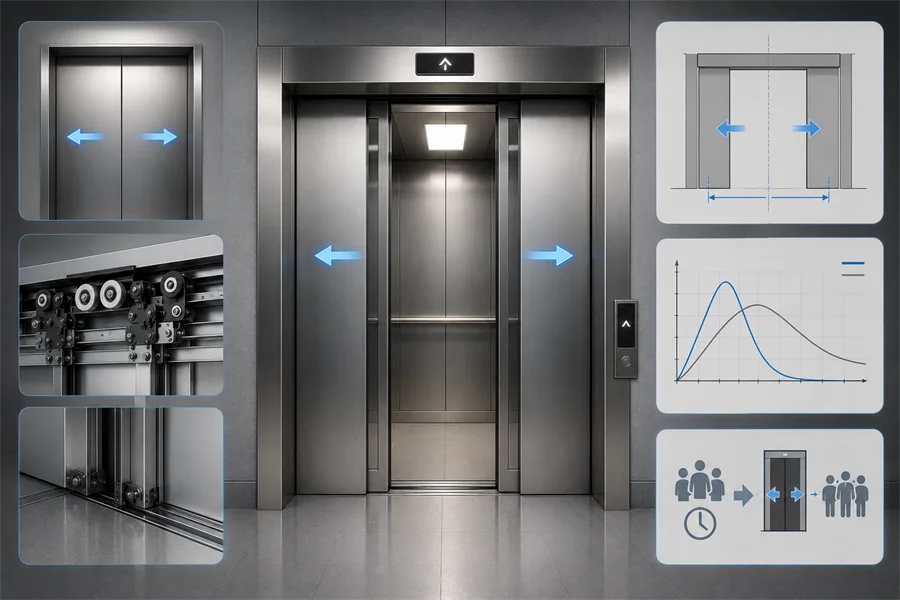
For this reason, center-opening doors are commonly installed in:
- Office towers
- Hospitals
- Hotels
- Shopping centers
- Airports
- High-rise residential buildings
Their primary limitation is installation space.
Center-opening doors require adequate door pocket space on both sides of the entrance. Buildings with limited shaft width or structural restrictions may not provide sufficient room for this arrangement.
Side-Opening Doors
Side-opening doors move one or more panels in the same direction.
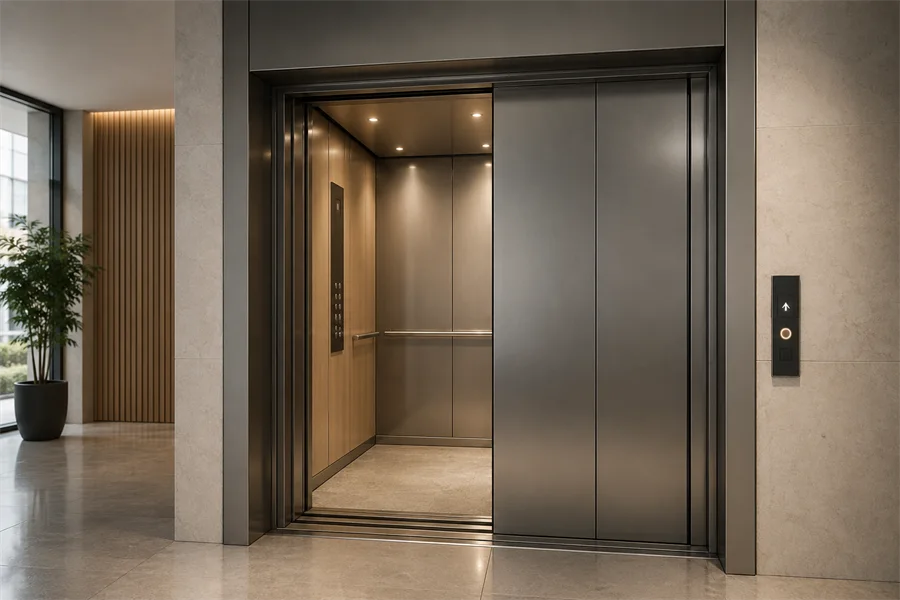
Although passenger throughput is typically lower than center-opening systems, side-opening configurations require less shaft pocket space and often integrate more easily into existing buildings.
They are widely used for:
- Retrofit projects
- Existing buildings
- Compact residential elevators
- Buildings with limited shaft dimensions
In many modernization projects, side-opening doors eliminate the need to enlarge structural openings while still providing acceptable entrance widths.
Telescopic Doors
Telescopic systems use multiple interconnected panels that slide in a single direction.
Their principal advantage is maximizing clear entrance width within restricted shaft dimensions.
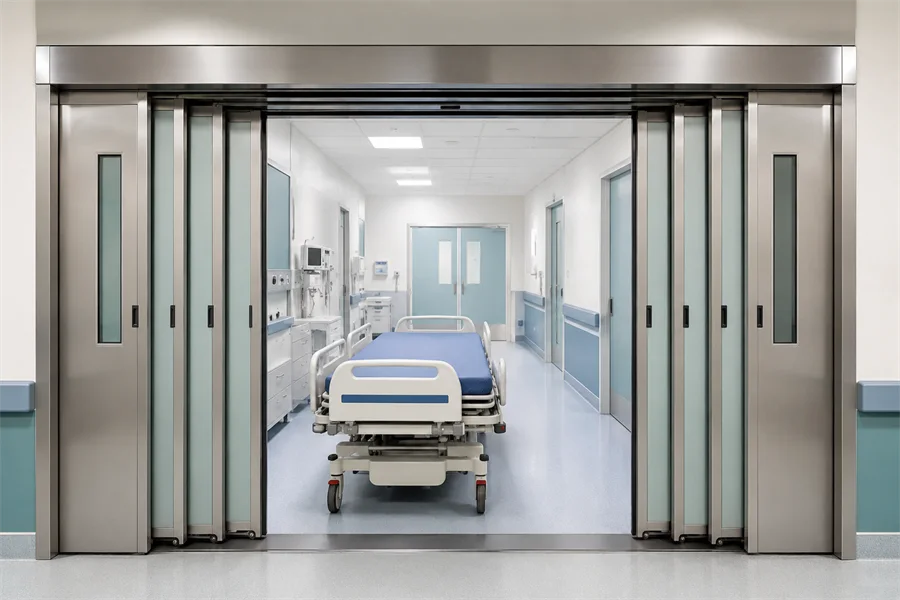
Although they contain more moving components—including additional guide rollers, hangers, door linkages, and synchronization mechanisms—they often provide the most practical solution where architectural constraints limit installation space.
Hospitals frequently specify telescopic doors because they improve stretcher access without requiring wider shafts.
Vertical Sliding Doors
Vertical sliding doors move upward or downward rather than horizontally.
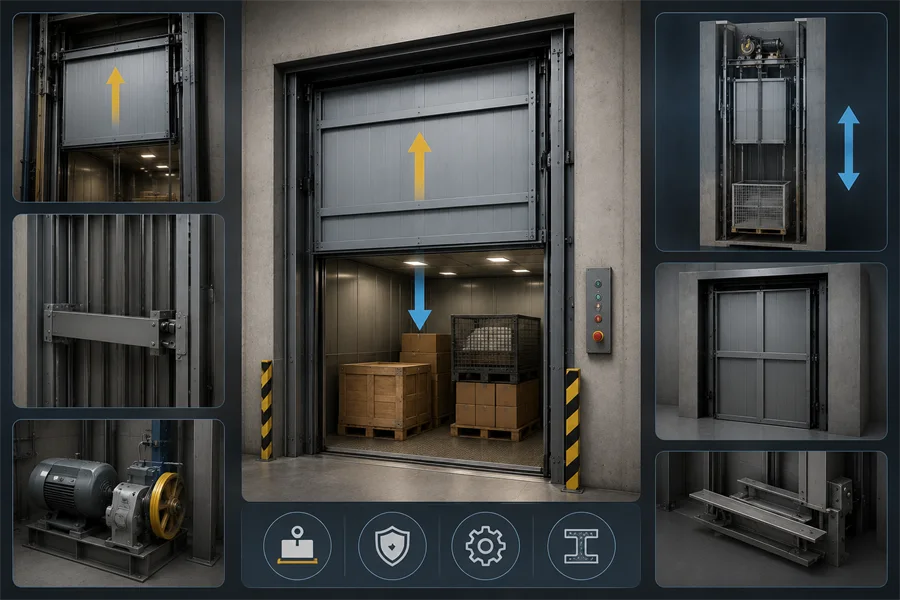
These systems are primarily used in freight elevators and industrial lifting equipment where durability and cargo clearance take priority over passenger throughput.
Their reinforced construction enables repeated heavy-duty operation, although the increased door weight generally requires more robust operators and stronger supporting structures.
Manual Swing Doors
Manual swing doors remain common in residential elevators, platform lifts, and accessibility applications.
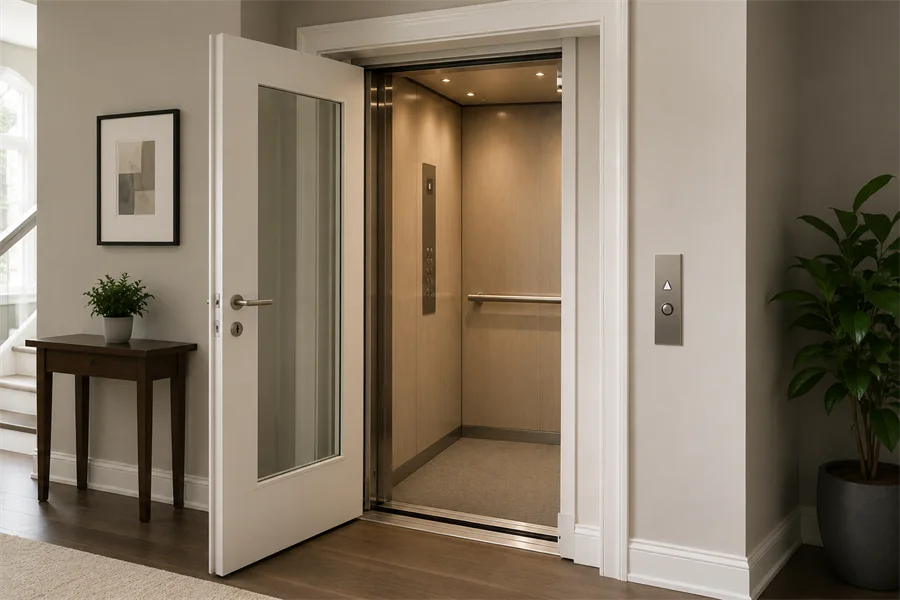
Because users operate the entrance manually, these systems simplify mechanical construction while reducing equipment costs.
However, they are generally unsuitable for buildings experiencing frequent passenger traffic because manual operation reduces handling efficiency and increases boarding time.
Engineering Trade-Offs Between Door Configurations
No door configuration is ideal for every project.
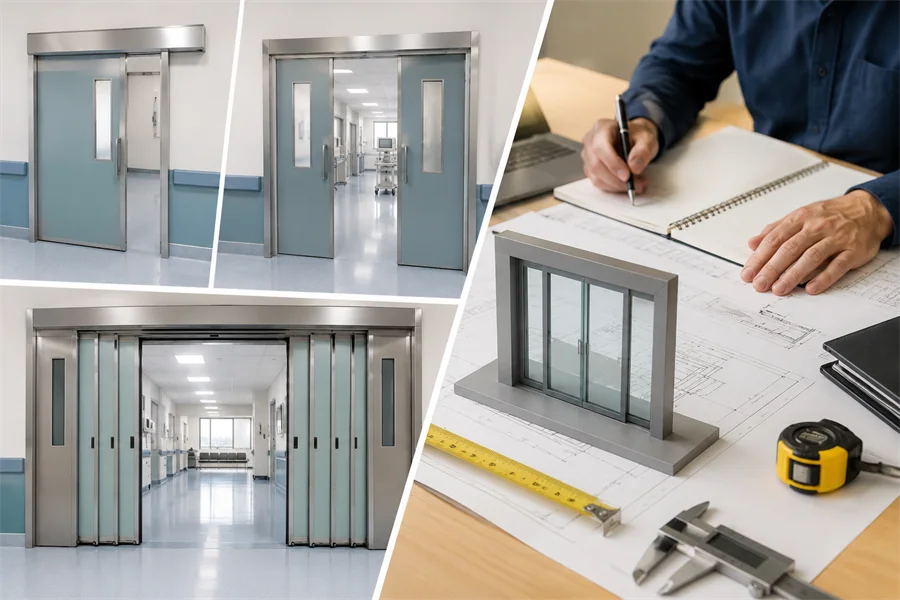
Engineers evaluate each system according to building conditions rather than product specifications alone.
| Door Configuration | Engineering Advantages | Engineering Limitations | Best Applications |
|---|---|---|---|
| Center-opening | High passenger throughput, balanced movement, fast door cycles | Requires larger shaft pocket space | Commercial buildings, hospitals, hotels |
| Side-opening | Better for narrow shafts and retrofit projects | Lower boarding efficiency | Existing buildings, residential projects |
| Telescopic | Maximizes entrance width within limited space | Greater mechanical complexity | Hospitals, modernization projects |
| Vertical sliding | Excellent durability for heavy cargo | Slower operation and increased structural loads | Freight elevators, industrial facilities |
| Manual swing | Simple construction and lower installation cost | Manual operation reduces traffic efficiency | Home elevators and accessibility lifts |
Notice that the “best” door system depends less on the door itself than on the building it serves.
For example, installing a center-opening system in a narrow retrofit shaft may require costly structural modifications that provide little operational benefit. Conversely, selecting a compact side-opening configuration for a busy commercial tower may reduce passenger throughput and increase waiting times throughout the building’s lifecycle.
Successful elevator projects therefore begin with building compatibility rather than product comparison.
Engineers first evaluate shaft geometry, entrance width, structural limitations, passenger traffic, accessibility requirements, fire compartmentation, and future modernization plans. Only after these factors have been assessed can the most appropriate elevator door system be selected.
This building-first approach reduces installation risk, improves long-term maintainability, and helps ensure that the door system continues supporting efficient vertical transportation throughout the building’s operational life.
Common Elevator Door System Failures and Their Engineering Causes
Because the elevator door system completes an operating cycle every time passengers enter or leave the elevator, it experiences considerably more repetitive movement than many other elevator components. In a busy office building, hospital, or shopping mall, a single elevator may perform hundreds or even thousands of door cycles every day.
Unlike sudden failures of major mechanical equipment, most door-related problems develop gradually. Small changes in alignment, friction, component wear, or electrical feedback accumulate over time until the controller detects an abnormal condition and interrupts normal operation.
For maintenance teams, understanding the engineering relationship between wear and system performance is often more valuable than simply replacing failed parts.
| Common Failure | Typical Engineering Cause | Operational Impact |
|---|---|---|
| Doors fail to close completely | Roller wear, contaminated door tracks, damaged guide shoes | Elevator remains unavailable until the safety circuit is restored |
| Repeated door reopening | Light curtain contamination, sensor misalignment, excessive closing force | Passenger delays and reduced handling capacity |
| Door interlock fault | Mechanical lock wear, electrical contact failure, poor adjustment | Controller cannot authorize elevator movement |
| Slow opening or closing | Aging door operator, belt wear, incorrect parameter settings | Longer waiting times and lower traffic efficiency |
| Door vibration or abnormal noise | Worn hangers, increased guide clearance, loose brackets | Accelerated component wear and reduced passenger comfort |
| Inconsistent leveling with door faults | Door zone signal or position feedback abnormalities | Delayed door operation and unreliable dispatching |
Although these problems appear independent, they often follow the same engineering progression.
A guide roller begins to wear.
↓
Door alignment gradually changes.
↓
Mechanical resistance increases.
↓
Door timing becomes inconsistent.
↓
The landing door no longer aligns perfectly with the interlock.
↓
Electrical confirmation becomes unreliable.
↓
The controller interrupts operation.
This sequence demonstrates why preventive maintenance focuses on identifying early mechanical wear before it develops into an electrical safety interruption.
Another common misconception is that every door failure originates from the door operator.
In reality, the operator is often functioning correctly while the actual cause lies elsewhere in the entrance assembly. Worn door hangers, damaged door tracks, contaminated landing sills, improperly adjusted door contacts, or increased guide shoe clearance may all create symptoms that appear to be operator failures.
Accurate diagnosis therefore requires evaluating the entire entrance mechanism rather than replacing individual components based solely on visible symptoms.
How Building Design Influences Elevator Door Selection
One of the most common mistakes during elevator planning is selecting a door configuration before fully evaluating the building itself.
In practice, the building determines the door system—not the other way around.
Shaft dimensions, structural openings, passenger traffic, accessibility requirements, fire regulations, and future modernization plans all influence which door arrangement provides the best long-term performance.
Shaft Dimensions and Structural Constraints
The available shaft space often establishes the practical limits for door selection.
For example, center-opening doors require sufficient pocket space on both sides of the entrance to accommodate moving panels. Existing buildings with narrow shafts or reinforced structural walls may not provide enough clearance, making telescopic or side-opening systems a more practical solution.
This is particularly common in modernization projects.
Rather than reconstructing the hoistway or enlarging structural openings, engineers frequently optimize the door configuration to fit existing building conditions while maintaining acceptable passenger access.
Passenger Traffic and Handling Capacity
Door performance directly influences how efficiently people move through a building.
In high-rise office towers, airports, hotels, and shopping centers, hundreds of passengers may use the same elevator group during peak periods.
Under these conditions, faster door cycles, wider entrance openings, and smoother passenger flow often contribute more to transportation efficiency than small increases in elevator speed.
Conversely, residential elevators generally experience much lower daily traffic.
For these projects, minimizing installation space, operating noise, and maintenance complexity may be more important than achieving the shortest possible door opening time.
Building usage therefore determines the engineering priorities.
Accessibility Requirements
Modern buildings increasingly serve users with different mobility requirements.
Wheelchairs, walking aids, hospital beds, freight carts, and luggage all influence the required entrance width, door dwell time, and obstacle detection strategy.
Healthcare facilities provide a good example.
Hospitals often specify wider center-opening or telescopic doors because patient transfer depends on smooth stretcher movement rather than maximum elevator speed. Improving entrance accessibility may significantly reduce transfer time while lowering the risk of collisions during emergency situations.
Accessibility planning therefore extends beyond regulatory compliance.
It also improves operational efficiency.
Fire Protection and Building Codes
Landing doors frequently contribute to the building’s passive fire protection strategy.
Depending on local regulations, fire-rated landing doors may be required to maintain compartmentation between floors while remaining fully compatible with the elevator’s locking system and safety circuit.
Consequently, engineers evaluate both elevator standards and building fire regulations during equipment selection.
Ignoring either requirement may create compatibility issues later in the project.
Modernization and Future Flexibility
Many buildings remain in service for several decades, while door operators, controllers, and electrical systems may be upgraded multiple times throughout that period.
This makes modernization compatibility an important procurement consideration.
Rather than selecting equipment solely for current project requirements, engineers often evaluate whether future controller upgrades, replacement parts, and maintenance access can be accommodated without extensive structural alterations.
Buildings designed with modernization flexibility generally experience lower lifecycle costs because equipment can be upgraded in stages instead of requiring complete replacement.
Procurement Considerations When Selecting an Elevator Door System
Selecting an elevator door system is not simply a purchasing decision.
It is an engineering evaluation that should consider the entire operating life of the building.
While specifications such as door width or opening speed are important, procurement teams increasingly focus on long-term reliability, maintenance accessibility, spare parts availability, and compatibility with future modernization projects.
Before selecting a supplier, project teams typically evaluate several engineering factors.
Evaluate Building Compatibility Before Product Specifications
Many procurement decisions begin by comparing catalogs.
Experienced project teams usually begin with the building instead.
Questions such as the following should be answered before evaluating individual products.
- What are the available shaft dimensions?
- Will structural modifications be permitted?
- How much entrance width is actually required?
- What passenger traffic is expected during peak periods?
- Does the project involve new construction or modernization?
These factors often eliminate unsuitable configurations before equipment comparisons even begin.
Compare Lifecycle Costs Rather Than Initial Purchase Price
The lowest purchase price rarely represents the lowest operating cost.
Door operators with smoother motion, better controller integration, and higher cycle durability may reduce maintenance frequency and component replacement over many years of operation.
Lifecycle evaluation should include:
- Expected door cycle rating
- Replacement part availability
- Maintenance accessibility
- Energy consumption
- Downtime risk
- Future upgrade compatibility
This approach provides a more realistic assessment of long-term project value.
Consider Controller and System Compatibility
An elevator door system does not operate independently.
The automatic door operator, controller, position sensors, interlocks, safety circuit, and traction system must function as an integrated control architecture.
When replacing individual components during modernization, engineers should confirm that communication protocols, operating parameters, and electrical interfaces remain compatible.
Failure to evaluate system compatibility may increase commissioning time and create unnecessary troubleshooting during installation.
Plan for Long-Term Maintenance
Maintenance requirements begin during equipment selection rather than after installation.
Door operators that are difficult to access, uncommon replacement parts, or highly specialized adjustment procedures may increase operating costs throughout the elevator’s lifecycle.
For this reason, procurement teams frequently evaluate supplier support, spare parts continuity, technical documentation, and long-term maintenance strategy alongside equipment performance.
The objective is not simply purchasing an elevator door system that performs well on the first day of operation, but selecting one that remains reliable after millions of operating cycles over many years of service.
Inspection and Preventive Maintenance
An elevator door system performs more operating cycles than almost any other mechanical subsystem within an elevator. While the traction machine moves only when the elevator travels, the door system operates every time passengers enter or leave the car. Over the lifespan of a commercial elevator, this can represent several million door cycles.
For this reason, maintenance should not focus solely on repairing faults after they occur. A preventive maintenance strategy helps identify gradual wear before it develops into operational interruptions or safety issues.
Routine inspections generally include both mechanical components and electrical verification devices.
Mechanical Inspection
Mechanical inspections concentrate on components that experience continuous movement and friction.
Typical inspection items include:
- Door panels and panel alignment
- Door hangers and hanger brackets
- Guide rollers and guide shoes
- Door tracks and landing sills
- Car sills
- Door clutch or door vane
- Door linkage mechanisms
- Door operator belts
- Door motor mounting
- Fasteners and supporting brackets
Engineers typically look for abnormal wear, increased clearances, loose connections, excessive vibration, and unusual operating noise.
Although these components appear relatively simple, gradual mechanical deterioration often changes door timing and alignment. Over time, these small deviations may prevent the landing door lock from engaging correctly or cause inconsistent electrical feedback to the controller.
Electrical Safety Inspection
Mechanical movement alone does not determine whether an elevator can operate safely.
The electrical verification system continuously confirms that every monitored door has reached a safe operating condition before movement is authorized.
Routine electrical inspections commonly include:
- Mechanical door lock operation
- Electrical interlock contacts
- Door contact verification
- Safety circuit continuity
- Door zone switch operation
- Door operator feedback signals
- Light curtain performance
- Photoelectric sensor alignment
- Door closing force monitoring
- Controller fault records
Rather than checking only whether the doors open and close, technicians verify that every confirmation signal is received in the correct operating sequence.
This systematic approach reduces the likelihood of intermittent faults that may otherwise be difficult to diagnose.
Predictive Maintenance and Lifecycle Management
Modern elevator maintenance is gradually shifting from time-based servicing toward condition-based maintenance.
Instead of replacing components after a fixed number of months, engineers increasingly monitor operational data such as:
- Door cycle count
- Opening and closing time
- Door motor current
- Fault frequency
- Repeated door reversals
- Operator temperature
- Maintenance history
These indicators help identify gradual performance changes before passengers experience noticeable problems.
For buildings with high passenger traffic, predictive maintenance can significantly reduce unexpected downtime while extending the service life of door operators, rollers, guide systems, and interlocks.
From a lifecycle perspective, replacing inexpensive wear components before they affect the safety chain is usually far more economical than responding to repeated service interruptions caused by secondary failures.
Future Trends in Elevator Door Systems
As elevator technology continues to evolve, door systems are becoming increasingly intelligent rather than simply more automated.
Modern developments focus on improving operational efficiency, predictive maintenance, passenger safety, and integration with digital building management systems.
Several trends are becoming more common in new commercial installations.
Intelligent Door Monitoring
Instead of reporting only fault conditions, newer door systems continuously monitor operating parameters.
These include:
- Door cycle statistics
- Motor load
- Opening time
- Closing time
- Door reversal frequency
- Component wear trends
This information allows maintenance teams to identify deteriorating performance before service interruptions occur.
Smarter Obstacle Detection
Traditional mechanical safety edges have largely been replaced by full-height infrared light curtains and advanced obstacle detection algorithms.
Future systems are expected to further improve entrance monitoring by reducing false door reversals while maintaining high passenger safety.
This is particularly valuable in buildings with heavy passenger traffic, where unnecessary reopening can significantly reduce elevator handling capacity.
Improved Modernization Compatibility
Many buildings remain operational for decades, while control systems and door equipment continue to evolve.
Manufacturers are therefore placing greater emphasis on modular door operators, standardized electrical interfaces, and upgrade-friendly designs that simplify future modernization without requiring extensive structural modifications.
For building owners, this improves equipment longevity while reducing the total cost of future upgrades.
Conclusion
An elevator door system is far more than the mechanism that opens and closes an elevator entrance. It is an integrated engineering subsystem that connects mechanical movement, electrical verification, passenger protection, and controller logic into a coordinated operating sequence.
Every elevator journey depends on the successful interaction of the door operator, landing doors, car doors, guide mechanisms, interlocks, obstacle detection devices, and safety circuits. Only after each component confirms a safe operating condition does the controller authorize brake release and traction machine operation.
From an engineering perspective, the performance of the door system influences much more than passenger convenience. It affects transportation efficiency, maintenance frequency, lifecycle operating costs, modernization flexibility, and the overall reliability of the building’s vertical transportation system.
For project developers, consultants, contractors, elevator distributors, and procurement teams, selecting an appropriate elevator door system should always begin with the building rather than the product itself. Factors such as shaft dimensions, entrance width, passenger traffic, accessibility requirements, maintenance strategy, and future modernization plans should be evaluated together before determining the most suitable door configuration.
When viewed within the context of the complete elevator system, the door assembly becomes more than an entrance—it becomes one of the most important links in maintaining safe, reliable, and efficient building mobility throughout the elevator’s operational life.
FAQ
What is an elevator door system?
An elevator door system is the complete assembly that manages passenger access to an elevator while ensuring safe operation. It includes the automatic door operator, car doors, landing doors, mechanical locks, electrical interlocks, guide mechanisms, obstacle detection devices, and the associated control logic that authorizes elevator movement.
Why is the elevator door system considered a safety system?
The elevator cannot move until the controller confirms that every monitored landing door and car door has reached a fully locked condition. The door system therefore forms an essential part of the elevator’s safety circuit and prevents movement whenever safe operating conditions cannot be verified.
What is the difference between a door operator and a door interlock?
The door operator provides the mechanical power required to open and close the doors. The door interlock verifies that the landing doors are securely locked before the controller permits the elevator to travel. One controls movement, while the other verifies safety.
Which door configuration is best for existing buildings?
There is no universal solution. Existing buildings often have limited shaft dimensions or fixed structural openings, making side-opening or telescopic door systems more practical than center-opening configurations. The final selection depends on building geometry, passenger traffic, accessibility requirements, and modernization objectives.
Why do elevator doors sometimes reopen before closing completely?
Repeated door reopening is commonly caused by obstacle detection devices such as light curtains or photoelectric sensors. Contamination, incorrect sensor alignment, excessive door closing force, or repeated interruption of the detection field by passengers may all trigger the controller to reopen the doors as a safety precaution.
How often should an elevator door system be inspected?
Inspection frequency depends on local regulations, building usage, and maintenance programs. High-traffic commercial buildings generally require more frequent inspections because door components experience significantly more operating cycles than those in residential elevators. Regular inspection of guide systems, interlocks, sensors, door operators, and safety circuits helps reduce unexpected downtime and supports long-term operational reliability.
Can an elevator door system be modernized without replacing the complete elevator?
Yes. Many modernization projects upgrade the door operator, controller, obstacle detection devices, interlocks, and electrical components while retaining compatible landing doors or structural elements. This phased approach can improve reliability and safety while reducing project costs and minimizing disruption to building operations.












