
When planning an outdoor elevator project, choosing the right elevator system is only part of the decision. The outdoor elevator shaft is equally important because it influences structural safety, installation efficiency, weather resistance, maintenance requirements, and long-term project costs.
Unlike indoor elevators that operate within a protected building environment, outdoor elevators are continuously exposed to rain, sunlight, wind, humidity, temperature fluctuations, and airborne contaminants. These conditions place additional demands on the elevator shaft structure and make material selection a critical engineering decision.
For most projects, the comparison comes down to two primary options: a steel structure elevator shaft or an aluminum alloy elevator shaft. Both are proven solutions, but their performance differs depending on the building type, environmental conditions, architectural requirements, and lifecycle expectations.
Understanding these differences helps project owners, contractors, architects, developers, and elevator distributors select the most suitable outdoor elevator shaft for long-term reliability and operational efficiency.
Why the Elevator Shaft Matters in Outdoor Elevator Projects
Many project teams focus on elevator capacity, speed, drive systems, and cabin design. However, the outdoor elevator shaft serves as the structural foundation of the entire vertical transportation system.
A properly designed outdoor elevator shaft must:
- Support the elevator car and guide rails
- Resist wind loads and structural movement
- Protect equipment from weather exposure
- Provide maintenance accessibility
- Maintain long-term operational stability
- Support future modernization requirements
In many cases, the shaft structure affects project schedules, installation complexity, building appearance, maintenance costs, and future upgrade flexibility.
For outdoor home elevators, commercial exterior elevators, and accessibility lift projects, shaft selection is often one of the most important decisions made during the planning phase.
Environmental Challenges Outdoor Elevator Shafts Must Withstand
The biggest difference between an indoor elevator and an outdoor elevator is the operating environment.
An outdoor elevator shaft must remain reliable while exposed to:
- Wind pressure
- Rain and moisture
- Dust and airborne debris
- UV radiation
- High humidity
- Salt-laden coastal air
- Seasonal temperature variations
Over time, these environmental factors can affect structural components, enclosure systems, guide rail alignment, protective coatings, and maintenance requirements.
This is why choosing an outdoor elevator shaft material should begin with an evaluation of environmental exposure rather than simply comparing material costs.
For example, a coastal outdoor lift installed near the ocean faces completely different challenges than an outdoor residential elevator located in a dry inland climate.
What Is a Steel Elevator Shaft?
A steel elevator shaft is constructed using structural steel components such as H-beams, square tubes, channel steel, and steel plates. Depending on project requirements, the structure may be fabricated as a welded assembly or supplied as a modular steel structure elevator shaft for site installation.
Steel remains one of the most widely used shaft materials for commercial and industrial outdoor elevator applications because of its strength and versatility.
In modern projects, different steel configurations may be selected according to structural requirements.
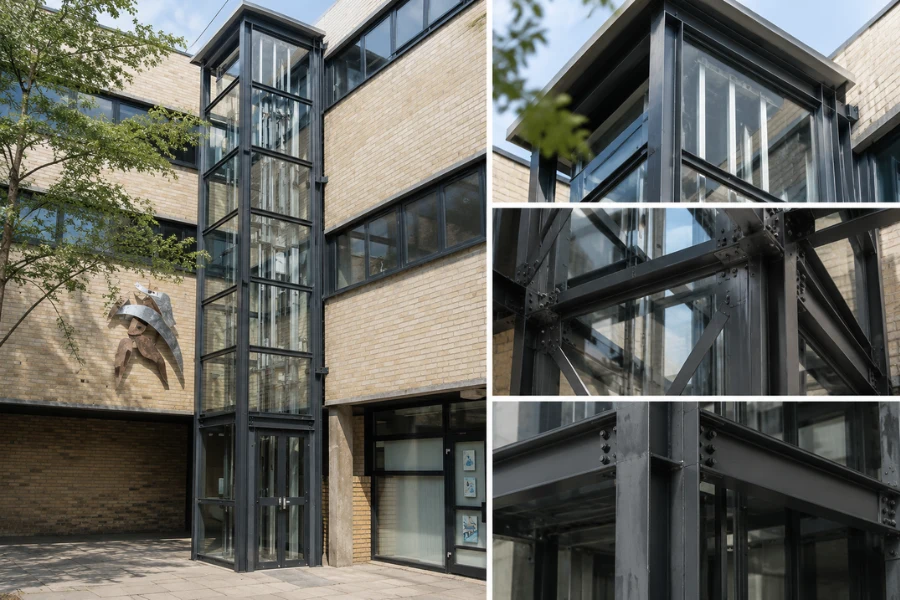
H-Beam Shaft Systems
H-beam shafts are commonly used for:
- Commercial outdoor elevators
- High-rise exterior elevators
- Public infrastructure projects
- Heavy-duty freight elevators
Their superior load-bearing capacity and rigidity make them suitable for demanding structural applications.
Square Tube Shaft Systems
Square tube shafts are frequently used for:
- Outdoor home elevators
- Panoramic elevators
- Accessibility lifts
- Existing building retrofit projects
They provide a balance between structural performance, architectural appearance, and installation flexibility.
Advantages of Steel Elevator Shafts
The primary advantages of steel structure elevator shafts include:
- High structural strength
- Excellent rigidity
- Superior wind resistance
- Large load capacity
- Cost-effective material pricing
- Wide application flexibility
For projects involving greater travel heights, heavier loads, or challenging wind conditions, steel often provides the strongest engineering solution.
What Is an Aluminum Elevator Shaft?
An aluminum elevator shaft is typically constructed using engineered aluminum profiles combined with glass panels or lightweight enclosure systems. Most aluminum alloy elevator shafts are designed as modular structures that can be transported and assembled efficiently on site.
These systems have become increasingly popular in residential and architectural applications because they combine functionality with modern aesthetics.
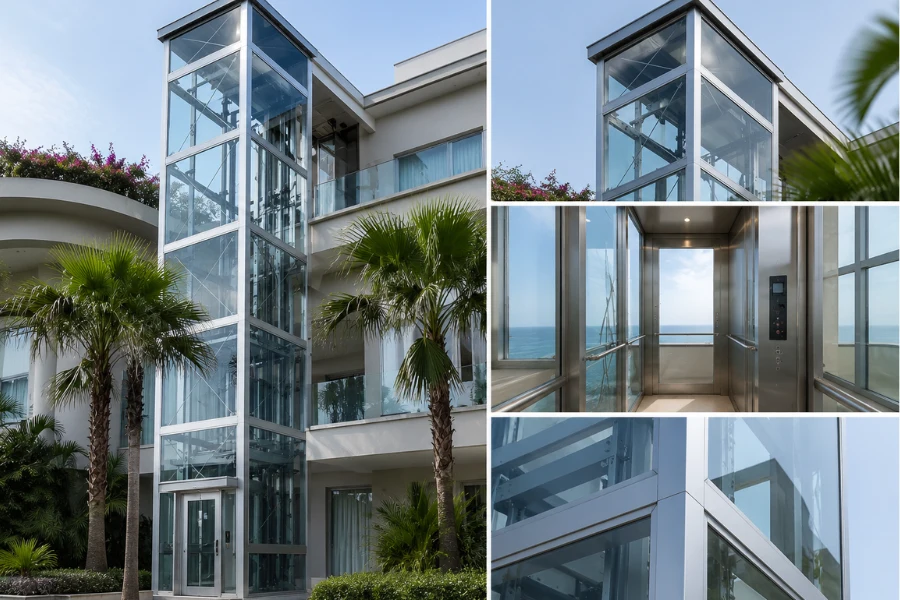
Common applications include:
- Outdoor home elevators
- Outdoor residential elevators
- Villa elevators
- Panoramic lifts
- Accessibility lifts
- Glass elevator shaft systems
Many outdoor elevator manufacturers favor aluminum for projects where appearance, installation speed, and corrosion resistance are important considerations.
Advantages of Aluminum Elevator Shafts
The primary advantages of aluminum alloy elevator shafts include:
- Lightweight construction
- Excellent corrosion resistance
- Modern architectural appearance
- Fast installation
- Reduced maintenance requirements
- Excellent compatibility with glass panels
Because aluminum naturally forms a protective oxide layer, it performs particularly well in humid and coastal environments.
For outdoor home elevator projects, aluminum shafts often provide an attractive balance between durability and aesthetics.
Steel Shaft vs Aluminum Shaft Comparison Table
| Factor | Steel Structure Elevator Shaft | Aluminum Alloy Elevator Shaft |
|---|---|---|
| Structural Strength | Excellent | Good |
| Wind Resistance | Excellent | Good |
| Load Capacity | Excellent | Moderate to High |
| Corrosion Resistance | Moderate | Excellent |
| Weight | Heavy | Lightweight |
| Installation Speed | Moderate | Fast |
| Maintenance Requirements | Moderate | Low |
| Architectural Appearance | Good | Excellent |
| Glass Integration | Good | Excellent |
| Coastal Suitability | Good with Protection | Excellent |
| Initial Cost | Lower | Higher |
| Lifecycle Maintenance Cost | Moderate | Lower |
Although aluminum and steel are often compared directly, neither material is universally better. The most suitable option depends on project-specific requirements and operating conditions.
Structural Strength and Wind Resistance
Wind load is one of the most overlooked considerations in outdoor elevator design.
Unlike indoor elevator systems, an outdoor elevator shaft is exposed to continuous lateral wind forces. As building height increases, wind pressure becomes a significant structural factor.
Steel provides a major advantage in this area because of its higher rigidity and load-bearing capacity.
Steel structure elevator shafts are often preferred for:
- High-rise outdoor elevators
- Commercial exterior elevators
- Public transportation facilities
- Industrial lifting systems
- Heavy-duty elevator applications
Their ability to resist structural deflection helps maintain long-term stability and ride quality.
Aluminum shafts can also meet safety requirements when properly engineered. However, larger profile sections or additional reinforcement may be required to achieve similar rigidity in taller structures.
For low-rise outdoor home elevators and outdoor residential lifts, this difference is often less significant. For taller buildings, structural analysis becomes increasingly important.
Corrosion Resistance and Weather Protection
Weather exposure is one of the primary reasons project owners compare steel and aluminum elevator shafts.
Outdoor elevator shaft systems must withstand years of exposure to:
- Rain
- Humidity
- UV radiation
- Airborne pollutants
- Salt exposure
- Temperature fluctuations
Steel structures require protective systems such as:
- Hot-dip galvanizing
- Powder coating
- Anti-corrosion paint systems
- Scheduled inspections
When properly protected and maintained, steel shafts can provide decades of reliable service. However, corrosion management remains an important part of lifecycle planning.
Aluminum offers a natural advantage because its surface develops a protective oxide layer that resists corrosion without extensive treatment.
This makes aluminum particularly attractive for:
- Coastal outdoor elevators
- Waterfront residential projects
- Tropical environments
- Humid climates
- Outdoor home elevators
For projects where minimizing long-term maintenance is a priority, aluminum often delivers significant operational benefits.
Installation Speed and Retrofit Compatibility
Many outdoor elevator projects involve existing buildings where construction space is limited and disruption must be minimized.
Installation efficiency therefore becomes an important project consideration.
Steel shafts are generally heavier and may require:
- Larger lifting equipment
- Additional structural connections
- Welding operations
- Longer on-site assembly periods
Aluminum alloy elevator shafts are commonly supplied as modular elevator shaft systems.
Their lighter weight simplifies:
- Transportation
- Handling
- Lifting
- Site assembly
This advantage is particularly valuable for:
- Outdoor residential elevators
- Existing building retrofits
- Accessibility upgrades
- Villa elevator installations
In many retrofit projects, modular aluminum systems can reduce installation complexity and shorten construction schedules.
Long-Term Maintenance Considerations for Outdoor Elevator Shafts
One of the most overlooked factors in shaft selection is long-term maintenance planning.
The lowest initial purchase cost does not always result in the lowest total ownership cost.
Outdoor elevator systems require structured maintenance programs throughout their operational life.
Monthly Maintenance
Routine monthly inspections often include:
- Visual checks of shaft enclosures
- Drainage inspections
- Door operation verification
- Surface condition assessments
Quarterly Inspections
Quarterly maintenance may include:
- Structural connection inspections
- Fastener verification
- Corrosion assessment
- Weatherproofing evaluation
Semiannual Maintenance
Semiannual maintenance commonly involves:
- Comprehensive shaft reviews
- Glass panel inspections
- Elevator enclosure assessments
- Protective coating inspections
Annual Structural Inspection
Annual inspections typically focus on:
- Structural integrity evaluations
- Corrosion management reviews
- Weather resistance assessments
- Long-term maintenance planning
Steel shafts generally require greater attention to corrosion protection during these maintenance cycles.
Aluminum shafts often reduce maintenance workloads because the material naturally resists rust and environmental degradation.
For project owners focused on lifecycle efficiency, maintenance planning should be considered as early as the shaft selection stage.
Which Shaft Material Is Better for Coastal Areas?
Coastal environments create some of the most demanding operating conditions for outdoor elevator systems.
Salt-laden air, high humidity, frequent rainfall, and constant environmental exposure can accelerate corrosion and increase maintenance requirements. For this reason, shaft material selection should always consider long-term environmental performance rather than focusing solely on initial construction costs.
Aluminum alloy elevator shafts offer a significant advantage in coastal applications because aluminum naturally forms a protective oxide layer that resists corrosion. This reduces the need for extensive surface treatments and lowers long-term maintenance requirements.
As a result, aluminum shafts are commonly selected for:
- Coastal outdoor home elevators
- Beachfront villas
- Waterfront residential developments
- Seaside hotels
- Resort accessibility lifts
- Oceanfront panoramic elevators
Steel structure elevator shafts can also perform successfully in coastal environments when protected with hot-dip galvanizing, powder coating, and a well-planned inspection program. However, corrosion monitoring becomes more important throughout the service life of the elevator.
For large commercial outdoor elevators, freight lifts, and public infrastructure projects near the coast, steel often remains the preferred structural solution because of its superior load-bearing capacity and rigidity.
The decision ultimately depends on whether corrosion resistance or structural capacity is the primary project requirement.
Which Shaft Material Is Better for Home Elevators?
For residential projects, both steel and aluminum shafts can provide safe and reliable performance.
However, homeowner priorities often differ from those of commercial building operators.
Steel shafts may be a better option when:
- Greater travel height is required
- Higher load capacity is needed
- Structural rigidity is a priority
- Budget control is important
Aluminum shafts may be a better option when:
- Architectural appearance is important
- Glass elevator shaft designs are preferred
- Installation speed is a priority
- Low maintenance is desired
- The project is located in a humid or coastal region
Many modern outdoor home elevators and outdoor residential elevators now utilize aluminum alloy shafts because they integrate naturally with glass enclosures and contemporary building designs.
For luxury villas and panoramic lift projects, aluminum often delivers both functional and aesthetic advantages.
Our Recommendation Based on Project Type
Different buildings create different engineering requirements.
Rather than viewing steel and aluminum as competing materials, it is more useful to evaluate which shaft solution best aligns with the project environment, operational objectives, and lifecycle expectations.
| Project Type | Recommended Shaft Material |
|---|---|
| Outdoor Home Elevator | Aluminum Alloy Shaft |
| Outdoor Residential Elevator | Aluminum Alloy Shaft |
| Glass Panoramic Elevator | Aluminum Alloy Shaft |
| Coastal Outdoor Lift | Aluminum Alloy Shaft |
| Villa Elevator | Aluminum Alloy Shaft |
| Accessibility Lift | Aluminum Alloy Shaft |
| Commercial Outdoor Elevator | Steel Structure Shaft |
| Public Building Elevator | Steel Structure Shaft |
| Freight Elevator | Steel Structure Shaft |
| Industrial Lift System | Steel Structure Shaft |
| High-Rise Exterior Elevator | Steel Structure Shaft |
| Heavy-Duty Outdoor Elevator | Steel Structure Shaft |
| Existing Building Retrofit Elevator | Project Specific |
Retrofit projects often require additional evaluation because structural constraints, installation access, architectural requirements, and maintenance objectives vary significantly from building to building.
The most effective approach is to evaluate the complete outdoor elevator system rather than focusing on shaft material alone.
Factors such as building structure, traffic demand, environmental exposure, maintenance strategy, modernization plans, and lifecycle cost expectations should all influence the final decision.
Why Shaft Selection Is About More Than Material Choice
Many elevator buyers assume that shaft selection is simply a comparison between steel and aluminum.
In reality, successful outdoor elevator projects require balancing multiple engineering considerations simultaneously.
These considerations include:
- Structural capacity
- Wind resistance
- Building integration
- Architectural appearance
- Installation accessibility
- Maintenance planning
- Future modernization flexibility
- Lifecycle operating costs
A shaft material that performs well in one project may not be the best choice in another.
For example, a high-rise exterior elevator serving a public building may prioritize structural performance and rigidity, while a coastal outdoor home elevator may prioritize corrosion resistance and appearance.
The goal is not to identify a universally superior material. The goal is to identify the most suitable material for the specific project environment.
EKCNE Outdoor Elevator Shaft Solutions
At EKCNE, we support outdoor elevator projects with customized shaft solutions designed around building conditions, installation requirements, and long-term operational objectives.
Our shaft portfolio includes:
- Steel Structure Elevator Shafts
- H-Beam Elevator Shafts
- Square Tube Elevator Shafts
- Aluminum Alloy Elevator Shafts
- Glass Elevator Shafts
- Custom Outdoor Elevator Shaft Systems
<< Know More About Our Elevator Shaft Portfolio >>
These solutions can be configured according to:
- Building height
- Elevator capacity
- Shaft dimensions
- Architectural style
- Environmental conditions
- Installation constraints
As a project-oriented vertical transportation solution provider, EKCNE helps contractors, developers, distributors, and project owners evaluate shaft compatibility alongside elevator system requirements.
By considering both immediate project needs and long-term lifecycle performance, we help customers reduce procurement risk and improve overall project reliability.
Conclusion
Steel elevator shafts and aluminum elevator shafts are both proven solutions for outdoor elevator applications.
Steel offers exceptional structural strength, rigidity, and load-bearing performance, making it ideal for commercial outdoor elevators, public buildings, freight lifts, and high-rise exterior elevator systems.
Aluminum provides outstanding corrosion resistance, lightweight construction, modern aesthetics, and simplified installation, making it particularly attractive for outdoor home elevators, villa lifts, panoramic elevators, and coastal projects.
The best choice depends on factors such as:
- Building type
- Environmental conditions
- Travel height
- Capacity requirements
- Maintenance expectations
- Architectural goals
- Lifecycle planning
Rather than asking which shaft material is universally better, project teams should evaluate which solution best supports the building’s operational requirements and long-term performance objectives.
With proper engineering, both steel structure elevator shafts and aluminum alloy elevator shafts can provide decades of safe and reliable service in outdoor elevator applications.












